

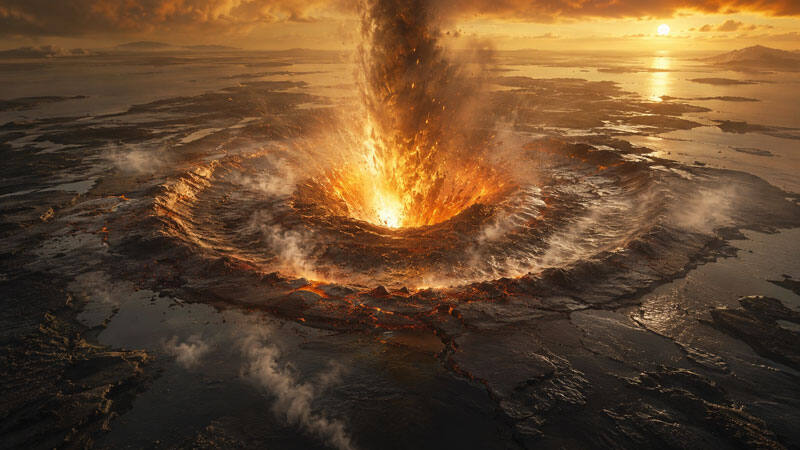
Geologists in Western Australia may have just pushed Earth’s impact record deeper into the past. A site in the Pilbara region, long treated as a candidate ancient crater, now appears to preserve the oldest known trace of an asteroid strike on our planet: 3.024 billion years old, if the new dating holds up. The site is North Pole Dome, in the Pilbara of Western Australia.
That is a small number only in the way geology uses numbers. On a planet that recycles its own scars through erosion, plate tectonics, and mineral change, keeping a clear impact signature for that long is rare. The new work also nudges aside the previous record holder in Greenland, where the Maniitsoq structure had been considered the oldest known impact event at about 3 billion years ago.
North Pole Dome and the new age estimate
Earlier estimates had placed the North Pole Dome impact at around 2 to 2.5 billion years ago, and some stratigraphic arguments even pushed the date to about 3.47 billion years ago. The new result narrows the field by dating minerals that were altered or newly formed in the shocked rocks themselves, rather than relying only on where the rocks sit in the regional sequence.
That matters because impact structures are messy business. If a crater survives at all, it usually does so as a damaged geological puzzle, not a neat hole in the ground. Australia’s example stood out partly because it was preserved well enough to tempt researchers into thinking it might be younger than it really was.
Why zircon and apatite changed the verdict
The key evidence came from two mineral systems. Zircon is a favourite for geochronology because it locks in uranium while excluding most lead when it forms, which makes uranium-lead ratios a reliable clock. A hard удар can reset that clock, and some zircons from North Pole Dome showed unusual branching, skeletal shapes consistent with rapid growth or recrystallisation under impact heating.
A second check came from apatite, a phosphate mineral formed by hot water moving through fractured rock after the collision. Both methods pointed to nearly the same age, around 3.02 billion years. In impact geology, that kind of agreement is better than any press release: it means the story is probably real, not just a lucky coincidence in the rocks.
What the Pilbara crater can still tell scientists
If the interpretation is confirmed, North Pole Dome would become the oldest known impact crater on Earth and the only recognized crater from the Archean. That is more than a record-book curiosity. Earth has almost erased its early impact history, while the Moon has kept millions of ancient craters intact, so every surviving terrestrial example gives researchers a rare look at a much rougher planet.
The bigger question is what a 3-billion-year-old strike did to the young crust. Impacts may have helped fracture rock, circulate hot fluids, and influence the formation of early continental nuclei. That makes North Pole Dome less like a trophy and more like a clue – one that could help explain how Earth’s first stable landmasses began to assemble.