

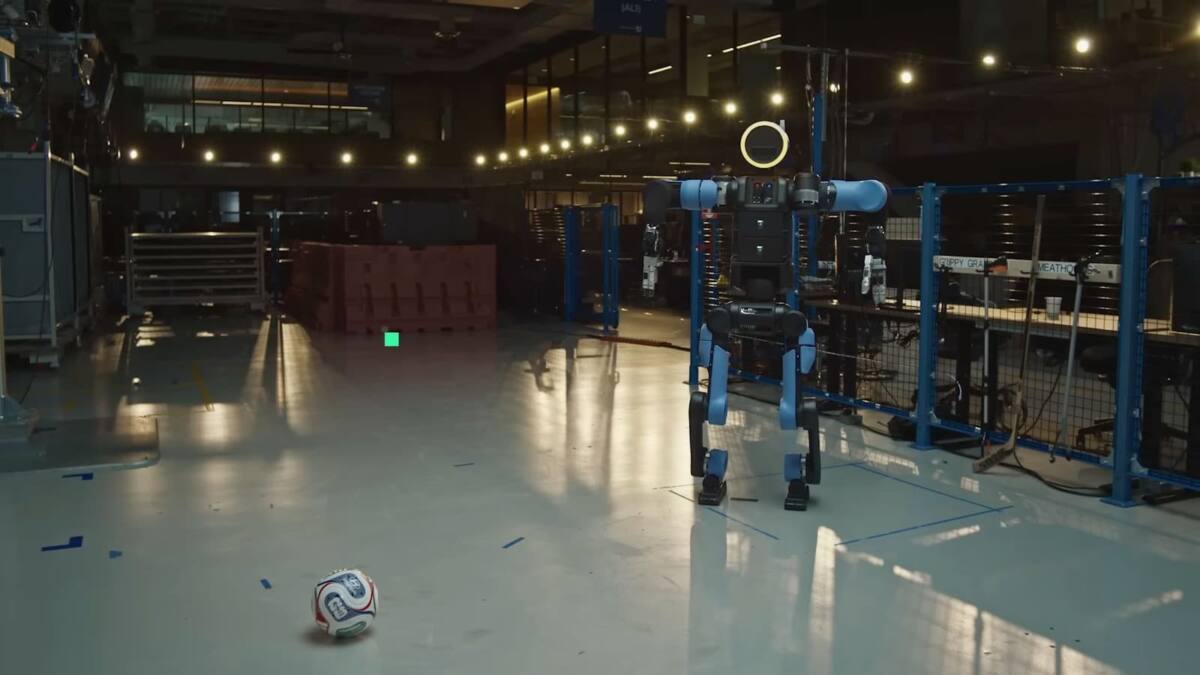
Boston Dynamics has turned Atlas into a football student ahead of the 2026 World Cup, and the timing is no accident. In a new video, the humanoid robot watches match footage, copies player movements almost immediately, and even mimics goal celebrations and injury reactions as the company ties the demo to the upcoming tournament.
The point is bigger than party tricks. Boston Dynamics is using football to show that Atlas can learn from visual examples, adapt its balance on the fly, and move from one task to another without being rigidly preprogrammed – exactly the sort of flexibility robotics firms have spent years promising and often failing to deliver.
Atlas copies football moves from video
In the clip, Atlas first studies players on a large screen, tracking body position, movement, and reactions during game situations. It then moves into a training area and reproduces the actions it just saw, including shifting weight onto a support leg, stepping forward smoothly, and nudging a ball with controlled contact.
The robot also works through coordination, balance, and timing drills, with its movement becoming more fluid as training continues. The emotional bits are the cheeky part: after one successful exercise, Atlas throws its arms up in a goal celebration, then drops to one knee to mirror a player reacting to an injury.
Why Boston Dynamics is teaching Atlas this way
Boston Dynamics says the system is built around reinforcement learning, where successful actions are rewarded, and it has also leaned heavily on simulation. The company says it ran millions of hours of training in parallel on GPUs while varying object weight, surface grip, object placement, and grasp strength, a practical way to narrow the gap between simulation and the messy real world.
That gap is the whole game in robotics. Plenty of systems look brilliant in a lab and then wobble the moment a sensor drifts or the floor texture changes; Atlas is being pushed to use proprioception – awareness of its own body, load, balance, and resistance – so it can correct itself while handling unstable objects. That matters far more on a warehouse floor than on a stage demo.
From mini fridges to World Cup cameos
This football lesson follows earlier Atlas demos in which the robot learned to carry mini-fridges weighing around 45 kilograms without losing balance. Hyundai, Boston Dynamics’ parent company, even called the new clip the first football school for Atlas in its ”School of Football” series and hinted that Atlas and the Spot robot could appear at World Cup-related events, though no role has been specified.
- Atlas learns from video rather than only from fixed motions.
- It uses proprioception to adjust movement in real time.
- Boston Dynamics is stress-testing skills that could later transfer to warehouses, construction sites, and factories.
The open question is how far this kind of visual imitation can go once Atlas leaves the controlled demo. If the robot can translate football timing into reliable real-world work, Boston Dynamics will have more than a cute World Cup tie-in on its hands; it will have another argument that humanoids are finally getting useful.