

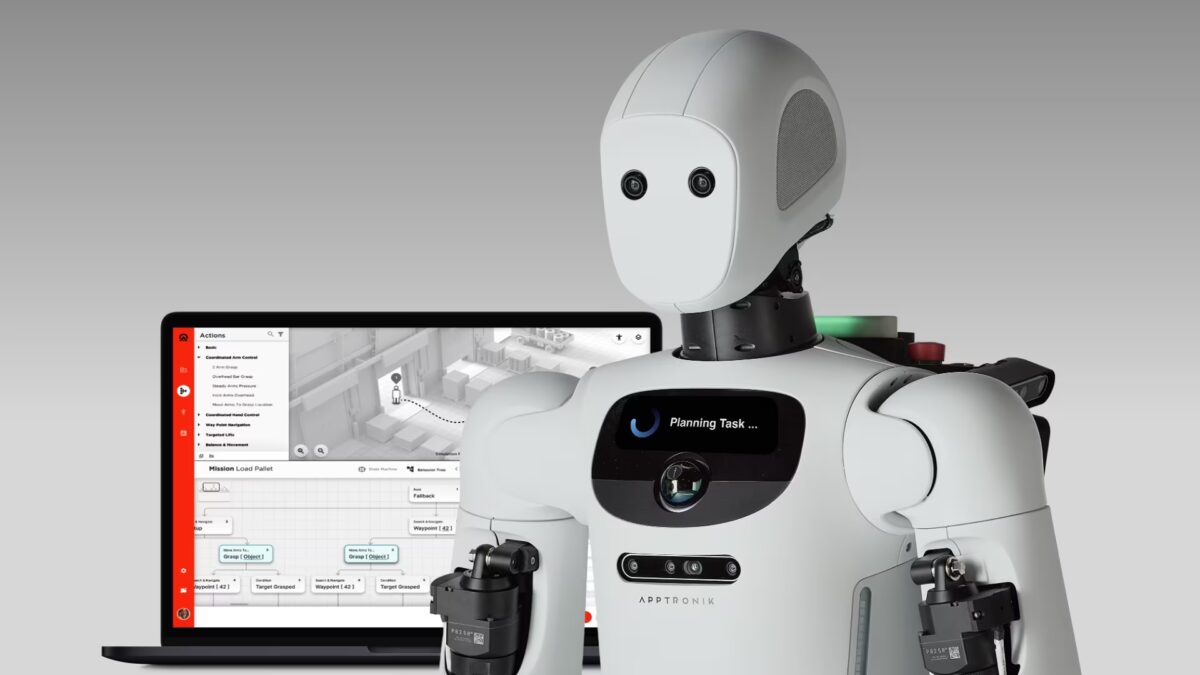
Apptronik has unveiled Robot Park, a sprawling 8,300-square-meter facility dedicated to nonstop training for its Apollo 2 robots. Here, robots tackle real-world tasks drawn from industry, logistics, and retail, while the company collects telemetry, motion recordings, and manipulation data to refine their control models.
Apollo 2 comes in two versions: a bipedal humanoid and a wheeled base. Both are positioned as data-gathering workhorses rather than finished products meant for mass sales. The wheeled variant fits seamlessly into existing warehouse automation setups. The bipedal robot is designed for complex environments where robots must operate in human-centric spaces without remodeling infrastructure.
Training data doesn’t just come from Robot Park. Apollo 2 units are already deployed with industrial partners like Mercedes-Benz and logistics provider GXO. Some run under remote human control; others operate autonomously. This hybrid approach lets developers demonstrate correct behaviors via teleoperation while exposing flaws in autonomous models that simulations alone might miss.
How Apptronik’s Robot Park trains Apollo 2 humanoid robots
Apptronik’s strategy reflects a shift in robotics: the winners won’t be those with the flashiest humanoid prototypes but those who build the largest, most realistic datasets. The industry is moving from one-off prototypes toward scalable data-driven infrastructures. For comparison, Figure AI is running pilots with BMW, Agility Robotics operates Digit in Amazon logistics, and Tesla is continuing Optimus development internally.
This push also aligns with Google DeepMind’s robotics research. DeepMind’s Gemini Robotics family of foundational models tackles perception, object manipulation, and action sequences. Their main bottleneck is not the AI but the lack of quality real-world physical data. Apptronik’s Robot Park aims to fill this gap, with Apollo 2 serving as the bridge from digital models to physical applications.
Apptronik traces its roots to the Human Centered Robotics Lab at the University of Texas at Austin and nearly a decade of work, including NASA projects like Valkyrie. Earlier this year, Apptronik partnered with Mercedes-Benz to integrate Apollo robots into production lines. Now the company is moving to continuous cycles of robot operation, data capture, model updates, and improved robot performance.
According to Goldman Sachs, the global humanoid robot market could balloon to $38 billion by 2035 if companies prove these robots can pay off in warehouses, logistics, and light industry. Eye-catching hardware alone won’t cut it. Hundreds of thousands of real-world operation hours are needed, and Robot Park represents Apptronik’s attempt to turn that effort into a manufacturing process.
Apptronik is already developing Apollo 3 based on insights from Robot Park’s data loop. The race against Figure, Agility, and Tesla will come down to how fast this data translates into meaningful autonomy gains. The next milestone to watch: whether Mercedes-Benz and GXO sites can scale benefits in production and logistics. That’s when humanoid robots may finally step beyond labs and into everyday industrial routines.