

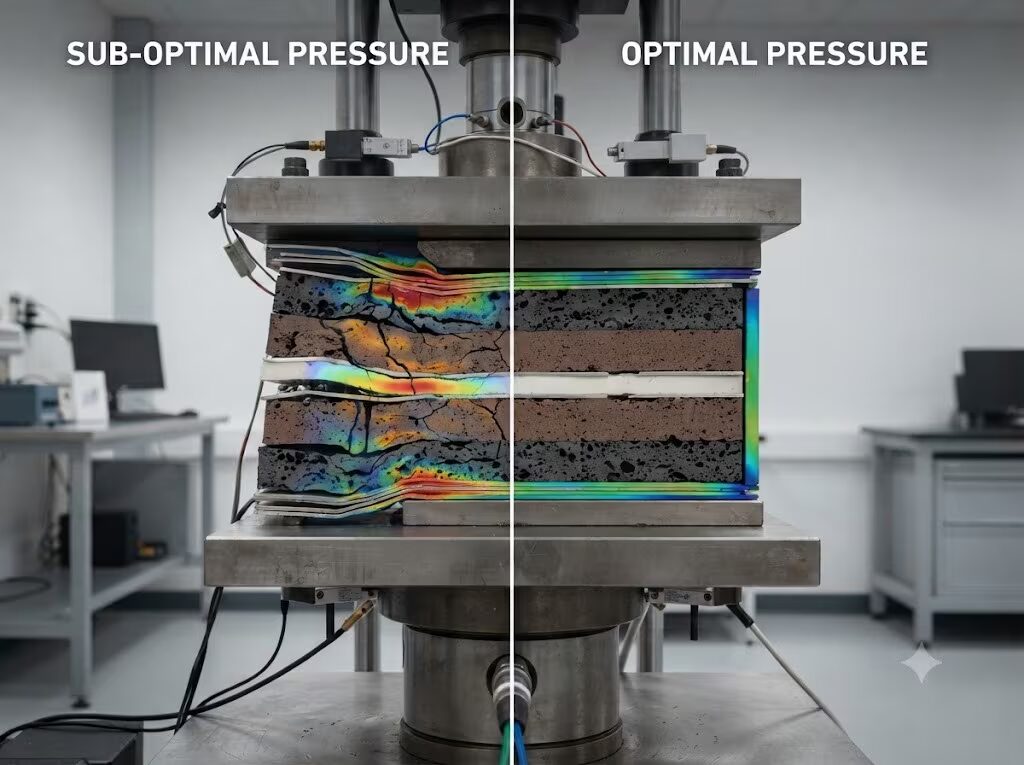
Researchers at Cambridge University found a surprisingly simple way to double the lifespan of electric vehicle batteries-without new chemistry, costly additives, or exotic ”supermaterials.” Their trick: maintain lithium-ion cells under a precisely calibrated constant pressure.
Published in Nature Energy, the study tackles a well-known problem: battery cells expand and contract during charging cycles, gradually damaging their internal structure and reducing capacity. To explore this, the team built a setup with pneumatic bellows that applied steady pressure to cells while tracking microscopic changes in their thickness in real time.
The sweet spot turned out to be around 12.5 bar (about 181 psi). At this pressure, battery cells lasted roughly twice as long compared to those under lower or higher compression. The relationship was delicate: too little pressure accelerated cathode cracking, while too much encouraged lithium deposits on the anode. Both scenarios degrade the battery but in different ways.
This mechanical pressure technique improves battery durability without requiring changes to the cell’s chemistry. Considering BloombergNEF estimates the average EV battery pack cost dropped to $115 per kWh in 2024, manufacturers seek not only cheaper but longer-lasting solutions. Slowing battery degradation makes it easier to meet typical warranties-usually eight years or 100,000 miles-without expensive module replacements.
Controlling mechanical pressure is already important for pouch and prismatic cells, and external pressure is often part of operating conditions in solid-state batteries. The Cambridge team refined this concept by dynamically maintaining an optimal pressure as the cell’s shape changes with age, rather than just applying a fixed squeeze.
However, turning this approach from a lab discovery into production EV technology won’t be quick. So far, tests were done on single cells; the challenge ahead is designing battery packs with hundreds of cells all receiving equal, adaptive pressure. Cambridge has filed a patent through Cambridge Enterprise, signaling real commercial potential-if engineers can build a compact, affordable system for applying precise pressure.
As battery longevity remains a key bottleneck in EV adoption worldwide, this mechanical pressure technique adds an elegant new dimension to battery management strategies. Watching how this idea scales and integrates with existing battery packs will be important. If successful, future electric vehicles might maintain their battery capacity far longer, reducing replacement costs and electronic waste.