
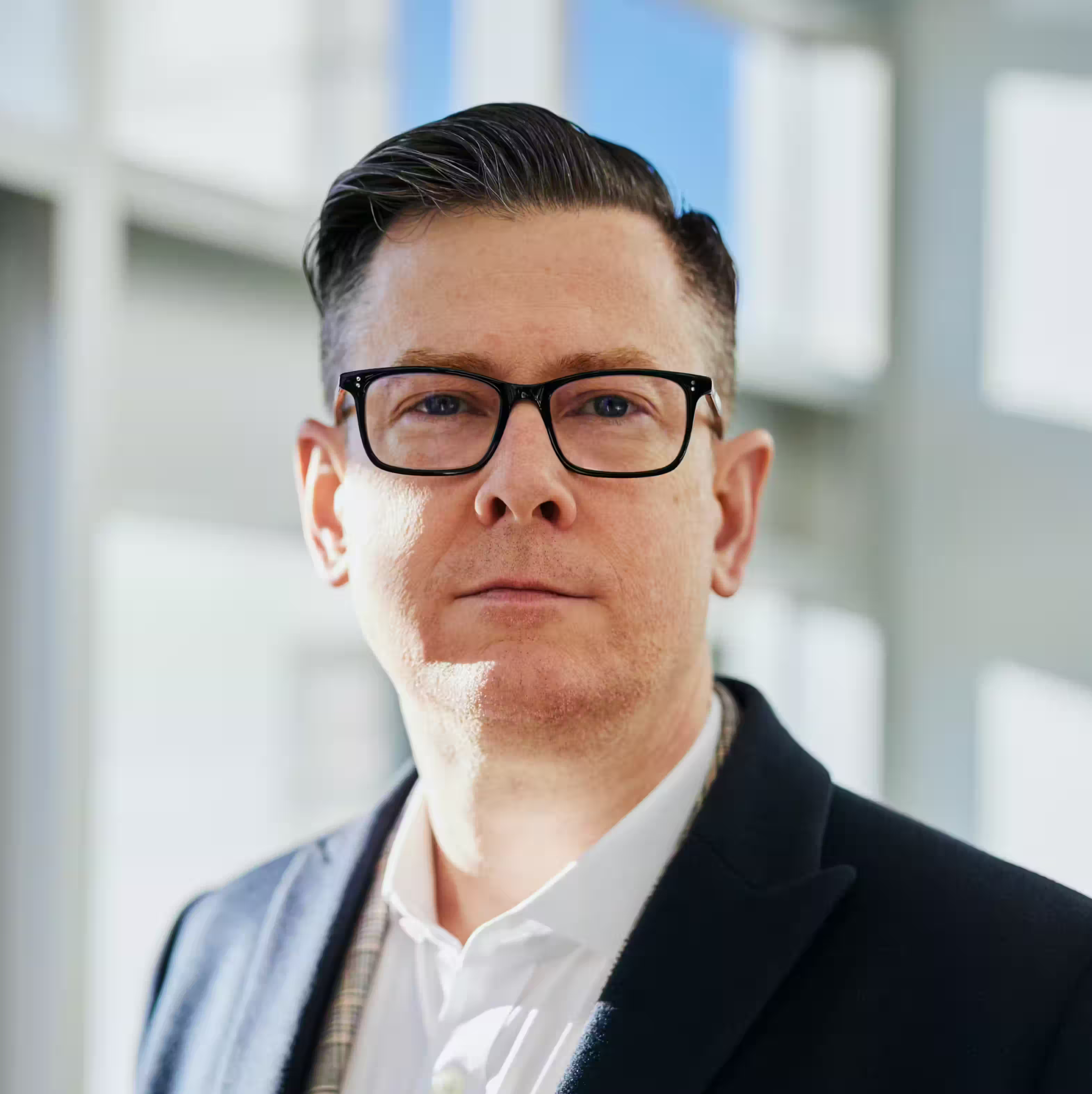
Andrej Karpathy has joined Anthropic, giving the startup one of the most recognizable engineers in modern AI and a public boost for its Claude research. He says he is returning to research for now, while his education work will wait.
The timing is no accident. Karpathy made the announcement on the same day Google opened its annual I/O conference, which gave Anthropic a chance to steal some oxygen from a much larger rival. That is either smart positioning or a very convenient coincidence, depending on how charitable you feel.
What Karpathy will do at Anthropic
Anthropic says Karpathy will help build a team focused on using Claude to accelerate pretraining research itself. In other words, the company is pushing one of its own models to help improve the next generation of models, which is exactly the sort of loop AI labs have been chasing for years.
That puts Anthropic closer to the long-running idea of recursive self-improvement: systems that help train their successors with less and less human intervention. It is an elegant pitch, and also a slightly unnerving one.
Why Andrej Karpathy matters in AI
Karpathy has a rare resume even by AI industry standards. He helped found OpenAI, led Tesla’s AI division, and played a major role in teaching a generation of engineers through Stanford’s CS231n course.
He also brings unusually relevant hands-on experience. At Tesla, he worked on Autopilot’s computer vision stack, while his later work at OpenAI centered on midtraining and synthetic data generation, both of which map neatly onto Anthropic’s pretraining ambitions.
- OpenAI founding member
- Former director of AI at Tesla
- Creator of Stanford’s CS231n deep learning course
Education and open source may slow down
The open question is what happens to the projects Karpathy built outside the big labs. He has spent recent years publishing widely watched videos on LLMs and neural networks, launching Eureka Labs in July 2024, and supporting open source tools such as autoresearch and the LLM Knowledge Base.
Anthropic is friendlier to open standards than some rivals, thanks to work like MCP, but it still sells mostly proprietary systems. That makes Karpathy’s next chapter look less like a clean handoff and more like a pause button on his education and open source work while he gets absorbed into the Claude machine.
A familiar talent war among AI labs
Anthropic’s gain is also a reminder of how tight the elite AI talent market has become. The labs are no longer just competing on model quality; they are competing on who can attract the researchers best suited to make those models train faster, cheaper, and with less human hand-holding.
If Karpathy can help Claude improve the process of building Claude, that is a neat internal loop for Anthropic. The bigger question is whether he stays inside the lab long enough to make that loop real, or eventually returns to the public-facing teaching work that made him such a singular figure in the first place.