

Machine learning has given the James Webb Space Telescope a cleaner pair of eyes. A new system called AMIGO reduces distortion in JWST data, letting astronomers pick out faint objects close to bright stars – territory that was effectively off-limits for the telescope before.
JWST’s near-infrared camera and spectrograph, NIRISS, is especially suited to this task, but its Aperture Masking Interferometer is punishingly sensitive to bright sources. Charge migration in the detectors warped the interference pattern, while small errors in the metal mask geometry made the resolution even worse. That is a bad combination if you are trying to spot exoplanets, brown dwarfs, or dust-heavy features in protoplanetary disks beside a glare factory of a star.
How AMIGO works with JWST data
AMIGO, short for Aperture Masking Interferometry Generative Observations, takes a different route from the usual ”clean up the image later” approach. Instead of trying to repair damaged frames after the fact, it builds a digital twin of the telescope, simulates the optics and electronics, then compares synthetic results with the real observations until the model and the data line up.
That matters because the system is not just a smarter filter. It uses a neural network to learn how charge redistributes nonlinearly inside the sensors, and it relies on automatic differentiation to calculate derivatives with machine precision at each step. In plain English: it is much better at untangling faint structure from the mess left behind by bright stars than standard image-processing tools.
What the new method revealed
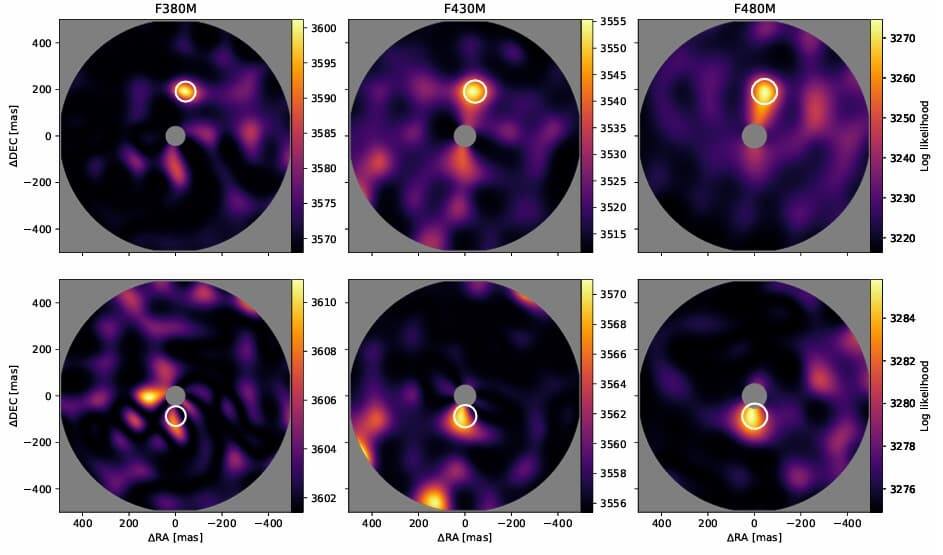
In testing, the algorithm identified the substellar objects HD 206893 c and HD 206893 B, and it also exposed volcanic hot spots on Jupiter’s moon Io. The same approach pulled out dust structures shaped by binary stars and helped examine a spiral jet near a distant black hole. That is a pretty wide upgrade for a method built to solve one very specific headache.
The practical payoff is direct: JWST can now work closer to bright stars without losing as much faint detail in the glare. That opens a better path to atmospheric studies of exoplanets and other compact systems, while also giving observing teams stricter guidance on brightness limits and observation setups that make the method work at full strength.
Where AMIGO could go next
The bigger story is not that AI ”improved” a telescope in some vague sense. It is that software is now compensating for hardware limits that used to define what a flagship observatory could and could not see. The next question is whether AMIGO becomes a one-off rescue tool for JWST, or a template for squeezing more science out of future instruments designed with the same uncomfortable trade-off between sensitivity and distortion.