

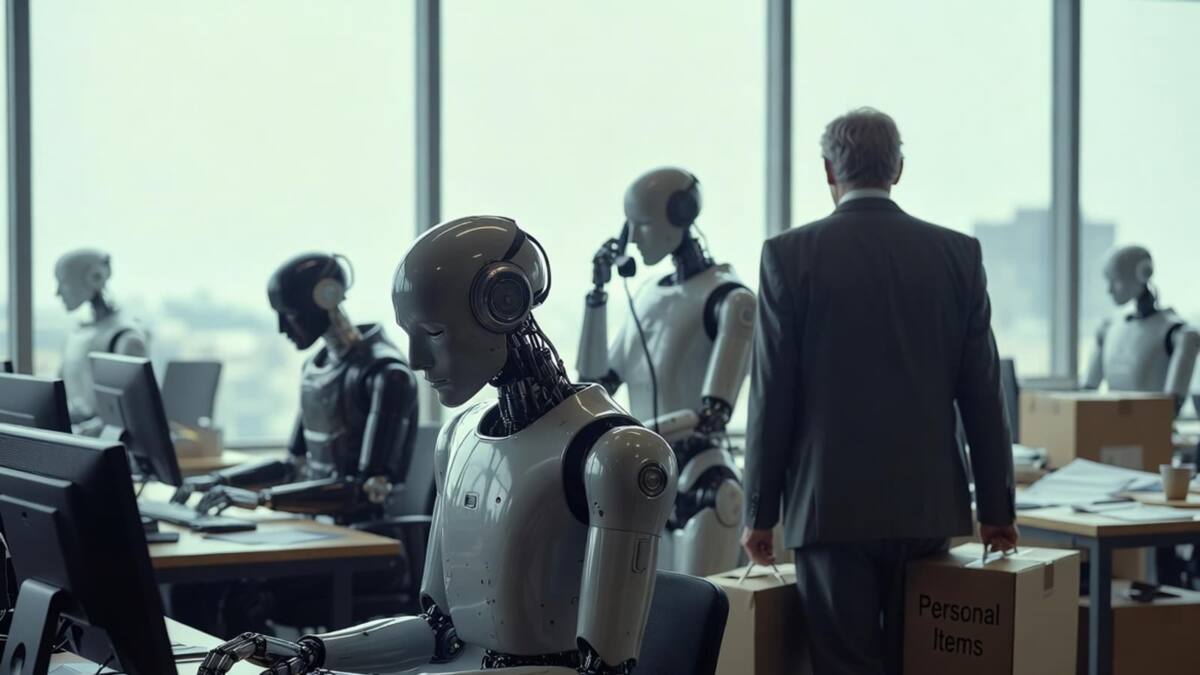
OpenAI chief executive Sam Altman says the AI wave has not turned into the broad job wipeout he once feared, especially for office workers and entry-level roles. Speaking at a Commonwealth Bank of Australia conference in Sydney, he said he is ”glad to be wrong” after expecting a harsher hit to employment from the rapid spread of AI tools like ChatGPT.
That is a more cautious admission than the usual Silicon Valley victory lap. The technology has advanced fast enough to shake hiring plans and staffing models, but not fast enough – at least so far – to deliver the mass white-collar displacement many people expected when ChatGPT arrived in 2022. The bigger story may be that companies are adopting AI quickly while still keeping human labor in the loop, which is awkward for evangelists and reassuring for everyone else.
Altman revises his own forecast
Altman said he and his executives were broadly right about the technical direction OpenAI predicted at launch, but ”quite wrong” about the social and economic fallout. He specifically pointed to early-career office jobs, saying he had expected a stronger impact by now than had actually materialized. In plain English: the model got smarter faster than the job market got smashed.
That adjustment matters because OpenAI is no small observer here; it helped set the tone for the entire generative AI boom. Rival firms such as Google and Anthropic have also pushed hard into enterprise AI, but the promised productivity revolution has often shown up as pilots, assistants, and workflow tweaks rather than sweeping headcount cuts. Businesses like the cautious version because it costs less politically.
What Altman says surprised him
- He expected junior and office-focused roles to feel a bigger shock by now.
- He now says his instincts on the social effects were wrong.
- He still believes OpenAI’s technical forecasts were broadly on target.
The subtext is obvious: AI is proving more uneven than apocalyptic. It can rewrite code, draft emails, and generate images, but firms still need people to supervise, edit, approve, and absorb the blame when the bot goes off-script. That is not the same as a labor-market collapse, though it does suggest the first jobs to feel pain may be the ones with the least protection and the most repetitive output.
OpenAI and the AI jobs debate
For OpenAI, this is a useful message. It can argue that the technology is powerful without pretending every spreadsheet job is about to disappear tomorrow. That position is also more believable now that companies have had time to test AI in real workflows and discover the messy part: productivity gains are real, but so are errors, oversight costs, and the stubborn habit of managers not wanting to bet the payroll on a chatbot.
The open question is how long that balance lasts. If AI systems keep improving and cheaper deployment spreads across customer support, back-office operations, and software development, the pressure on entry-level hiring could still rise sharply. Altman may be relieved that the first round of fears did not fully arrive, but the next round may be harder to shrug off.