

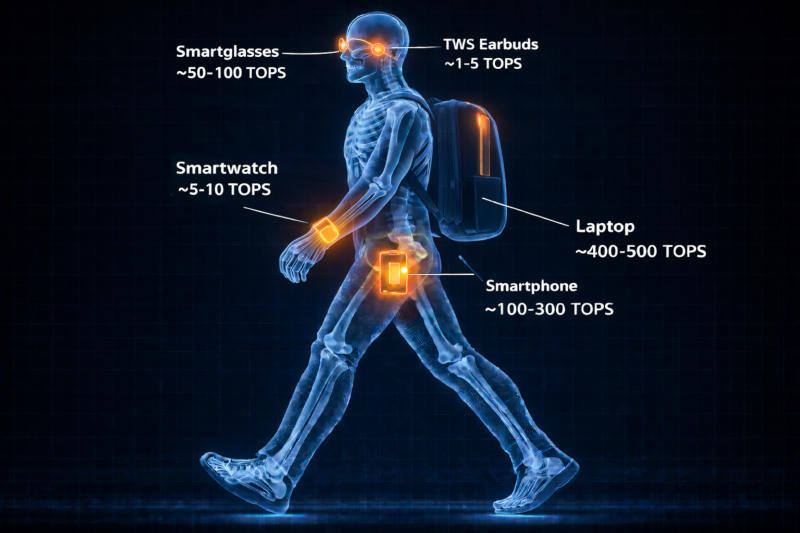
Your phone, watch, and earbuds are quietly turning into a distributed AI rig. A new Futuresource forecast says the combined on-device AI power in personal devices could reach 1,000 TOPS, or 1 POPS, by 2030, with smartphones doing most of the heavy lifting and wearables piling on enough silicon to make ”personal computer” sound quaint.
The pitch is simple: instead of sending every request to the cloud, more AI work happens locally, on the device in your pocket or on your wrist. That cuts response time and keeps sensitive data closer to home, which is exactly the kind of privacy story chip makers like to tell when they are also selling more expensive hardware.
Smartphones are doing the heavy lifting
Futuresource says the biggest swing will come from smartphones, where flagship chips from Qualcomm, MediaTek, Samsung, and Apple already claim up to 100 TOPS for AI tasks. The forecast says smartphone NPUs could triple in performance by the end of the decade, which is a tidy way of saying the next upgrade cycle will be sold as intelligence, not just speed.
- Current flagship phone AI performance: up to 100 TOPS
- Expected smartphone NPU growth by the end of the decade: 3x
- Projected total personal-device AI power by 2030: 1,000 TOPS, or 1 POPS
Wearables are no longer just accessories
Smartwatches are joining the party too. Futuresource points to about 94 million smartwatches shipped globally in 2025, while wireless earbuds are on a much larger scale: 360 million pairs a year, or more than 700 million individual earbud units because each side carries its own processor. That is a lot of tiny computers hanging off human bodies.
The broader trend is obvious even if the marketing gets silly. The industry is moving from cloud-first AI toward a hybrid model where devices do more work themselves, and that shift is being driven as much by battery life, latency, and privacy as by raw benchmark bragging rights. Cloud services are still essential, but the local chip is becoming the first stop rather than the last resort.
What 1,000 TOPS actually means for users
Even Futuresource’s numbers come with a caveat: raw TOPS does not automatically translate into better experiences. The firm expects the average personal-device AI load to sit between 450 and 550 TOPS, which suggests plenty of devices will have serious headroom long before consumers notice anything dramatic. The interesting battle now is not whether the silicon can do it, but which apps, assistants, and system features are good enough to make people care.
That is where the real winners and losers will start to separate. Chip vendors and device makers get to sell the vision of a ”walking supercomputer”; users will mostly judge whether their phone feels faster, their earbuds sound smarter, and their watch stops outsourcing common sense to the internet.