

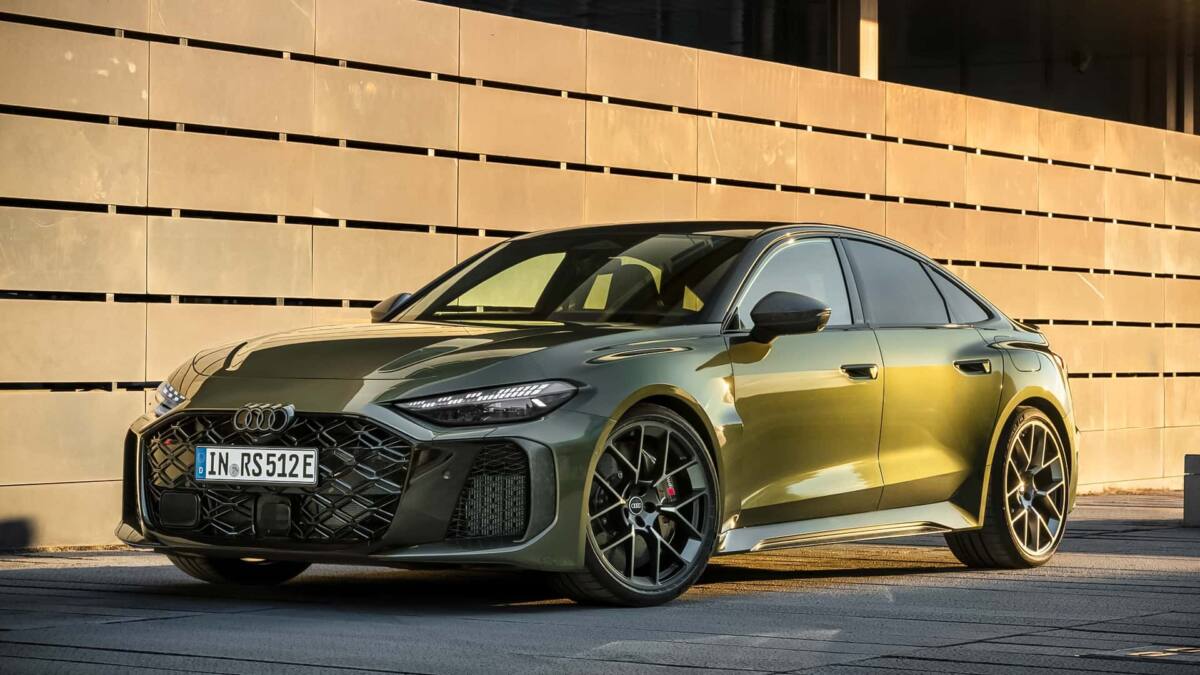
There are two competing engineering priorities inside the new Audi RS5: brute acceleration and an honest battery-backed electric range. Audi managed both. The consequence is hard to ignore – the car has ballooned in weight to a point that will bother purists and change how the RS badge feels on the road.
Audi has unveiled the redesigned RS5 as a liftback and an Avant, intended to replace the RS4. Under the hood sits a 2.9‑liter twin‑turbo V6 that produces 503 hp paired with an electric motor rated at 174 hp – a combined system output of 630 hp and 825 Nm of torque. Audi quotes 0-100 km/h in 3.6 seconds and a top speed of 285 km/h. A 25.9 kWh traction battery gives the RS5 up to 87 km of pure electric driving (WLTP numbers are implied by the figure).
All that performance and electric ability come at a steep mass penalty. Compared with its predecessor the RS5 is 625 kg heavier: the RS5 Avant in European specification tips the scales at 2,370 kg. That makes it heavier than Audi’s own RS6 with a V8. The car is also 9 cm wider than the regular A5, rides on 21‑inch wheels, and wears aggressive bodywork and giant oval exhaust outlets to sell the idea that this is still a focused performance model.
The RS5 keeps Audi’s Quattro system but adds active rear torque distribution and a dedicated RS drift mode (for closed‑course use) that can send up to 85% of drive to the rear axle. Inside there’s a three‑screen ”digital cockpit”, sport seats with massage and tailored stitching, and a Boost button on the flat‑bottom wheel that unlocks maximum system output for 10 seconds.
European orders open in Q1 2026. German pricing starts at €106,200 for the liftback and €107,850 for the Avant. Deliveries begin summer 2026, and Audi says the RS5 will reach the U.S. market the following year. Audi positions it against the BMW M3 and the Mercedes‑AMG C63.
So why does this matter beyond bragging rights for peak horsepower? Because the RS5 illustrates a larger shift in the high‑performance market. Manufacturers are trying to thread three needles at once: meet increasingly strict emissions rules, deliver instant electric torque and keep or improve lap times. The quick fix is to bolt on a big battery and one or more electric motors. The result is cars that accelerate like sports cars on steroids but handle and feel like much heavier machines.
That trade‑off has already been playing out across the segment. Hybrid drivetrains add mass that affects braking distances, tire wear, unsprung load perception and chassis balance. A 25.9 kWh battery is substantial for a plug‑in performance car – it explains the 87 km electric range claim – and it explains much of the RS5’s weight. The irony is clear: the package intended to add usable electric range and comply with CO2 rules is also the thing that undermines the lightweight, nimble character buyers of previous RS models prized.
Who wins? Buyers who want a single car that can sprint to 100 km/h in the mid‑3s, cover daily commutes on electric power, and carry luggage or family in an Avant. Fleet managers and regulators win too – a PHEV RS5 can help lower average CO2 numbers. Who loses? Traditionalists who care about steering feel, throwable chassis balance, and the sensory drama of a high‑revving, lighter sports saloon. Track enthusiasts will get raw pace but may find the car’s mass an unwelcome partner on fast corners and under heavy braking.
What did Audi leave unanswered? Cooling and weight distribution under repeated track stress, charging rates and how much of that 25.9 kWh is usable in real‑world conditions. Audi’s RS mode and 10‑second Boost are flashy, but they don’t change the thermodynamic reality: pushing a 2.3‑ton performance car hard will stress brakes, tires and battery systems differently than in a sub‑1.9‑ton sport sedan.
My read: This RS5 will sell to wealthy buyers who prize a high‑performance daily that can limp around town on electric power and blast on demand. It is not a purist’s RS; it is a compliantly electrified RS – and one that illustrates where performance brands are headed. Expect more cars like this: enormous on paper, heavy in person, fast in a straight line and engineered carefully to hide compromises until you push them hard.
If you want a lighter, more analog experience, the market will still offer choices – older generation models, lighter track specials, or fuller EVs with lower center of mass but different driving characters. For everyone else, the RS5 is an unapologetic expression of today’s engineering priorities: keep peak performance, add electric range, and let mass be the price of admission.