

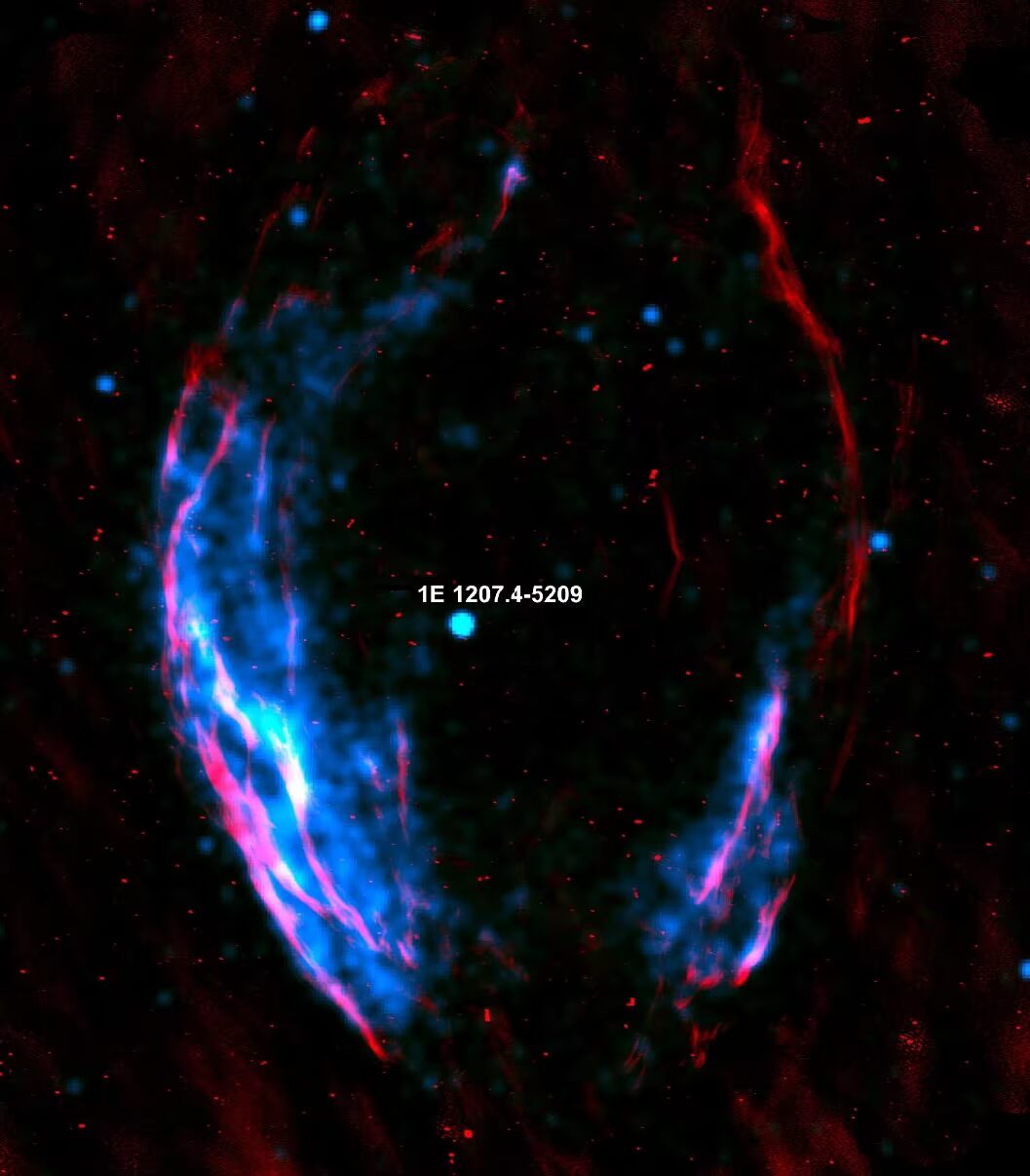
A neutron star thought to be radio-silent for decades has finally emitted faint radio pulses. Astronomers detected these signals from 1E 1207.4-5209, one of the rarest types of neutron stars known as central compact objects (CCOs). This discovery, made using South Africa’s MeerKAT radio telescope, challenges longstanding assumptions and suggests there may be an unseen population of similar faint pulsars hidden in the Milky Way.
CCOs are neutron stars located at the cores of supernova remnants, and until now, they were not observed emitting the regular radio pulses typical of pulsars. Fewer than a dozen central compact objects are known, and 1E 1207.4-5209 has long been considered a textbook example of a ”radio-quiet” neutron star.
A team led by Zhang Lei from the National Astronomical Observatories of the Chinese Academy of Sciences discovered that 1E 1207.4-5209 is indeed emitting radio signals-pulses repeating every 424 milliseconds, matching the star’s rotation period. Their findings were published in Nature Astronomy (DOI: 10.1038/s41550-026-02899-2).
Located about 10,000 light-years from Earth at the center of a supernova remnant, the neutron star earned its nickname ”Blue Eye” due to composite imaging. The brightest X-ray spot at its core resembles a glowing pupil. By overlaying MeerKAT’s 1.3 GHz radio data with eROSITA’s X-ray images, astronomers successfully isolated the source from the surrounding cosmic dust and gas.
The team links the newly detected radio emission to a rotational ”glitch” observed by X-ray telescopes back in 2015-a sudden spin-up event inside the neutron star, likely caused by changes deep within its ultra-dense interior. Researchers believe this glitch may have altered the star’s magnetic field, allowing faint radio waves to escape and become detectable from Earth.
This discovery has broader implications beyond a single object. If ”radio-quiet” CCOs can emit weak radio signals-perhaps only after internal glitches or disruptions-astronomers might be missing a significant population of young neutron stars in our galaxy. While more than 3,500 pulsars have been catalogued as of 2026, only a handful of central compact objects are known, highlighting a gap likely caused by observational limits.
Looking ahead, continued monitoring of the ”Blue Eye” pulsar is critical to determine whether its radio emission stabilizes or remains episodic. Such observations could also shed light on other mysteries, including the elusive neutron star suspected in SN 1987A, the famous supernova in the Large Magellanic Cloud whose radio pulses have yet to be detected.