

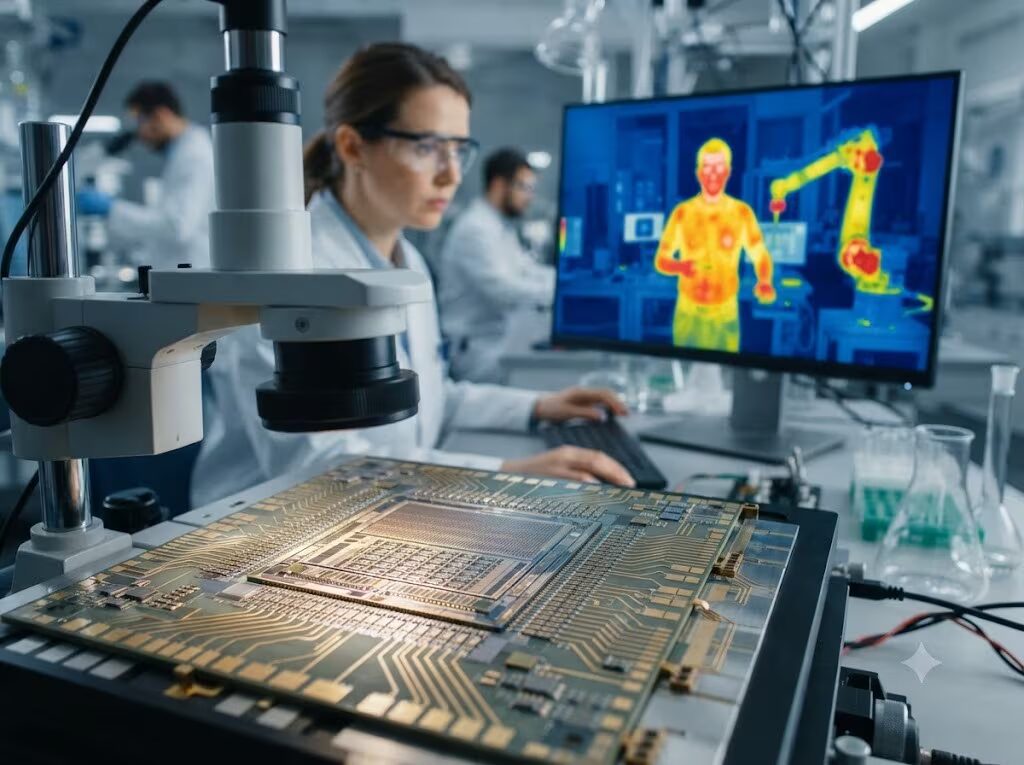
Scientists have significantly improved the sensitivity of common thermal cameras without altering their basic materials. Led by Professor Fengnian Xia, the team inserted a miniature two-terminal NPN transistor into the sensor’s circuitry, increasing the temperature sensitivity of microbolometers from about 10% to an astonishing 150% per kelvin. If scaled up for mass production, this breakthrough could enhance night vision devices, robotics, automotive driver-assistance systems, and industrial diagnostics.
The research, published in Nature Sensors, took a straightforward approach. Instead of hunting for exotic new sensor materials, the team integrated the transistor into the familiar microbolometer design. These sensors detect infrared radiation indirectly by measuring heating effects on a sensitive element, which changes its electrical resistance with temperature shifts.
Low-cost thermal cameras have long struggled with sensitivity limitations. High-end infrared systems use cooled photon detectors offering superior precision, but they come with steep costs and complexities. More affordable cameras-found in cars, handheld devices, surveillance, and fire alarms-rely on microbolometers based on vanadium oxide or amorphous silicon. These materials are cheaper but less sensitive to subtle temperature variations.
How the transistor increases thermal camera sensitivity
The researchers aimed to boost the temperature coefficient of resistance (TCR), a key parameter describing how much a material’s resistance changes with temperature. A higher TCR means tiny temperature differences cause larger electrical signals, making it easier for electronics to capture fine thermal details. According to lead author Jiazheng Chen, the transistor introduces a feedback mechanism between charge carriers, amplifying this sensitivity-and it can be tuned to fit specific applications.
Comparing sensitivity improvements in microbolometers
The numbers are striking for a lab experiment: boosting TCR from 10% to 150% per kelvin represents a 15x improvement. This is significant for an industry that has been squeezing better performance out of the same materials for years without disrupting production lines. Companies like FLIR, Hikmicro, and ULIS have mostly refined resolution, processing algorithms, and pixel size recently. None have achieved such a leap in TCR through a simple circuit tweak.
Applications and future integration of enhanced thermal sensors
This advancement comes at a critical moment. The global demand for infrared and thermal imaging systems-worth billions of dollars-is growing mainly due to civilian uses like advanced driver-assistance systems (ADAS), drones, predictive maintenance, and compact cameras for mobile devices, rather than military orders. The team plans to port their design to silicon platforms to facilitate integration into existing semiconductor manufacturing lines.
Challenges and next steps for transistor-enhanced thermal cameras
However, the path ahead is less headline-grabbing than the dramatic gain suggests. The researchers must build complete devices and test the transistor-enhanced sensors outside the controlled lab environment, especially in the mid-infrared range. That’s when it will become clear whether the sensitivity boost holds up through mass production, where cost, power consumption, and stability are as critical as raw performance percentages.