

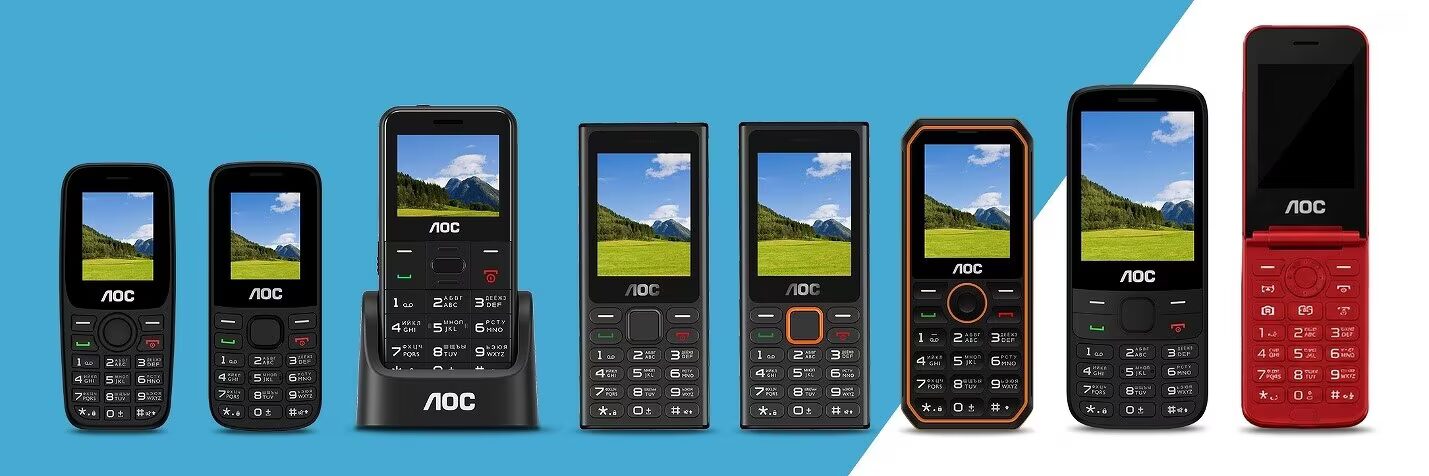
AOC, a brand best known in Russia for monitors, is stepping into the ultra-basic mobile phone segment. Their exclusive Russian distributor, Sangfei SES Electronics Rus, announced plans to launch eight feature phone models in July 2026, priced between 890 and 2,590 rubles ($12-$35). These phones promise long battery life, USB-C charging, and essential functions focused on calls and SMS.
These new AOC feature phones target the no-frills, conservative corner of the mobile market. All support dual SIM cards but only 2G networks. Most come with Bluetooth 2.1 and microSD slots supporting up to 32GB. A standout feature? Every phone includes a USB-C port-a rarity among budget feature phones still reliant on older charging standards.
AOC feature phone models and pricing
- AOC A170 – 890 rubles, 1.77-inch display, 800mAh battery, up to 35 days standby
- AOC A175 – 1,100 rubles, 1.77-inch display, 0.08MP camera, 1,000mAh battery
- AOC A205 – 1,800 rubles, large buttons, charging dock, 2-inch screen
- AOC A240 – 1,600 rubles, 2.4-inch screen, Bluetooth, 1,400mAh battery
- AOC A245 – 1,800 rubles, 2.4-inch screen, Bluetooth, 2,500mAh battery, up to 70 days standby
- AOC A248 – 1,900 rubles, rugged design, 2,500mAh battery, up to 69 days standby
- AOC A280 – 1,900 rubles, 2.8-inch screen, 1,400mAh battery, up to 40 days standby
- AOC A285 – 2,590 rubles, flip phone, 2.8-inch screen, up to 35 days standby
The AOC A245 steals the spotlight with its 2.4-inch screen, Bluetooth, and a hefty 2,500mAh battery promising up to 70 days of standby time. If that claim holds true outside press releases, it could become a go-to phone for anyone who wants to forget about daily charging.
The lineup also offers clear role-specific models. The A205 targets seniors with oversized buttons, a simplified interface, and a charging dock. The A248 is built tough with a rugged case. Meanwhile, the A285 flip phone serves those who still prefer clamshell designs – a rare but persistent niche in the feature phone segment.
AOC’s entry lands in an already crowded Russian budget phone segment. Established players like Maxvi, F+, and Xenium dominate the under-3,000-ruble category. Internationally, HMD occasionally releases Nokia-branded feature phones catering to a similar crowd. AOC’s edge will likely hinge on combining low prices, USB-C charging, and impressive battery life rather than competing on camera specs or network features.
This launch is timely given Russia’s strained mobile internet environment and intermittent messenger outages, which have driven users back to traditional calls and SMS. Dual-SIM cheap phones like these have gained fresh relevance as backup devices, dedicated phones for older relatives, or minimal communication tools for work.
We’ll know how well AOC’s phones fare when they hit stores later this summer, standing alongside Maxvi and Xenium models. The real test isn’t the brand but whether their standby time claims hold true. If the A245 and A248 really run for around two months on a single charge, this lineup could carve out a serious niche in Russia’s saturated budget feature phone segment.