

Russia’s United Aircraft Corporation (UAC) shared a rare glimpse into four passenger aircraft projects from the Yakovlev Design Bureau that never made it to production. Among these is the almost sci-fi Yak-33-a VTOL supersonic jet designed to reach Mach 3-and the Yak-242, whose innovations later influenced the MC-21 airliner. This collection underscores a familiar story in Soviet and Russian aviation: civil programs often stalled not for lack of ideas, but due to accidents, shifting priorities, and chronic funding shortages.
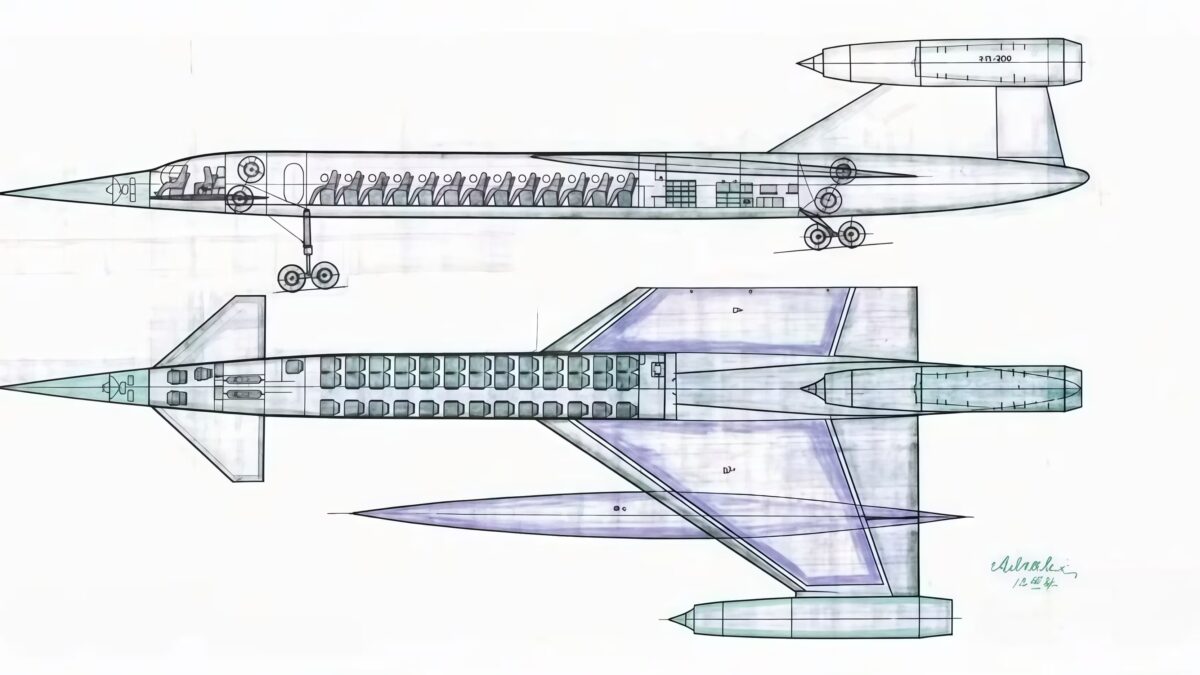
Yak-33 VTOL Mach 3 passenger jet concept
The standout oddity among these is the Yak-33, a project from the early 1960s that aimed to create a VTOL (Vertical Take-Off and Landing) passenger aircraft capable of supersonic speeds. Designed for a top speed of Mach 3 and a range of 4,000 km, it would have been powered by two RD36-41 engines for cruising and six lift engines to enable vertical takeoff and landing. The design emphasized low-altitude flight and planned extensive use of steel and titanium to handle the extreme stresses.
However, the project hit a wall when it became clear that the aircraft’s compact size was incompatible with its ambitious performance goals, leading to its cancellation.
Yak-46 regional jet canceled after fatal crash
The Yak-46 was closer to conventional civilian passenger aircraft: a 78-seat regional jet developed from the Yak-42 starting in 1982. It featured a cruising speed of 700 km/h, a range of 800 km, and two D-36 engines mounted on either side of the tail fuselage. But the program was abruptly canceled the same year after a fatal Yak-42 crash grounded the entire family of aircraft, halting its development indefinitely.
Yak-242 precursor to MC-21 narrow-body airliner
The Yak-242, conceived in 1993, was an ambitious modernization of the Yak-42 aimed at the 150+ seat narrow-body passenger jet market dominated today by the Airbus A320neo and Boeing 737 MAX. Planned to carry 156-162 passengers and powered by two PS-90A12 engines, many of its design features later influenced Russia’s MC-21 airliner. Although the Yak-242 never reached production, its legacy lives on in Russia’s ongoing efforts to compete in the lucrative short- and medium-haul segment now largely ruled by Airbus and Boeing, with China’s COMAC C919 trying to carve out its own share.
Yak-48 regional and business jet stalled by funding
The Yak-48 was an effort to break into the light administrative and regional aircraft passenger markets. Initiated by a 1995 government directive, it included a business jet variant seating four passengers with a 5,000 km range at 870 km/h cruise, and a 19-seat regional version with a 3,310 km range. Development included collaboration with Israel Aircraft Industries during the 1990s but faltered due to lack of funding-an all-too-common fate among Russian projects from that decade. Many promising designs remained just concepts or models while Western manufacturers took the lead in regional and business aviation segments.
This UAC release offers more than archival interest. It highlights the deep lineage of current Russian civilian aircraft programs, tracing a line from the Yak-42 and Yak-242 projects directly to the MC-21, which aims to enter the mainstream medium-haul passenger jet market. The critical question now is whether Russia can ramp up production to meet delivery targets and challenge global players within the next few years.