

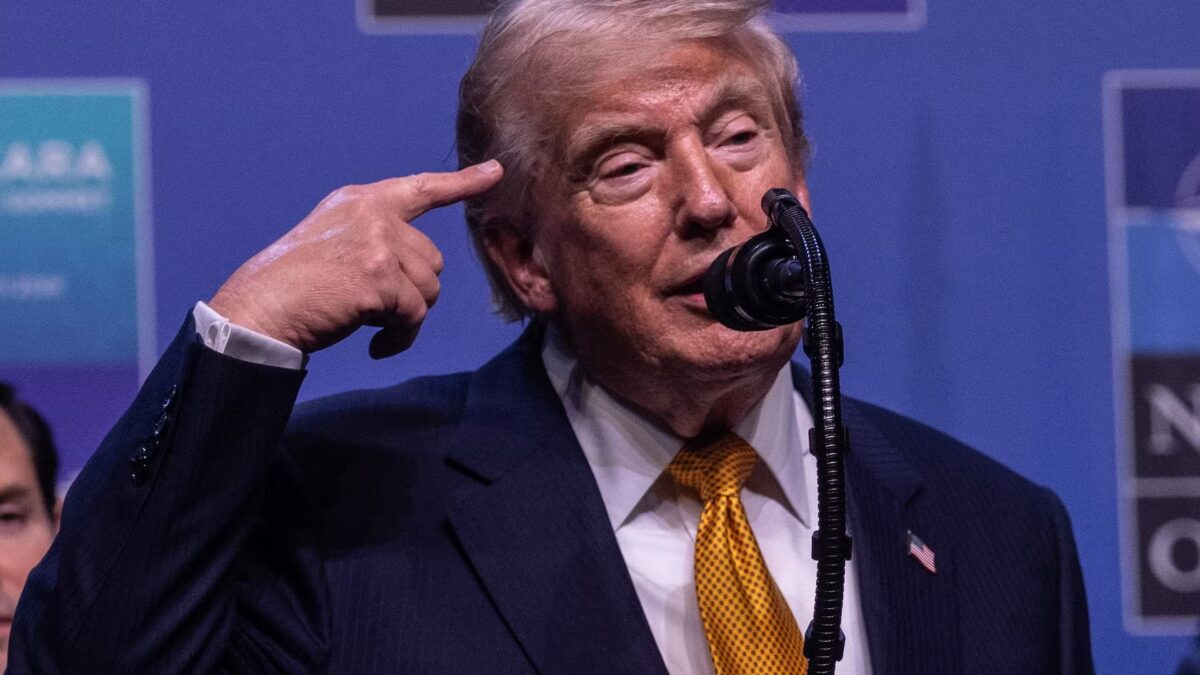
Donald Trump has mistakenly referred to TikTok as ”Tic Tac” at least three times over the past week, including during a NATO summit in Turkey where he joked about speaking ”on Tic Tac.” These slip-ups might have been dismissed as mere gaffes if not for a surprising twist: Trump has recently been defending the same platform he once tried to ban during his first term as US president.
At the NATO event, Trump’s verbal slip-ups didn’t stop at ”Tic Tac.” He also called Japan the ”Islamic Republic of Japan,” mixed up Ukrainian President Volodymyr Zelensky with Russian President Vladimir Putin, and pronounced Lenin’s name as ”Len-in.” Still, he doubled down on his claim that he holds the top spot on TikTok-an easy statement to verify, since his account has roughly 16.6 million followers, while the platform’s top creator, Khaby Lame, boasts over 160 million.
Trump’s recent frequent references to TikTok stand out given his past. Earlier this week, at a White House event with tech mogul Michael Dell, Trump argued that TikTok no longer poses a threat because it is now controlled by ”great American companies,” a stark contrast to his previous warnings about the app endangering national security.
TikTok’s unexpected comeback in Trump’s speeches
The turnaround is striking. During his first term, Trump relentlessly pushed to ban TikTok in the US, citing ByteDance’s Chinese origins as a national security risk. His efforts were abandoned under Joe Biden’s administration, but in 2024, Congress passed a law mandating TikTok either sell its US operations to American owners or face a ban.
By the 2024 presidential campaign, Trump had reversed course and opposed any ban. Since his return to the White House, he has delayed enforcement of the law multiple times. The American version of TikTok now operates under a new ownership structure:
- ByteDance retains a minority stake of 19.9%
- Control belongs to a consortium of US investors including Oracle, Silver Lake, MGX from the UAE, and a Michael Dell-backed firm
This reshaped TikTok is the platform Trump now defends, rather than the one he fought against in 2020.
This shift explains why Trump frequently name-drops figures like Larry Ellison and Michael Dell. Oracle has been the prime candidate to serve as TikTok’s US tech partner, and Ellison is part of the business circle that Trump regularly engages with. The repeated TikTok mentions are less random gaffes and more signals of a political and corporate strategy.
Another factor is TikTok’s dominance as a platform: it reaches approximately 170 million users in the US, making it a vital channel for political campaigns. Both parties embraced short videos aggressively during the 2024 elections, a marked shift from a few years ago when Washington mainly viewed TikTok as a security risk. Trump clearly doesn’t want to lose access to a platform that connects directly with young audiences, even if many aren’t his biggest fans.
Trump’s verbal stumbles about names and platforms wouldn’t normally make headlines, but there’s a cumulative effect. When Biden once confused Zelensky with Putin in 2024, it sparked a media conversation about presidential age and cognitive health. Trump’s repeated slips-misnaming TikTok, confusing world leaders-are piling up and blending into a broader narrative.
”Tic Tac” has quickly become a meme on X (formerly Twitter), reflecting a new political media rhythm where gaffes burn out within a single news cycle instead of lasting weeks. Looking ahead, a key moment will come when the White House reevaluates whether TikTok’s ”Americanization” is sufficient to keep the app running in the US without fresh restrictions.