

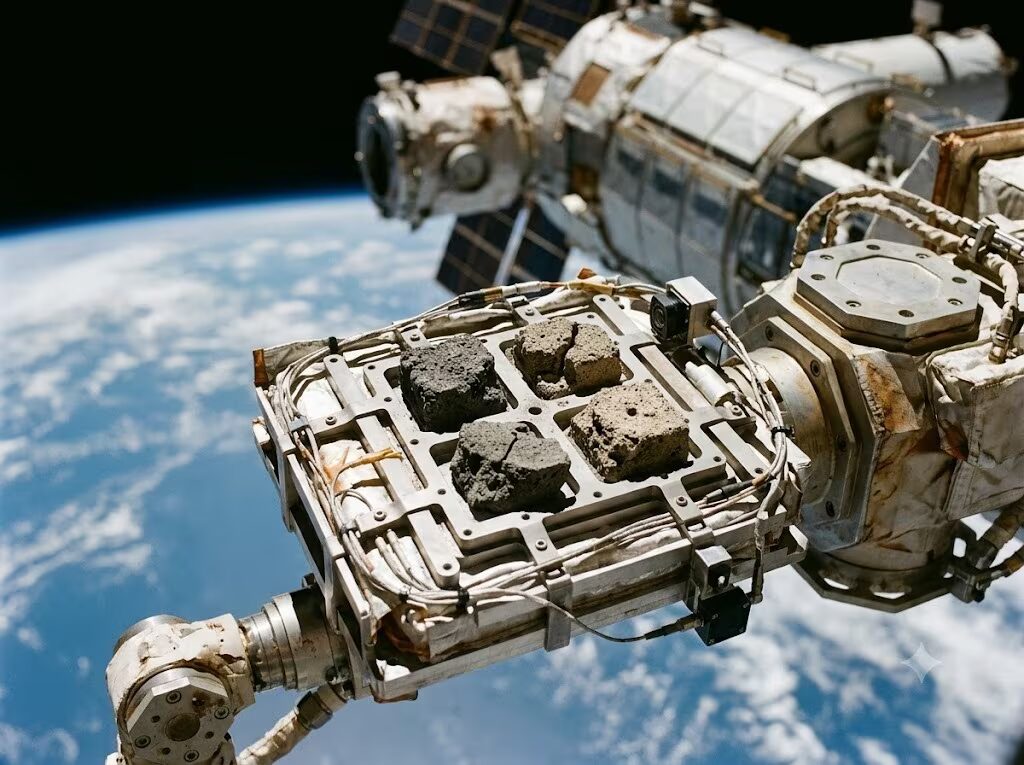
Researchers at the University of Delaware sent lunar concrete and other construction material samples outside the International Space Station (ISS) for six months-and the results could reshape how we build future lunar bases. After returning to Earth, some samples performed just as well as, or even better than, their Earth-kept counterparts, marking a breakthrough for space construction where shipping every kilogram from Earth costs a fortune.
The materials tested are geopolymers, developed in Professor Norman Wagner’s lab as a low-energy alternative to traditional cement. Unlike conventional cement, which requires energy-intensive firing, these geopolymers use chemical bonding to harden. The team bases their formulations on simulated lunar and Martian soil known as regolith, aiming to leverage local resources for construction rather than hauling bulky materials from Earth.
These samples were sent into orbit as part of NASA’s MISSE-20 mission and attached to the space station’s exterior, where they endured intense vacuum, radiation, and temperature swings for half a year. According to a report in Advances in Space Research, the materials did not degrade; some even showed improved strength compared to control samples stored on Earth.
Strength in the lab and survival in space don’t guarantee effective lunar construction, though. To be viable, the material must be produced reliably on the Moon itself. That’s why the same team extended their work using machine learning, as detailed in Acta Astronautica. Their model predicts geopolymer strength based on the regolith composition and production parameters. Lunar soil varies significantly between regions, and when building on the Moon, there’s no margin for error.
The researchers also studied the material’s behavior before hardening-during mixing and shaping-and identified a gel transition point where the fluid mix turns into solid structure. Before this point, mixing neither accelerates curing nor affects final strength. This is a bonus for automated construction tech like robots and 3D printers, giving them more time to deliver and position the material without rushing.
Interest in such methods is accelerating as NASA’s Artemis program aims to land astronauts on the Moon and establish permanent infrastructure within the next decade. European and American teams are already testing 3D printing with regolith simulants-ESA and ICON have demonstrated lunar building concepts using local materials. Against this backdrop, exposing lunar concrete to space on the ISS is a small but important step: before building lunar habitats, it’s smart to make sure the walls can handle the harshness of space itself.