

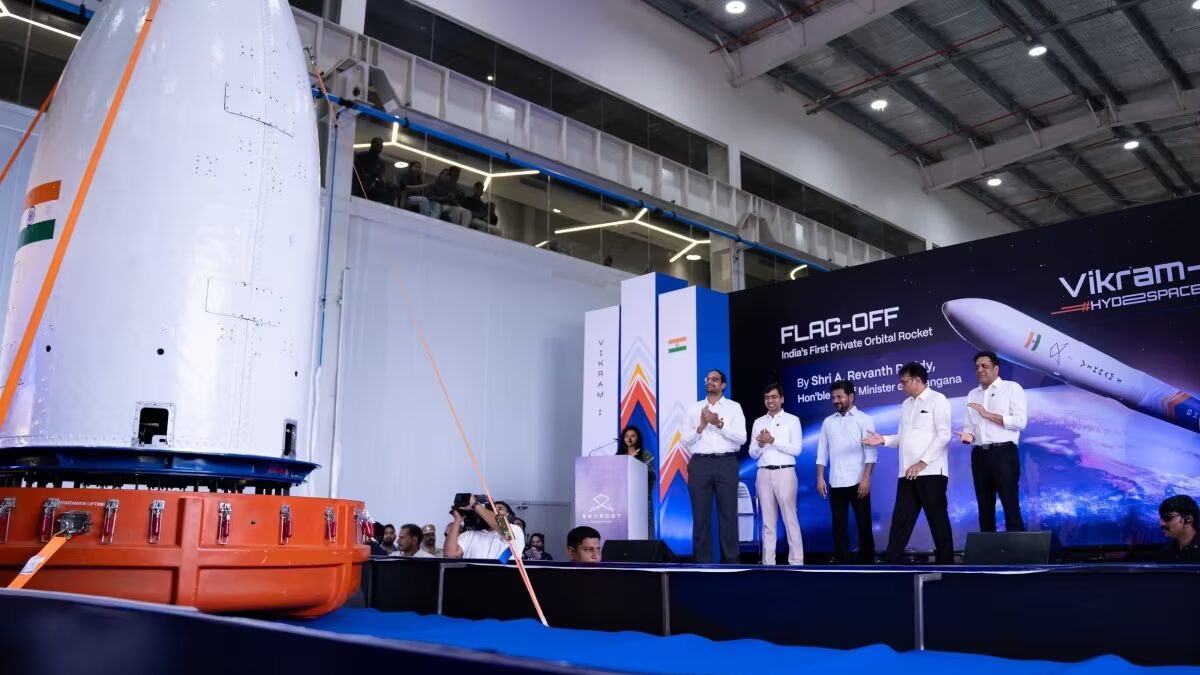
India’s first fully indigenous private orbital rocket, Vikram-1, is poised for launch on July 12 from the Satish Dhawan Space Centre. Skyroot Aerospace, the startup behind the vehicle, views this mission-named Aagaman-not just as a test flight but as an important step toward becoming a commercial launch provider in a market historically dominated by the state-run ISRO. The launch window remains open until August 4, allowing flexibility for potential delays.
The Aagaman mission will place several CubeSats and other payloads from both Indian and international customers into a low Earth orbit of approximately 450 km, at an inclination of 60 degrees. While fundamentally a demonstration flight, Skyroot hopes it will validate the rocket’s design and telemetry, a key milestone before committing to regular commercial launches.
Founder and CEO Pawan Kumar Chandana emphasizes that reliable telemetry data from this maiden flight will reveal necessary tweaks to perfect Vikram-1 for commercial operations. In the competitive small launch sector, flashy renders won’t pay the bills; investors and customers want proven reliability-something Virgin Orbit and Astra learned the hard way. Meanwhile, Rocket Lab’s Electron rocket, steadily operational since 2017, offers a proven model for success in this niche.
Vikram-1 is designed to deliver up to 350 kg to low Earth orbit. Its four-stage architecture features three solid-fueled stages followed by a liquid upper stage, providing greater precision in payload deployment. Skyroot previously tested some of these technologies on a 2022 suborbital flight with Vikram-S, but moving from suborbital hops to orbital missions is an entirely different challenge, marking the divide between experimental rocketry and commercial viability.
Building India’s private launch sector with Vikram-1 rocket
Founded in 2018, Skyroot Aerospace wouldn’t have progressed without recent policy shifts by the Indian government. The state has eased regulations for private space firms and granted access to ISRO’s testing and launch infrastructure. This support has helped India transition from a state-controlled space monopoly into a growing arena for startups building rockets, satellites, and space services.
In May, Skyroot closed a $60 million funding round valuing the company at $1.1 billion. The capital is earmarked not only for Vikram-1 operations but also for Vikram-2, a larger launcher currently in development. This investment signals growing confidence among backers in India’s emerging commercial space ecosystem-no longer just an abstract buzzword, but concrete ventures pushing toward their first orbital launches.
Additionally, government incentives sweeten the deal: Indian satellite launches can receive subsidies covering up to 30% of launch costs, capped at $3,000 per kilogram of payload. For small satellites, especially CubeSats and tech demonstrators, this offers a compelling reason to choose domestic launch services over foreign alternatives.
Competition is already intensifying. Agnikul Cosmos, another Indian startup, conducted a suborbital test of its Agnibaan rocket from Sriharikota in 2024. Meanwhile, ISRO itself fields the Small Satellite Launch Vehicle (SSLV), which has rebounded from a shaky 2022 debut to two successful flights targeting small satellites. Skyroot is entering a busy segment where a single successful launch won’t be enough to claim market share.
Skyroot’s roadmap is ambitious: following Vikram-1’s debut, it aims for up to two more launches in 2026 and plans to roll out Vikram-1U with strap-on boosters in early 2027, boosting payload capacity to 550 kg. CEO Chandana also mentions aspirations to produce one rocket per month once reliability is established-an aggressive cadence critical to making small launch economics work.
If Aagaman proceeds as planned and validates key systems, Skyroot will claim the milestone of India’s first private orbital launch operator. By the close of the current launch window on August 4, the global space industry will get its first real answer: will Vikram-1 become a viable export product that opens India’s private launch market to the world or remain another promising but unproven vehicle on the launchpad?