

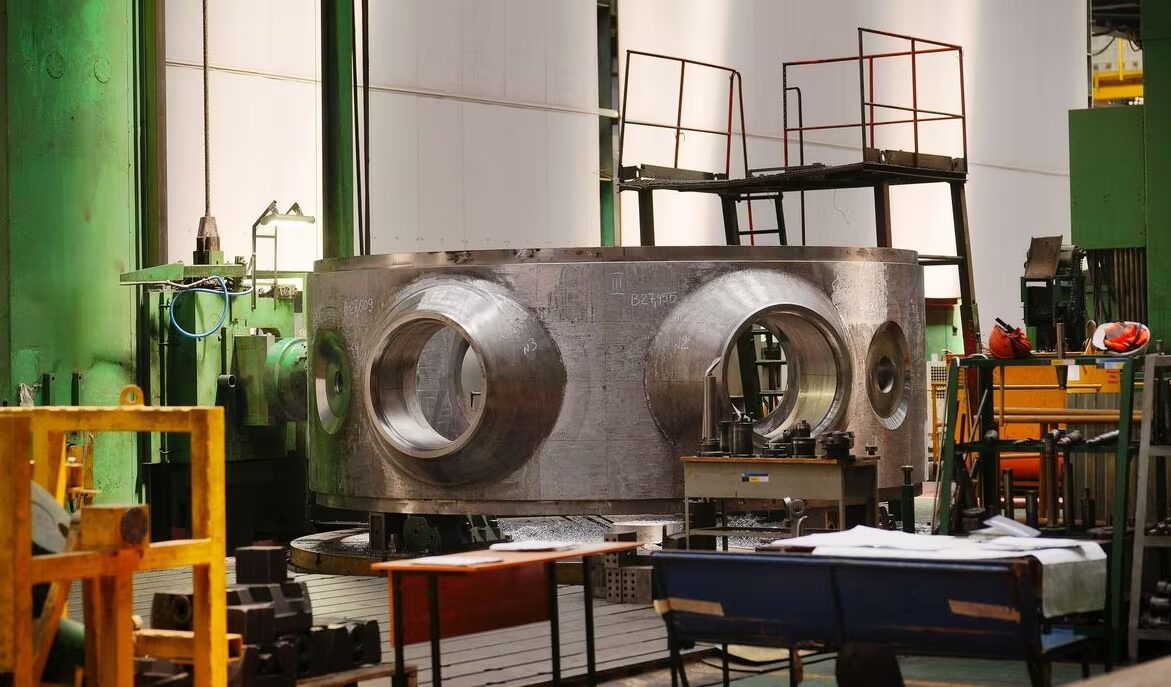
Rosatom has kicked off the assembly of the reactor pressure vessel for the fourth unit at Egypt’s El Dabaa nuclear power plant. The work is underway at the AtomMash facility in Russia’s Rostov region, where the first massive reactor parts have already arrived-each weighing over 65 tons. These are components for the Generation 3+ VVER-1200 reactors, the same model that Russia is installing at several international sites.
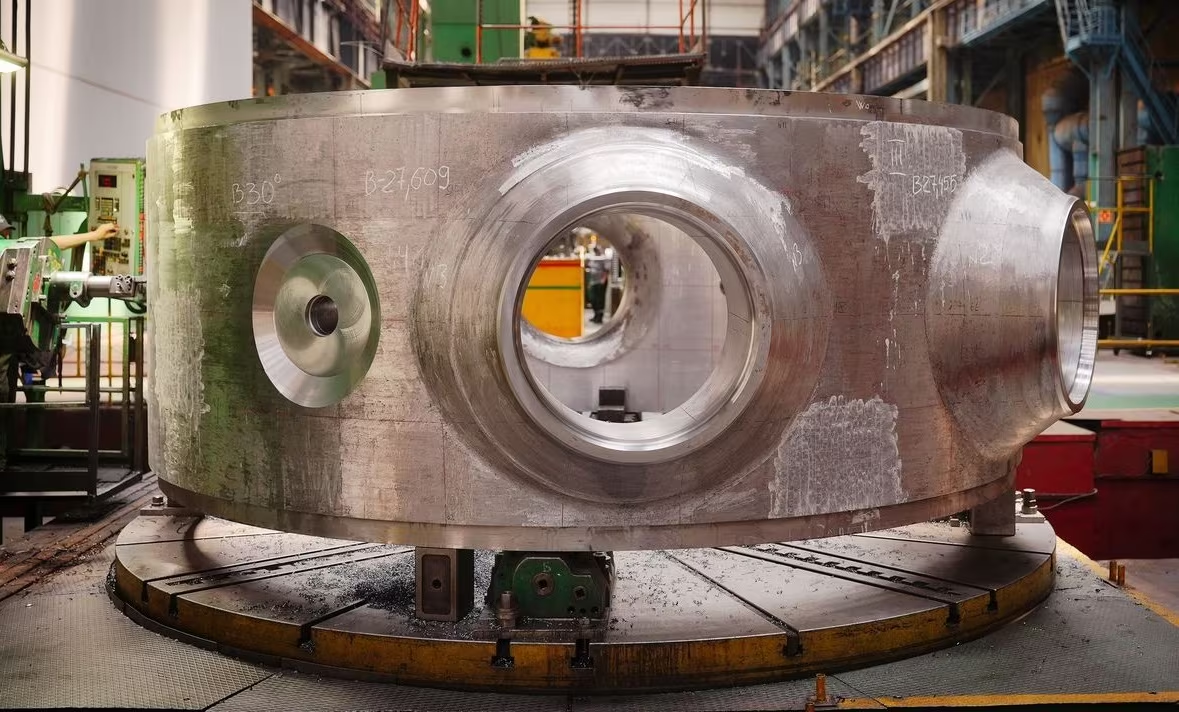
The manufacturing process starts with precise machining. Each part is carefully refined on industrial lathes to ensure millimeter-level accuracy during the final assembly of the reactor vessel. After machining, the components receive an anti-corrosion overlay-a protective coating designed to shield the metal from rust for decades.
This isn’t Russia’s first contribution to the El Dabaa project. Rosatom has already built and shipped reactor vessels for units one and two and is currently producing the vessel for unit three. Alongside this, AtomMash is fabricating 12 steam generators for units two, three, and four, plus various other critical equipment. The main circulating pump sets for the first unit have also been dispatched.
El Dabaa will be Egypt’s first nuclear power plant, consisting of four VVER-1200 units totaling 4.8 gigawatts of capacity. Rosatom estimates the plant will generate up to 37 billion kilowatt-hours annually, supplying roughly 10% of Egypt’s current electricity demand.
The project offers a real-world demonstration of the VVER-1200 design, which is already operational at Russia’s Novovoronezh II and Leningrad II plants, as well as the Belarusian nuclear power station. Construction at El Dabaa began with the first concrete pour in 2022. The assembly of the fourth unit’s reactor vessel confirms that all four units are being built simultaneously, rather than sequentially.
For context, Russia’s VVER (Water-Water Energetic Reactor) line competes internationally with Western pressurized water reactors such as those from Westinghouse and Framatome. While the El Dabaa project reinforces Russia’s role in global nuclear exports, it also highlights the challenges and geopolitics involved in building large-scale nuclear plants outside traditional markets.
Looking ahead, the key question will be how quickly Egypt can integrate and operate this new nuclear capacity, given the scale of the project and the geopolitical complexities surrounding Russian-built infrastructure in the region. Monitoring the timelines for reactor commissioning and how they manage technical and regulatory hurdles will provide insight into the future expansion of nuclear energy in emerging markets.