

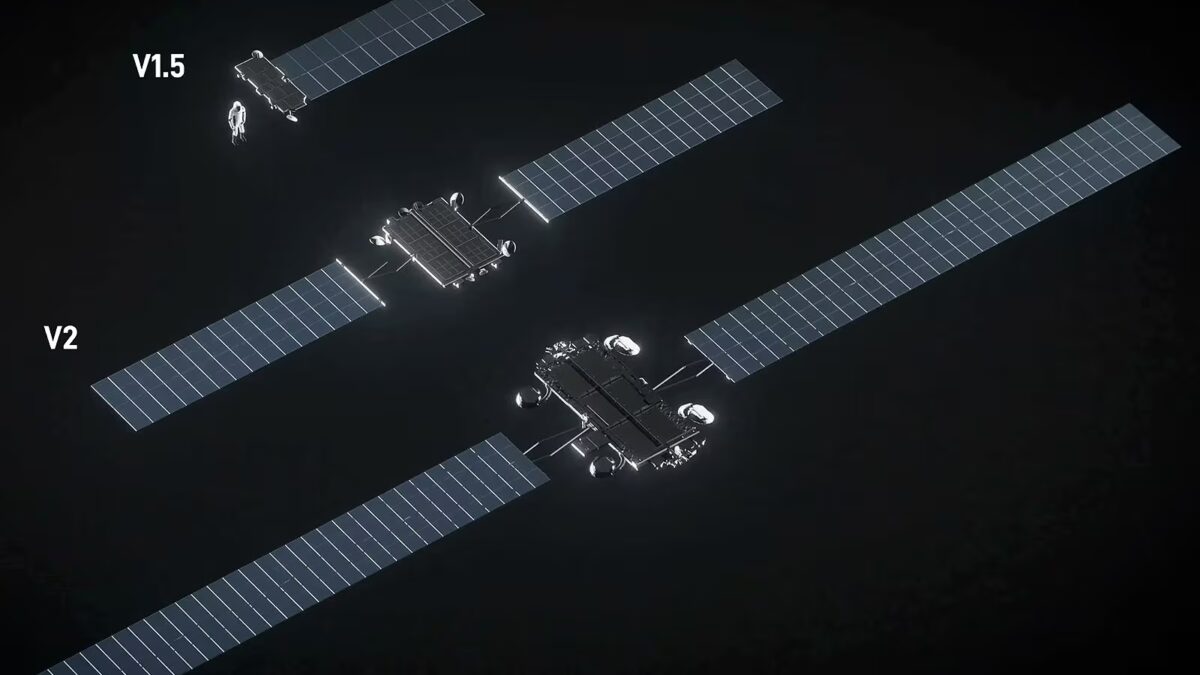
SpaceX has filed an application with the US Federal Communications Commission (FCC) to launch the third generation of its Starlink satellite constellation, proposing a network of up to 100,000 satellites. That’s nearly ten times larger than the current Starlink fleet, which comprises about 10,700 satellites. But this leap isn’t just about scale: SpaceX claims each new satellite could handle up to 4 terabits per second (Tbps) by combining radio and laser communications.
If the FCC signs off, Starlink Gen3 would mark the most significant upgrade since the service launched. The new satellites are expected to be substantially heavier-around 2 metric tons each-meaning they’ll require SpaceX’s Starship rocket for deployment. The planned orbits sit in two altitude bands roughly between 323 and 327.5 km and between 473 and 477.5 km.
According to SpaceX’s projections, Gen3 satellites could boost download speeds by about tenfold to reach 1 Tbps per satellite, while upload capacity might increase 22 times. This huge jump isn’t just marketing fluff; it targets real-world needs like AI services, enterprise cloud computing, video calls, model synchronization, and edge computing. These applications demand not only high download speeds but also substantial upload bandwidth.
Starlink has long moved beyond being just a solution for remote internet access. The service now caters to private customers, maritime operators, airlines, and military users alike. SpaceX reports servicing over 5 million customers worldwide as of 2025. Meanwhile, competitors are closing in: Amazon’s Project Kuiper has a license for more than 3,200 satellites, and Chinese players Qianfan and Guowang are building their own multi-thousand-satellite constellations.
This FCC filing isn’t just about expansion-it’s also SpaceX’s strategic move to secure its dominance in the next growth phase. While the FCC approved Starlink’s second generation with tens of thousands of satellites, deployment speeds remain constrained by rocket availability, satellite production, and frequency coordination. If Starship begins regular launches as planned, SpaceX could accelerate constellation build-out faster than rivals. The stakes go beyond satellite internet alone-this will shape the backbone infrastructure for clouds, AI workloads, and large-scale network services.
The rollout of Starlink Gen3 will be one to watch-not just for who lands the most satellites first, but for how rapidly next-gen satellite tech can transform global connectivity and the data-hungry digital services of tomorrow.