

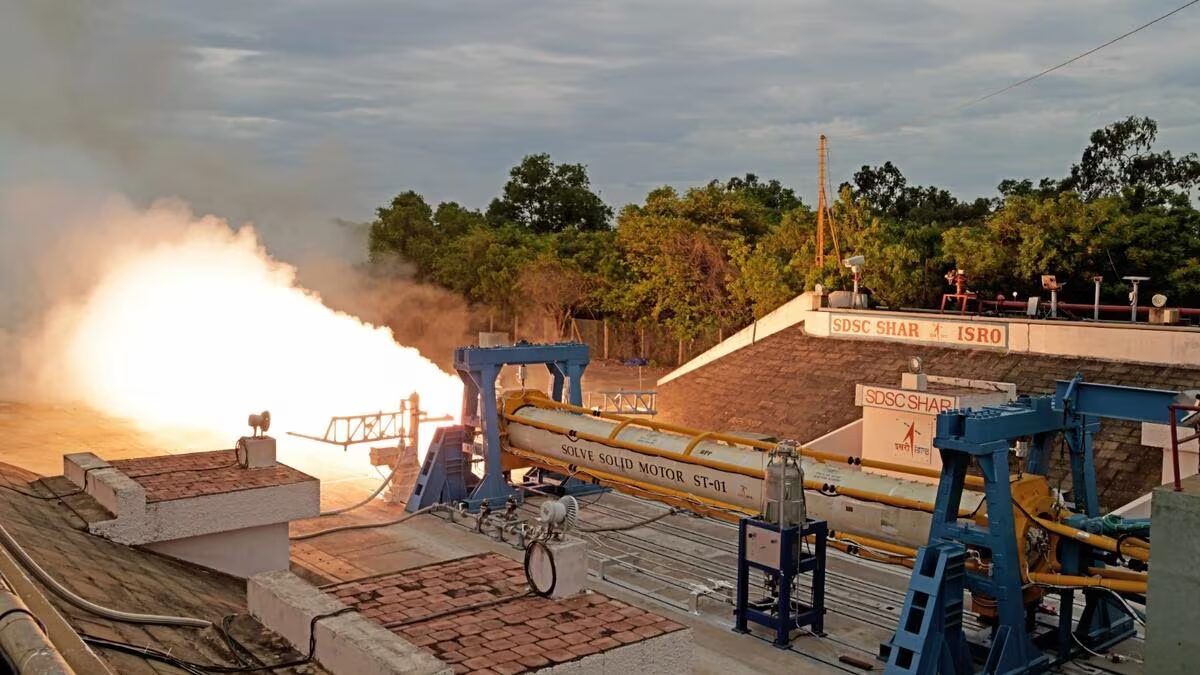
India’s space agency ISRO has completed the first ground test of the SOLVE solid-fuel rocket, a key step toward a series of suborbital trials for the Gaganyaan crewed spacecraft program. Unlike traditional rockets aimed at reaching orbit, SOLVE’s primary role is to validate the capsule’s separation and parachute deployment sequence before splashdown, a critical phase for crewed missions where errors carry the greatest risk.
The test took place on July 3 at the Satish Dhawan Space Centre on Sriharikota Island. According to ISRO, the rocket motor performed within expected parameters. The solid rocket stage draws on technology from the widely used PSLV launcher but has been extensively modified for this mission. Among the changes are a gentler thrust profile and thrust vector control achieved through secondary injection, enhancing control during flight.
In upcoming missions, SOLVE will lift the test capsule to an altitude between 10 and 17 kilometers. After reaching this height, the capsule will separate and sequentially deploy a system of ten parachutes to slow its descent to a safe speed before landing in the Indian Ocean. This approach allows ISRO to evaluate the most delicate and failure-prone parts of the return sequence without committing to a costlier orbital launch, speeding up the accumulation of safety data.
This progress marks a significant milestone for Gaganyaan, whose original timeline has shifted. A first uncrewed flight was previously anticipated in early 2026, but delays have pushed the schedule back. For India, the stakes are high: a successful crewed mission would place the nation among only a few-Russia, the US, and China-that have independently launched humans into orbit.
ISRO’s recent momentum on complex projects has been notable. Following the Chandrayaan-3 lunar landing near the Moon’s south pole in 2023, the agency gained strong political backing and technological credibility. In 2024, it successfully placed the Aditya-L1 solar observatory at the Lagrangian point. Despite these achievements, a crewed program is a different challenge altogether, where the cost of failure weighs not just on budgets but on human lives.
The key question now is how swiftly ISRO will move from ground tests of SOLVE to suborbital flights deploying the actual capsule and parachute system. Gaganyaan aims to carry a crew of three to roughly 400 kilometers altitude for missions lasting up to three days. The more suborbital validations ISRO completes in 2026, the more credible their updated timeline for the first uncrewed orbital launch becomes.