

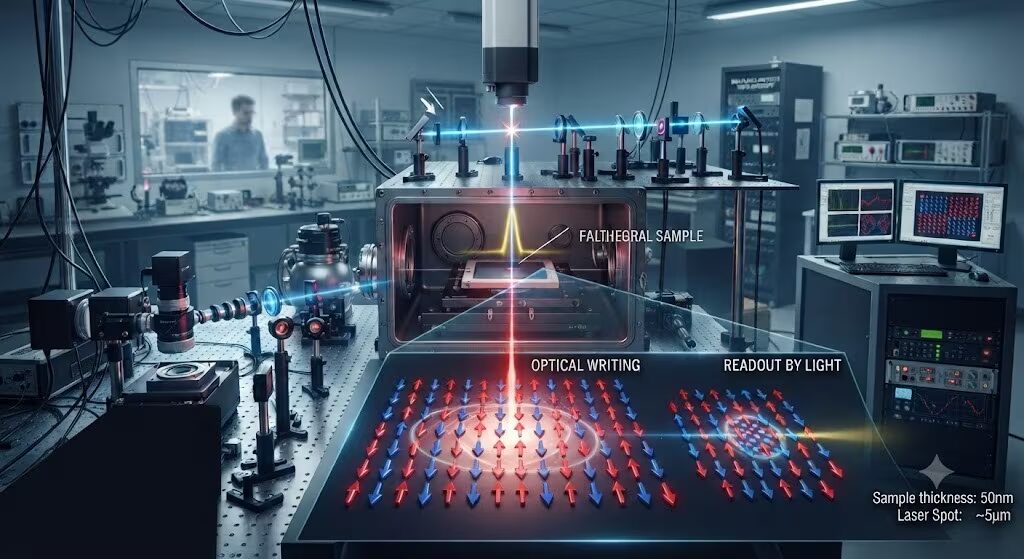
A team of researchers from Germany and Japan, including the University of Augsburg, has demonstrated for the first time that ultrashort laser pulses can record magnetic memory in an antiferromagnetic material entirely without electric currents or external magnetic fields. This all-optical approach could pave the way for telecom infrastructure where data is written by light and read optically, eliminating traditional electronic bottlenecks.
Antiferromagnets have long attracted interest for spintronics and memory technologies because they switch states extremely fast, resist external magnetic noise, and don’t produce stray magnetic fields. Yet controlling them has been notoriously difficult, leaving a big gap between lab experiments and practical devices-until now.
Published in Nature Materials, the study led by Professor István Kézsmárki’s group took a novel route: instead of relying on light polarization as most magneto-optical experiments do, they manipulated the propagation direction of laser pulses. In other words, the geometry of the light beam itself was key. This enabled fully optical switching of magnetic states and writing of information inside the antiferromagnet.
The team also demonstrated reading the magnetic states all-optically, without converting the signal back to electric form. The method operates within telecom wavelengths, making it fully compatible with existing fiber-optic infrastructure. In theory, this could unify data transmission and storage into a single optical process-cutting out steps where signals are converted between light and electricity.
All-optical magnetic memory writing in antiferromagnets
All-optical magnetic switching isn’t entirely new. Since 2007, femtosecond laser pulses have been known to flip magnetization in certain ferrimagnetic materials, sparking an entire branch of magneto-optics research. But most efforts have focused on ferrimagnets or other magnetically responsive materials-not antiferromagnets, which are trickier to control.
Progress on antiferromagnetic memory until now largely depended on electric current control. A milestone came in 2016 when researchers built a prototype memory recording data in antiferromagnets via electrical pulses. That showed antiferromagnets could store data, but unresolved issues remained: handling devices without physical contacts, reducing heat, and bypassing the limitations imposed by electrical circuits.
The new study targets these challenges head-on. Using laser pulses, the scientists created complex magnetic patterns inside the material and repeatedly switched them without erasing the stored states. Persistence across multiple rewrites is fundamental-memory is useless if bits vanish with every read or overwrite attempt.
The timing couldn’t be better: global data center power demands are soaring alongside AI and cloud computing growth. The International Energy Agency estimates data centers already consume a significant fraction of worldwide electricity-and that’s only increasing. Memory technologies promising lower heat output and fewer signal conversions are attracting industrial attention, even if commercial products are years off.
Still, bringing antiferromagnetic optical memory to market won’t be simple. The non-volatile memory sector is already competitive, with strong contenders like MRAM, ReRAM, and phase-change memory vying for multi-billion-dollar growth through this decade. Antiferromagnetic optical memory boasts advantages in speed and native optical compatibility but must prove it can match or surpass density, durability, manufacturing cost, and real-world robustness before moving beyond the lab.
The technology’s next test lies in engineering: how small can memory cells get? How many write-read cycles will the material endure? Can it be integrated on chips without exotic fabrication tools? These hurdles typically take years to clear. Yet if recording information with light in antiferromagnets can be transferred from experimental setups to workable prototypes, telecom and server hardware could gain a truly new path to ultrafast, energy-efficient non-volatile memory.