

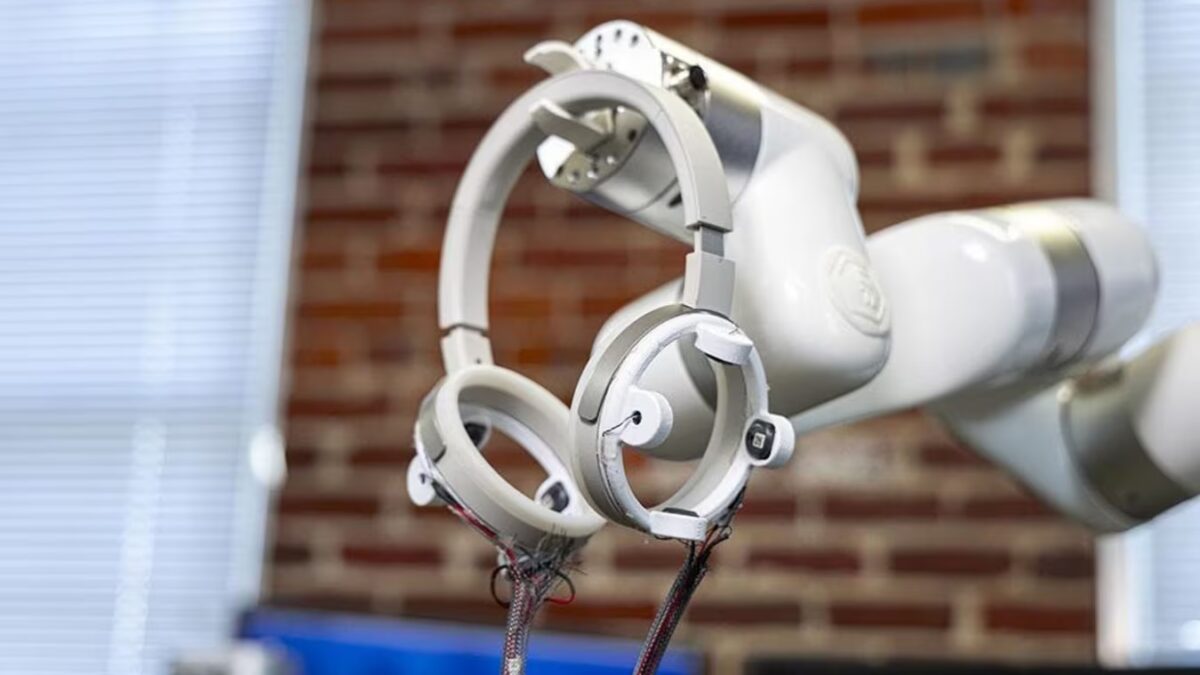
Researchers at Georgia Tech have unveiled Spherephones, a headset that alerts workers to nearby robot movements not with a blaring siren but through spatial audio cues. Instead of a simple alarm, the system translates a robot’s direction, speed, and distance into a shifting melody, letting workers perceive risk without diverting their eyes. The idea is straightforward: hearing reacts faster than sight, especially in busy factories filled with flashing lights, moving carts, and noisy machines.
How Spherephones use spatial audio for robot movement awareness
The headset features an open-ear design with four speakers around each ear – front, back, top, and bottom. This setup creates a three-dimensional soundstage, allowing users to detect robot movements coming from angles traditional headphones struggle with, like below or diagonally from behind.
As a robot approaches, the wearer hears a low-intensity background melody that changes dynamically as the robot moves. This audio pattern doesn’t just signal danger; it reveals where the threat is coming from and how fast it’s closing in. Unlike conventional factory alarms that simply indicate something is wrong, Spherephones provide detailed situational awareness through sound.
Testing Spherephones with assembly and virtual reality tasks
In tests, participants performed assembly and sorting tasks while relying solely on the headset’s audio cues to track robot motion. Virtual reality experiments produced similar results: users instinctively turned toward sounds approaching from behind, even without visuals. The team behind Spherephones sees potential beyond industrial safety – applications could include navigation aids for people with visual impairments, immersive gaming, and therapeutic uses.
Rising need for audio safety devices in human-robot workspaces
The demand for technologies like Spherephones is rising as more robots share workspace with humans. According to the International Federation of Robotics, over 541,000 industrial robots were installed worldwide in 2023, with many factories adopting collaborative models where robots and operators work side by side. Current safety measures focus mainly on light towers, floor markings, cameras, and emergency stops. Precise audio guidance remains rare, leaving room for Spherephones to carve out a niche if the technology moves beyond lab prototypes to real-world factory floors.
Potential of spatial audio for enhancing factory worker safety
With industrial environments growing louder and more complex, spatial audio might become an essential tool for worker safety. Spherephones could lead the way in integrating sound-based awareness on the factory floor, offering a fresh approach to managing human-robot coexistence – an area primed for development as automation expands.