

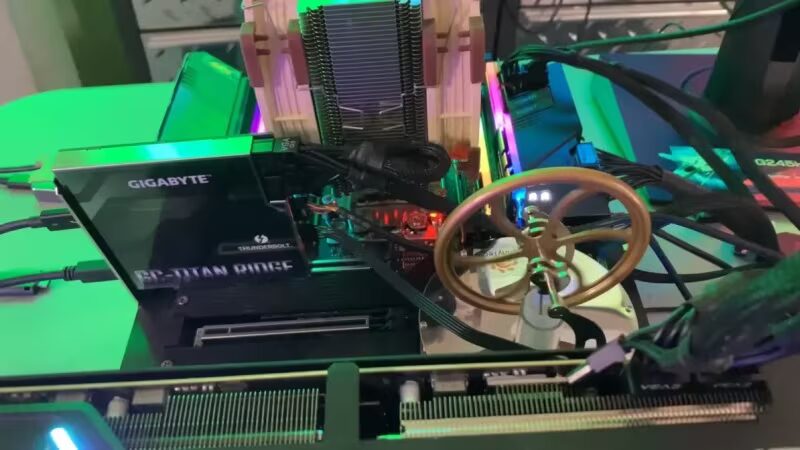
Dave Plummer, a former Microsoft engineer and one of the original developers of Windows Task Manager, demonstrated a quirky yet revealing experiment: he placed a tiny Stirling engine directly beside an AMD Threadripper CPU and spun it using the processor’s heat generated under load. Instead of relying on a campfire or a hot cup of tea, Plummer’s heat source was a workstation running Cinebench, pushing the CPU to full tilt.
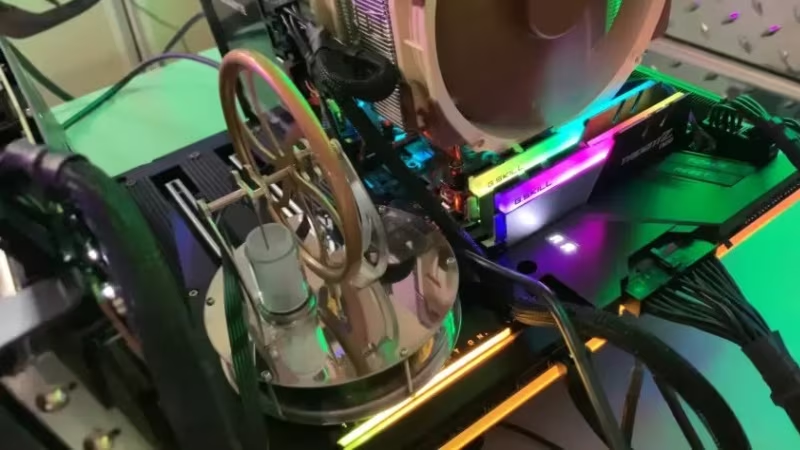
In Plummer’s video posted on X (formerly Twitter), the Stirling engine is perched on the motherboard right next to the AMD Threadripper 3970X. This beast packs 32 cores built on Zen 2 architecture and has a 280-watt thermal design power (TDP). Under full multithreaded load, it produces plenty of heat-enough to get the Stirling engine spinning. Cinebench is an ideal stress test here since it maxes out all cores and ramps up power consumption quickly.
The engine itself isn’t powering anything or assisting with cooling. Plummer didn’t show temperature measurements before or after attaching the engine, so its practical impact is negligible. The point is to illustrate how much heat a high-end desktop CPU wastes, even during standard heavy workloads.
The Stirling engine was invented in 1816 by Scottish engineer Robert Stirling. Its simple principle relies on a sealed chamber where a working fluid alternately heats and cools, causing pressure changes that produce mechanical motion. Low-temperature Stirling engines are common educational toys-they can run on tiny heat differences, like a human hand or a hot mug of coffee.
This experiment hits home with the realities of modern workstation CPUs, where thermal management is often as challenging as raw performance. The latest Threadripper Pro chips push TDP up to 350 watts, and top-tier desktop CPUs from Intel and AMD often draw well over 200 watts under full load. Seeing a small flywheel spin above the CPU socket isn’t just a neat party trick; it’s a stark visual reminder that today’s processors generate a lot of heat-even when operating normally.
As multi-core desktop CPUs continue to push power envelopes, cooling solutions will have to evolve beyond traditional air and liquid setups. Plummer’s Stirling engine demo underscores the untapped potential (and waste) in the heat produced by these chips. It raises fascinating questions about whether future PC designs might repurpose CPU heat for other kinds of energy harvesting-or if this excess heat will remain a thermal burden for years to come.