

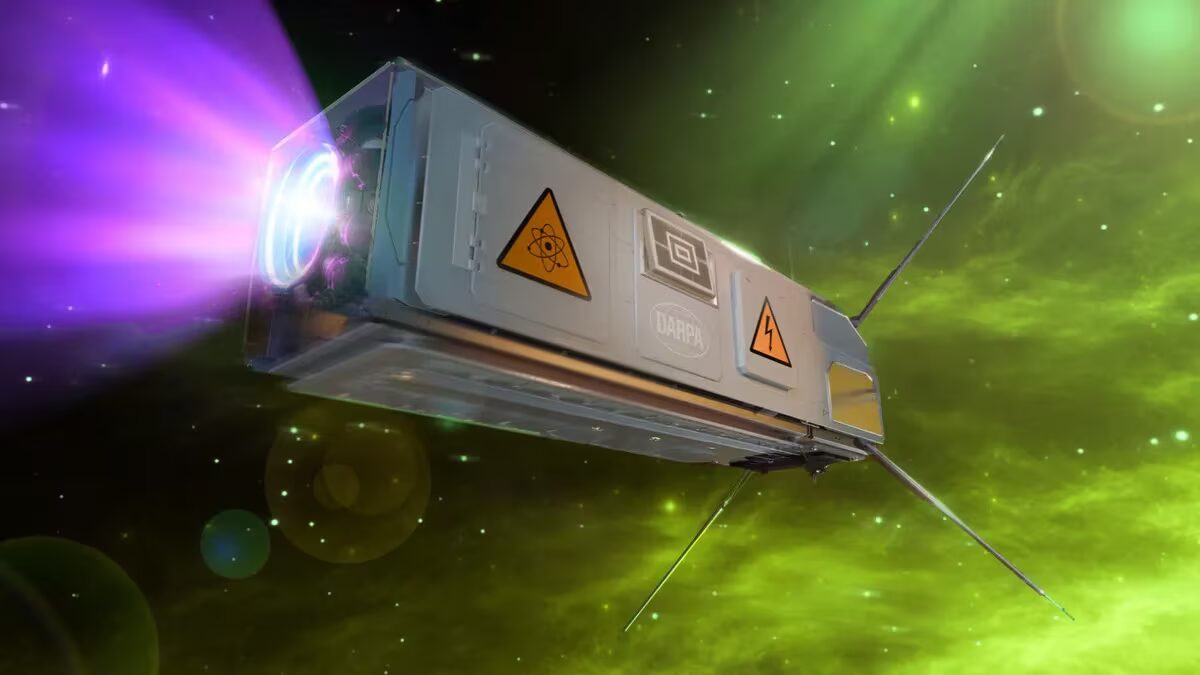
The US is doubling down on nuclear batteries designed to power spacecraft for decades without replacement. Morgan State University has secured a $3.37 million contract from DARPA to develop next-generation radioisotope power sources that can run reliably for up to 30 years without maintenance. The goal is straightforward: keep equipment going in environments where sending humans or swapping batteries is too costly, complex, or dangerous.
The project, named SYMPHONEE, is part of DARPA’s Rads to Watts program. Alongside Morgan State, collaborators include defense giant Northrop Grumman, the Pacific Northwest National Laboratory, Project Omega, Applied Research Associates, and Widetronix. Unlike conventional batteries that store and then release energy, these devices convert radioactive decay directly into electricity.
SYMPHONEE nuclear batteries use strontium-90 for long-lasting power
At the heart of the design is strontium-90, a radioactive isotope extracted from nuclear waste with a half-life of about 28.8 years-ideal for ultra-long-lasting power cycles. Developers aim to boost the specific power of these radioisotope sources beyond current standards, making them not only durable but also compact enough for practical deployment in various platforms.
Applications of ultra-long-life radioisotope power sources
The envisioned applications are tangible: satellites, interplanetary probes, autonomous underwater systems, remote sensors, and military electronics. Project Omega has already demonstrated marine drones capable of operating for up to 10 years autonomously; SYMPHONEE intends to push operational lifespans even further. For DARPA, this extends a long-standing interest in powering gear that must run for months or years without logistical support.
Comparison with existing space nuclear power technologies
Radioisotope generators are no stranger to space missions-NASA’s Voyager probes and the Curiosity rover rely on plutonium-238-based systems, though these are large and costly. Meanwhile, a separate resurgence in civilian micro nuclear batteries is underway, with companies in the US and China showcasing betavoltaic cells that can power sensors and medical devices for decades, but usually only at microwatt or milliwatt scales. If SYMPHONEE succeeds in scaling up output, defense and space tech could gain a middle ground in power solutions-bridging tiny sensors and bulky radioisotope thermoelectric generators (RTGs).
Future prospects for compact nuclear batteries in off-grid environments
This initiative highlights a practical approach to powering off-grid technology where recharge or replacement is out of the question. Expect continued progress in compact, long-lived nuclear batteries that strike a balance between endurance and size, unlocking new endurance thresholds for space exploration and beyond.