

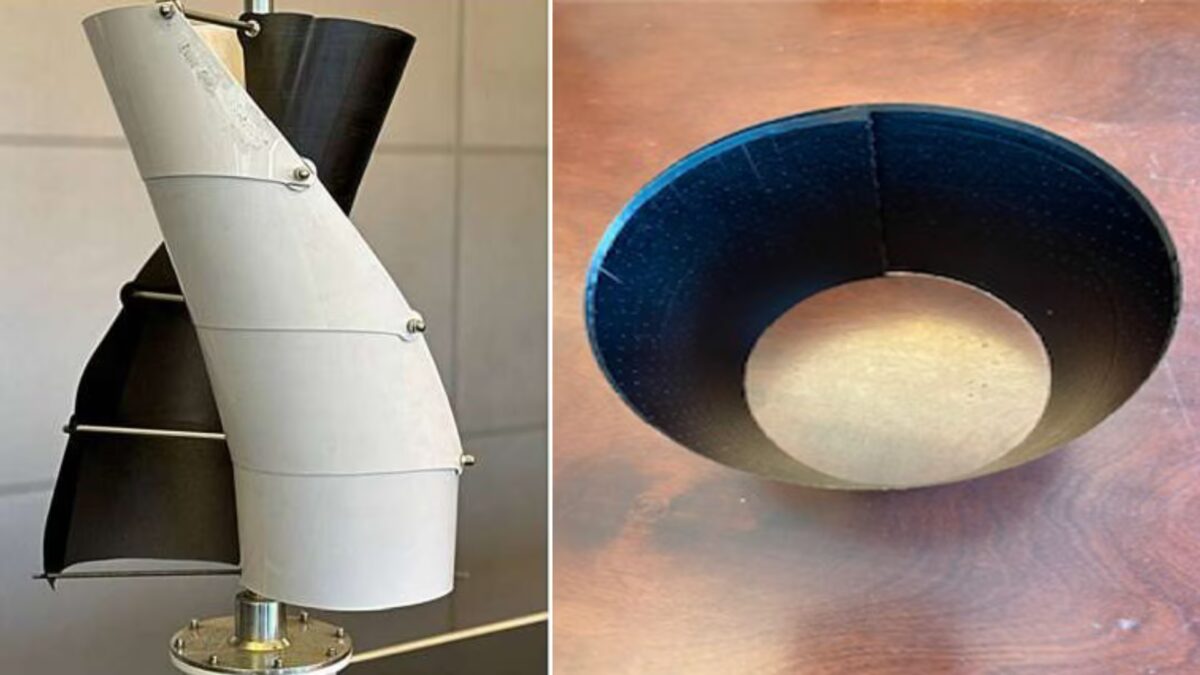
Researchers at Concordia University have devised a way to manufacture blades for vertical axis wind turbines without costly molds or extensive mechanical finishing. They 3D print and cure flat composite blanks that then curve themselves into the desired aerodynamic shape thanks to internal stresses within the material. This technique could significantly cut production costs for small urban wind turbines.
The process might seem unusual at first. Scientists begin by calculating the final blade shape, then design the carbon fiber and epoxy layup to produce internal tension during curing. Once cooled, the flat piece naturally bends into its target form, eliminating the need for traditional mechanical shaping.
Lab tests show these composite blades weigh about 80% less than comparable aluminum blades while closely matching aerodynamic profiles. Turbines equipped with them spun faster than metal-bladed counterparts. If these results hold up beyond controlled experiments, manufacturers could simplify rotor assembly and reduce weight significantly.
The team focuses on small vertical axis wind turbines, which occupy a niche compared to conventional horizontal axis models. These compact turbines are often mounted on roofs or urban spaces where wind is variable and direction shifts frequently. However, small production runs still face high tooling and mold expenses, making cost reduction critical.
Composite materials are well established in wind energy: major manufacturers already use fiberglass and carbon fiber in large blades for traditional horizontal turbines. The sector continuously seeks lighter, easier-to-manufacture components as blades grow longer and logistics become more complex. Printing flat parts that then self-deform offers a clever solution for low-volume, localized manufacturing.
The next step is practical testing to verify durability under real-world conditions-variable loads, rain, UV exposure, and vibration. For small turbines, reliability and serviceability often trump peak efficiency. If scaled successfully, this self-shaping composite method could extend beyond wind power to other industries needing complex-shaped composite parts without the high costs of traditional molding.