

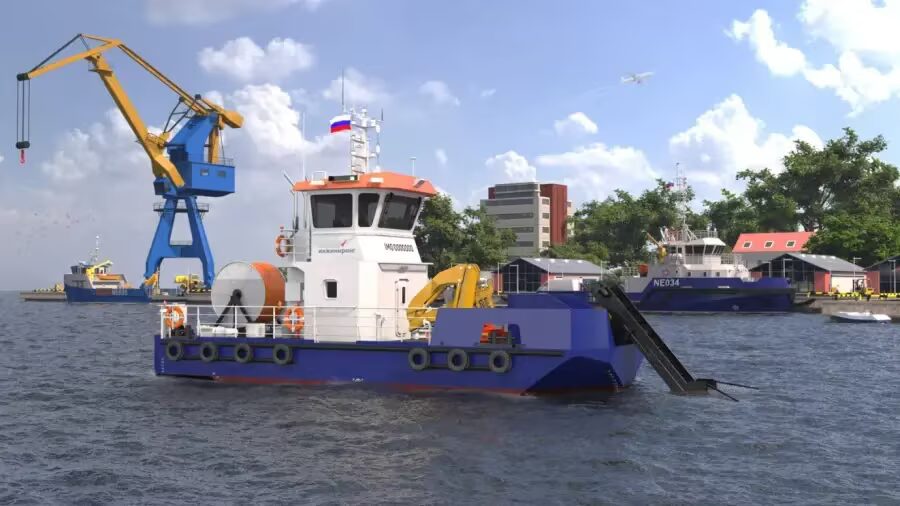
Russia has launched sea trials for the oil and debris collector vessel Eco-1, built at the Onega Shipbuilding and Repair Yard for state port operator Rosmorport. This compact service ship, based on the NE028 design, is tailored for port and coastal operations to swiftly recover oil spills, remove floating trash, and deploy boom barriers. Once testing wraps up, Eco-1 will join Rosmorport’s Northwestern Basin branch for active duty in the Baltic region.
Alexander Solovyov, director of the Onega Shipyard, announced the trial start during a government and Ministry of Transport briefing. The NE028 series consists of two vessels: Eco-1 is the first launched, with the second, the MNMS Lebed, slated for delivery to Rosmorport’s Astrakhan branch on the Caspian Sea.
Design and capabilities of the NE028 oil cleanup vessel Eco-1
The NE028 project targets short-range, everyday operations within port waters rather than long-distance voyages. The vessel’s roles include setting up containment booms, applying reagents to contaminated areas, collecting oil residues with a flash point above 60°C, removing floating debris, and transporting cargo-including containers-on deck. For port services, such a multipurpose vessel streamlines several routine tasks.
- Length: 15.5 meters
- Beam: 6 meters
- Draft: 1.5 meters
- Displacement: approximately 95.7 tons
- Powerplant: twin 120 kW diesel engines
- Speed: minimum 7 knots
- Crew size: 2
- Ice class: Ice1 with AUT3 system
The NE028 features a single-deck design with twin shafts powered by diesel engines. It sports a working deck at the bow, a two-tier wheelhouse, and an aft machinery space. This layout prioritizes maneuverability and quick access to equipment-key for narrow or constrained waterways. Its shallow draft also lets the vessel operate where larger ships cannot venture.
Deployment areas and environmental roles of Eco-1
Rosmorport’s assignment of the vessels reflects their operational zones: the Northwestern Basin covers Baltic ports and approaches, which see heavy maritime traffic alongside stringent environmental regulations. Meanwhile, the Astrakhan branch services the Caspian Sea and river delta regions, where shallow water and restricted navigation demand small, specialized boats.
As Russia’s federal authority overseeing marine safety and infrastructure maintenance in its seaports, Rosmorport relies on vessels like Eco-1 for rapid spill containment and debris cleanup. The faster such a vessel reaches a pollution site, the easier it is to contain the damage and mitigate environmental impact.
The rollout of compact oil debris collectors also aligns with broader fleet modernization efforts. Russian ports handle hundreds of millions of tons of cargo annually-including oil and oil products-which puts ecological safety measures front and center. Despite their modest size, these specialized service vessels are vital operational assets rather than mere regulatory checkboxes.
If trials proceed on schedule, Eco-1 will become the first of two NE028 vessels delivered to Rosmorport. Observers will be watching the MNMS Lebed’s performance next to gauge how well the series meets the practical demands of Russia’s challenging maritime environments.