

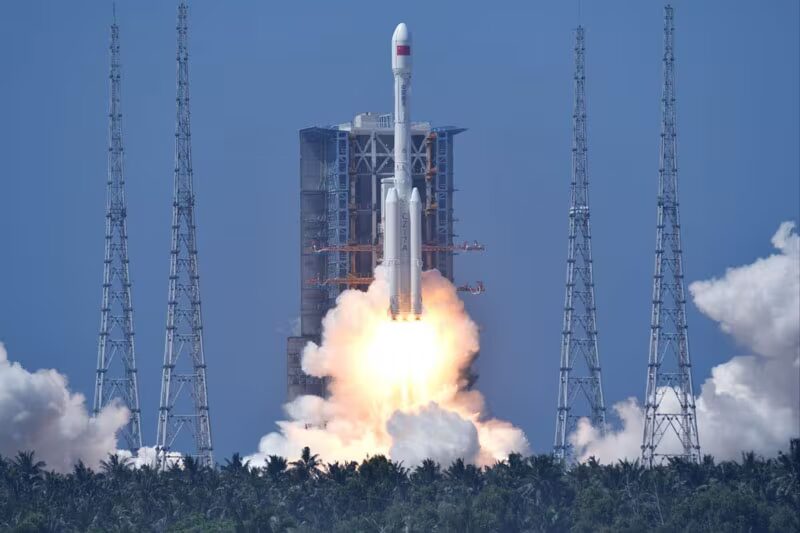
China has successfully tested a new upper-stage liquid rocket engine in space that delivers 750 newtons of thrust, setting a new benchmark in its class. According to China Space News, the engine operated for 11,617 seconds in orbit and logged over 14 hours of total runtime during ground tests-an impressive endurance for upper-stage engines that require multiple firings to place satellites into geostationary orbit.
Developed by the China Academy of Aerospace Propulsion Technology in Xi’an, this engine was installed on the communications satellite 26A, launched on June 23 by a Long March 7A rocket from Wenchang Cosmodrome. After reaching a transfer orbit, the satellite’s propulsion system fired five times to reach geostationary orbit at about 35,800 kilometers altitude.
The headline here isn’t just thrust-it’s lifespan. Chinese engineers initially designed the engine for around 10 hours of operation, but ground tests proved it could exceed 14 hours without a noticeable performance drop. In flight, the specific impulse measured roughly 320 seconds, matching the efficiency of Western engines used for heavy satellite deployment.
Comparison of China’s upper-stage rocket engine with Western counterparts
Compared to international counterparts, China’s new engine looks promising. Europe’s LEROS-1B produces 635 N of thrust, has a specific impulse of 317 seconds, and a qualified operational life of 20,500 seconds (about 5.7 hours). The American Aerojet Rocketdyne R-42DM offers 890 N thrust and 327 seconds specific impulse but has an expected total runtime of around 22,500 seconds-roughly 6.25 hours.
If China’s numbers hold up in regular use, this new engine nearly doubles the operational lifespan of both competitors.
Impact of longer engine life on satellite deployment
For satellite operators, longer engine life isn’t just an impressive stat. Higher thrust and extended runtime mean satellites reach their final orbits faster and consume less propellant during orbital raising. China Space News reports that swapping older 400 N engines for this new 750 N model could cut deployment time for heavy satellites by about 30%.
Considering that geostationary satellites on major platforms often weigh over 5 to 6 tons, such improvements translate directly into mission cost savings.
Future plans for China’s upper-stage rocket engines
Looking ahead, China aims to develop 5,000 N engines for larger spacecraft and orbital tugs. These more powerful chemical engines will support not only heavy communications satellites but also inter-orbital transport systems-a critical capability for expanding China’s presence beyond Earth orbit.
This latest test appears to be the first step in a broader program pushing the limits of upper-stage propulsion technology.