

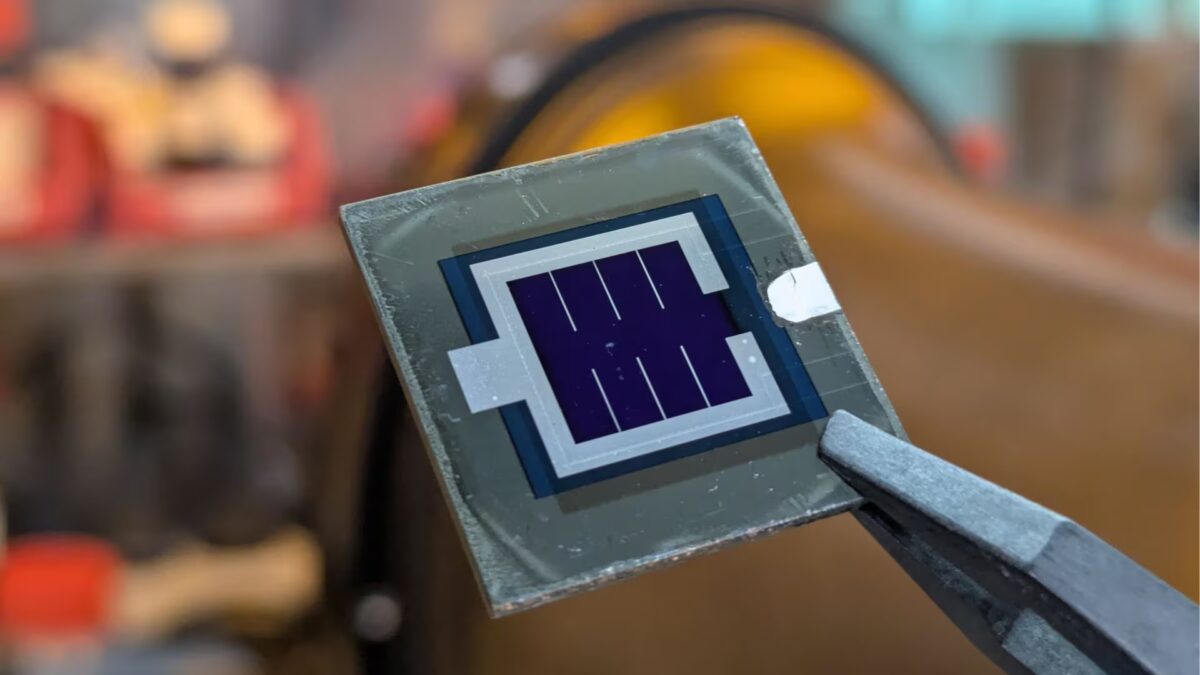
Researchers at Berlin’s Helmholtz Center and Humboldt University have pushed thin-film tandem solar cell efficiency to a new certified record of 25.5%, up from their previous 24.6%. This breakthrough isn’t just about the number-the cell’s active area now exceeds 1 cm², crossing the threshold where lab curiosities become viable for real-world applications.
The tandem cell pairs two materials stacked to harvest different parts of the solar spectrum: a bottom layer of CIGS (copper indium gallium selenide) and a top layer of perovskite. Perovskite absorbs higher-energy photons, while CIGS covers the red and infrared wavelengths, combining strengths to boost overall performance.
This efficiency leap was achieved not by a single breakthrough but through a suite of refinements: tuning the bandgap of the CIGS layer, improving interlayer coatings, and adding ultra-thin (around 1-nanometer) passivation layers. These incremental improvements often make the difference between a promising concept and a commercial-ready solar cell.
Achieving certified efficiency on scalable thin-film tandem solar cells
Besides the single cell, the team demonstrated a mini-module measuring 2.25 cm² with a respectable 19.7% efficiency. This is significant because larger areas tend to reveal stability and scaling challenges that tiny lab cells hide. Solar Cell Efficiency Tables typically highlight results on samples larger than 1 cm² as more realistic indicators of technology readiness than microscopic test spots.
Comparison between CIGS-perovskite and perovskite-silicon tandem cells
In the tandem solar space, this achievement is intriguing. While perovskite-silicon tandems have surpassed 30% efficiency-dominating headlines-CIGS-based tandems offer a different value proposition: lighter, potentially flexible solar cells. High-efficiency single-junction CIGS cells have historically lagged behind these new tandem figures, marking this jump as a significant gain.
Potential applications and future efficiency targets for thin-film tandem solar cells
Scaling this technology to large-area modules that maintain 25%+ efficiency could open doors where traditional silicon panels struggle due to weight or form factor constraints-such as building facades, lightweight roofs, vehicles, and portable electronics. The researchers estimate that cells following this architecture have already reached up to 27.5% in the lab, setting a new target of 30% efficiency as the next milestone.