

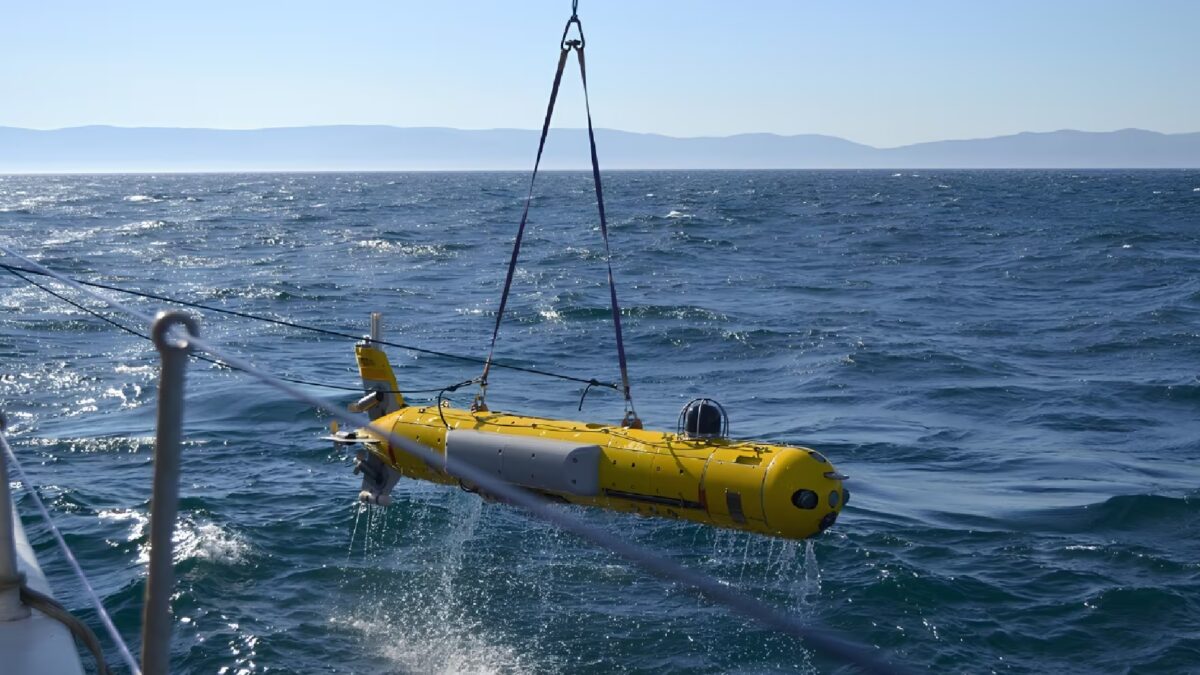
The autonomous underwater vehicle MMT-3500 has completed an unprecedented expedition beneath Lake Baikal, covering nearly 180 kilometers underwater and reaching depths of 1,410 meters. Over multiple missions, the robot collected more than 75 gigabytes of data, navigating challenging areas in the lake’s South Basin. This marks a significant shift for Baikal research, which historically relied on manned or tethered submersibles for deepwater exploration. For the first time, a large volume of scientific data was acquired via an untethered, autonomous platform.
The expedition was conducted by specialists from the Institute of Marine Technology Problems of the Far Eastern Branch of the Russian Academy of Sciences (IPMT FEB RAS), the Limnological Institute of the Siberian Branch of RAS, and the Institute of Dynamics Systems and Control Theory of SB RAS. Operations were launched from the research vessel G. Yu. Vereshchagin. The MMT-3500 itself was built in Vladivostok for oceanic missions but had never before been tested in freshwater environments until now.
Researchers focused on three zones within Baikal’s South Basin, including the mud volcanoes known as ”Malenkiy” and ”Tolstiy,” as well as the waters adjacent to the Baikal Pulp and Paper Mill (BPPM). On one of the technical dives near Cape Kadilny, the robot descended to 1,410 meters-approaching the lake’s maximum depth of 1,642 meters.
Expedition leader Mikhail Makarov reported no clear evidence of environmental harm in the surveyed area from the former BPPM, which ceased operations in 2013. However, analysis of the extensive dataset is ongoing. The condition of bottom sediments and surrounding waters remains a sensitive issue in Lake Baikal conservation debates.
During the expedition, the team gathered high-resolution underwater photographs, side-scan sonar imagery, seabed cross-sections, and multibeam echo sounder measurements. Alexander Pavin, head of the technical vision systems lab at IPMT FEB RAS, highlighted the unprecedented spatial resolution and coverage of the data collected. In comparison, Baikal’s deep bottoms were previously explored in 2008 by the Russian manned submersibles Mir but had never been surveyed at this scale by an autonomous vehicle of this class.
This first deployment confirms that autonomous underwater missions are viable for Lake Baikal. If the ongoing data analysis validates the imaging and mapping quality, the MMT-3500 could become a routine tool for continuous environmental monitoring here-especially in areas where traditional hydrographic surveys provide less detail.
Lake Baikal, located in Siberia, is the world’s deepest and oldest freshwater lake, holding about 20% of the planet’s unfrozen surface freshwater. Its unique ecosystem has long drawn scientific attention, but the harsh conditions and extreme depths limit accessible research methods. Autonomous underwater vehicles (AUVs), like the MMT-3500, which are common in oceans, have only recently started making headway in such freshwater environments. Internationally, firms like Bluefin Robotics and Saab Kongsberg have popularized AUVs for ocean exploration and monitoring; this Russian-built vehicle’s success adds a new chapter to autonomous freshwater research.
The expedition’s ability to map the seabed in fine detail while covering large areas places it ahead of many conventional approaches. Regular autonomous surveys could significantly improve environmental assessments, pollution tracking, and the study of geological features within Baikal. As concerns about legacy industrial pollution persist, especially from facilities like the Baikal Pulp and Paper Mill, precise and frequent data collection becomes critical.
Looking ahead, the key question is how quickly and widely autonomous underwater vehicles will be integrated into freshwater research programs beyond Baikal. Will the MMT-3500’s performance inspire similar deployments across other vast lakes worldwide? Its initial success certainly opens doors for more scalable, less labor-intensive environmental monitoring solutions in challenging aquatic ecosystems.