

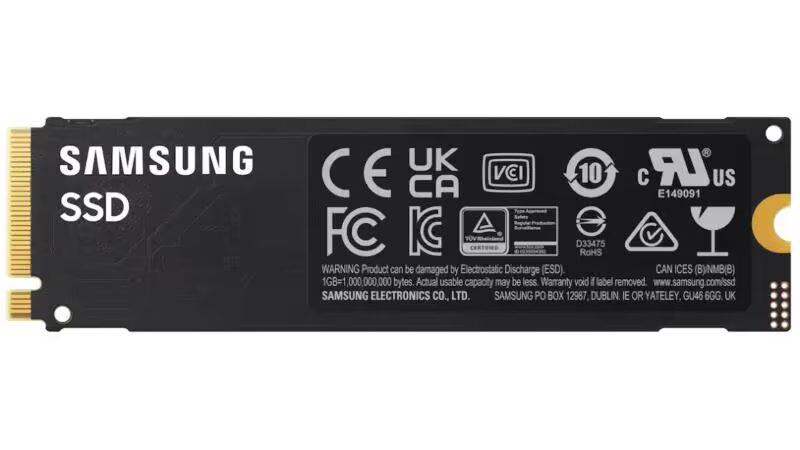
Samsung is preparing a new consumer SSD called the 990, positioned below its flagship 990 PRO line. This DRAM-less PCIe 4.0 NVMe drive targets a more affordable segment, trading the onboard DRAM buffer for Host Memory Buffer (HMB), which borrows system RAM to help manage data. The 990 briefly appeared on Samsung’s Canadian website in 1TB and 2TB models before the pages were pulled.
Essentially, Samsung aims to fill the gap between entry-level SSDs and its premium 990 PRO series. Using HMB instead of dedicated DRAM reduces manufacturing costs and complexity-a strategy already common among budget SSDs. However, such drives generally fall short under heavy sustained workloads and mixed-use cases compared to those with onboard DRAM buffers.
The Samsung 990 features the company’s own 3D V-NAND paired with a proprietary controller. The 1TB version boasts sequential read and write speeds up to 7,150 MB/s and 6,450 MB/s, respectively. The 2TB model increases read speed slightly to 7,250 MB/s while maintaining the same write speed of 6,450 MB/s.
Samsung 990 SSD specifications
- Interface: PCIe 4.0 NVMe
- Capacities: 1TB and 2TB
- Memory: Samsung 3D V-NAND
- Cache: HMB (no onboard DRAM)
- Sequential Read Speed:
- 1TB: up to 7,150 MB/s
- 2TB: up to 7,250 MB/s
- Sequential Write Speed: up to 6,450 MB/s (both capacities)
- Random IOPS (2TB): up to 850,000 read / 1.2 million write
- Warranty: 3 years
- Endurance:
- 1TB: 400 TBW
- 2TB: 800 TBW
Compared to the 990 PRO, the new 990 falls short in endurance and warranty. The 990 PRO offers sequential speeds up to 7,450 MB/s read and 6,900 MB/s write, a 5-year warranty, and endurance up to 1,200 TBW on the 2TB variant. Samsung’s 990 clearly targets the fast-but-affordable tier of PCIe 4.0 drives rather than premium enthusiasts.
Samsung has taken a similar approach before with the 980 SSD-also DRAM-less but limited to PCIe 3.0 and lower speeds. The SSD market has evolved since then. Budget drives without DRAM buffers now regularly approach PCIe 4.0 speed ceilings. Competitors like Lexar’s NM790 and WD Blue SN580 already occupy this value segment, so Samsung appears to be catching up to a segment it previously underrepresented.
Samsung hasn’t announced a release date or pricing. The important factor will be how the 990’s cost compares to the 990 PRO. If the price difference is minimal, buyers will likely opt for the proven durability and longer warranty of the PRO. But if Samsung positions the 990 aggressively among mainstream PCIe 4.0 SSDs, it could become a compelling choice in the high-capacity consumer drive segment.
Overall, the Samsung 990 shows the company’s continued push to democratize PCIe 4.0 performance with budget-conscious compromises. It will be interesting to see how the SSD performs under real-world workloads without DRAM and how it stacks up against similarly priced rivals in a segment growing increasingly competitive.