

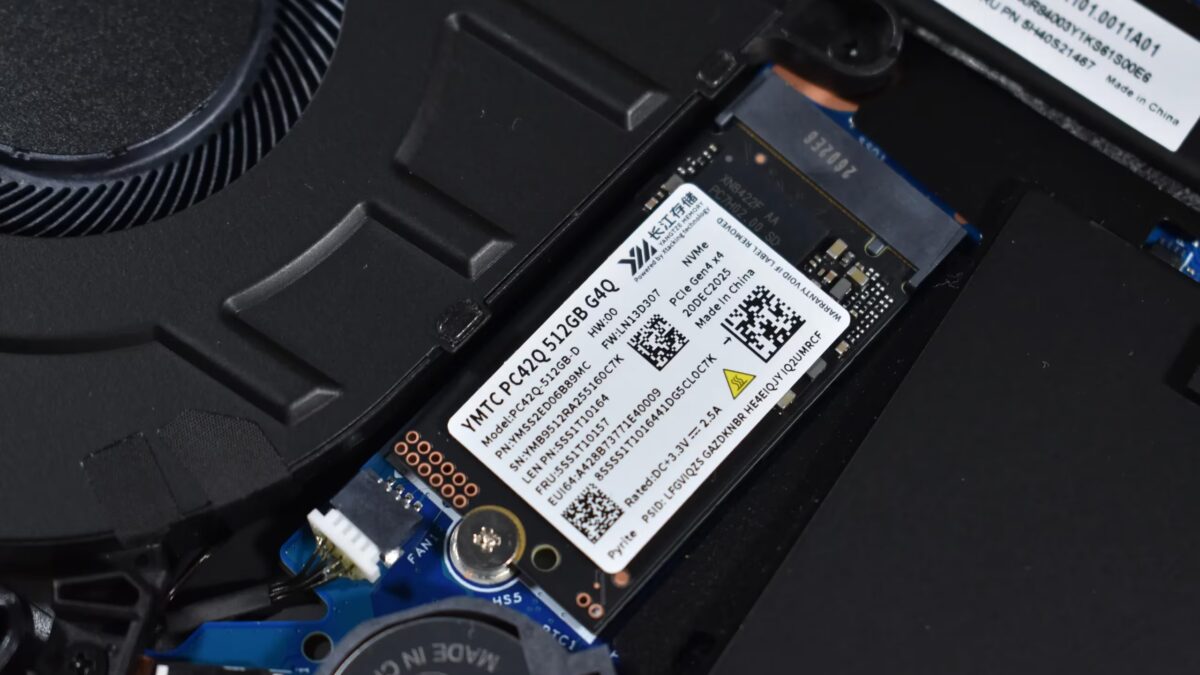
Lenovo has begun shipping mass-market ThinkBook 14 laptops equipped with SSDs from China’s Yangtze Memory Technologies (YMTC), marking a significant shift in its supply chain. Notebookcheck spotted YMTC drives in a specific ThinkBook 14 Gen 9 IPL configuration – a departure from the Samsung, Kioxia, or Western Digital SSDs Lenovo typically uses in this segment.
The tested ThinkBook 14 Gen 9 IPL model packs a 512GB M.2 2242 SSD with a PCIe 4.0 NVMe interface. On paper, the drive supports modern standards, but benchmark results fall short of what’s expected in this class. Sequential read speeds hovered around 3950 MB/s, and writes reached up to 2514 MB/s. Under sustained load, performance throttled noticeably, and 4K random read/write speeds lagged behind the average for business laptops.
These numbers aren’t surprising given the compact M.2 2242 form factor. Shorter SSDs often struggle with heat dissipation and have fewer controller options compared to the more common 2280 modules. Still, many OEM PCIe 4.0 drives in similar laptop segments already push beyond 5000 MB/s read speeds. The performance gap with YMTC’s SSD shows up in longer file transfers and mixed workloads, where the drive reduces speed earlier than competitors.
YMTC’s appearance in Lenovo laptops fits a broader memory industry trend. PC makers have been hunting for alternative NAND suppliers over recent quarters as prices rise and production capacity shifts toward AI server components. Despite U.S. export restrictions since 2022 limiting YMTC’s access to some equipment and partnerships outside China, the company remains a major player domestically.
For Lenovo, this change matters given its enormous scale. It has held the top spot in global PC shipments for years, with IDC and Gartner estimating the company controls about a quarter of worldwide deliveries. Should YMTC SSDs expand beyond isolated ThinkBook 14 configurations into broader ThinkBook and IdeaPad lines, this wouldn’t just be a one-off supplier swap-it could open a significant new channel for Chinese NAND in mainstream laptops.
This move raises a key question for the competitive SSD landscape: can YMTC improve performance and reliability enough to challenge established players in the global laptop market? Given how critical SSD speed and endurance are to user experience, Lenovo’s adoption signals a cautious but bold bet on China’s NAND industry, even amid geopolitical headwinds and ongoing supply chain volatility.
Performance of YMTC SSDs in Lenovo ThinkBook 14 Gen 9 IPL
The YMTC SSD in the ThinkBook 14 Gen 9 IPL model is a 512GB M.2 2242 PCIe 4.0 NVMe drive. Key performance details include:
- Sequential read speeds: approximately 3950 MB/s
- Sequential write speeds: up to 2514 MB/s
- Noticeable throttling under sustained load
- Lower 4K random read/write speeds compared to average business laptops
Impact of SSD form factor on performance
The compact M.2 2242 form factor contributes to the reduced performance of YMTC’s SSDs. This shorter design limits heat dissipation and restricts controller choices compared to the common M.2 2280 modules used in many laptops.
Industry trends driving Lenovo’s choice of YMTC SSDs
Manufacturers are exploring alternative NAND suppliers like YMTC amid rising prices and shifting production toward AI server components. Despite U.S. export restrictions limiting YMTC’s access to some equipment since 2022, the company remains a key player in China’s domestic memory market.
Lenovo’s global PC shipment dominance and supply chain shifts
Lenovo leads global PC shipments, controlling about 25% of worldwide deliveries according to IDC and Gartner. If YMTC SSDs expand beyond select ThinkBook 14 models, Lenovo’s adoption could open a significant new channel for Chinese NAND products in mainstream consumer and business laptops.
Future outlook for YMTC SSDs in the laptop market
The essential question remains whether YMTC can improve SSD speed and reliability to compete with established global players. Lenovo’s use of YMTC SSDs demonstrates a cautious but strategic commitment to China’s NAND industry despite geopolitical challenges and supply chain uncertainties.