

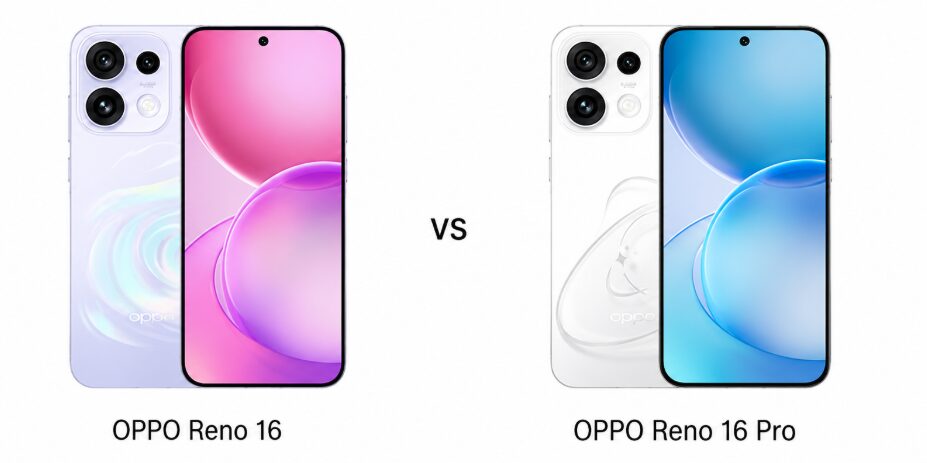
The OPPO Reno 16 and Reno 16 Pro look like twins, but the Pro is doing the heavy lifting where it counts: faster display refresh, a stronger chipset, a much bigger main camera sensor, and more aggressive slow-motion video modes. If you were hoping for a dramatic redesign, OPPO did not bother; if you wanted a more expensive phone that actually earns the badge, that is the one you are looking at.
Both phones stick with a premium build, IP68 and IP69 protection, stereo speakers, an in-display fingerprint scanner, and ColorOS 16. That sameness is part of the pitch: one model for buyers who want the essentials done well, and one for people who will pay extra for the bits you can feel in games, photos, and on the spec sheet.
OPPO Reno 16 display and design are almost unchanged
On paper, the screen difference is simple. Both phones use a 6.32-inch AMOLED panel with 1216 × 2640 resolution, HDR10+ support, peak brightness up to 3,600 nits, and Crystal Guard protection. The Reno 16 runs at 120Hz, while the Reno 16 Pro pushes that to 144Hz, which should feel a bit snappier in scrolling and gaming, even if it is hardly a night-and-day leap for casual use.
The chassis story is just as restrained. You get the same glass front and aluminum frame, with either a glass or composite plastic back depending on the variant. In other words, OPPO is not charging you for nicer materials; it is charging you for the hardware tucked underneath them.
Chipset and battery differences
This is where the gap gets more interesting. The Reno 16 uses Snapdragon 7 Gen 4, while the Reno 16 Pro moves to MediaTek Dimensity 8550 Super with higher CPU frequencies and a more capable Mali-G720 MC8 GPU. The Pro also starts at 12GB RAM, whereas the standard model comes in 8GB and 12GB versions, so the cheaper phone is already fighting with one hand tied behind its back.
Battery capacity is shared: 6,700mAh silicon-carbon internationally, or 6,000mAh in Europe. Charging is also close, with 80W wired charging and 55W PPS on both devices, while the Pro adds UFCS support and finishes a little faster. That is nice, but not the reason to spend more.
- Reno 16: Snapdragon 7 Gen 4, 8GB or 12GB RAM
- Reno 16 Pro: Dimensity 8550 Super, 12GB RAM starting point
- Both: 6,700mAh battery internationally, 80W wired charging, 55W PPS
The Reno 16 Pro camera upgrade is the real headline
OPPO saved the biggest flex for the camera department. The Reno 16 pairs a 50MP main camera with a 50MP telephoto lens offering 3.5x optical zoom and a 50MP ultrawide camera. The Reno 16 Pro swaps in a 200MP main sensor, keeps the same 50MP telephoto and ultrawide cameras, and adds far more ambitious video options, including 1080p recording up to 480fps and 720p slow motion at 960fps.
The selfie setup does not change: both phones use a 50MP autofocus ultrawide front camera with 4K video recording at up to 60fps. So if your phone life revolves around selfies and video calls, the standard model gives away less than you might expect.
Reno 16 price versus Reno 16 Pro price
The Reno 16 is priced around $600 (₹62,000), while the Reno 16 Pro lands around $830 (₹71,000). That roughly $230 jump buys the faster chipset, the 200MP main camera, the 144Hz display, more RAM out of the gate, and expanded video recording. This is a classic tiered smartphone strategy: keep the base model broad, make the Pro feel genuinely premium, and hope buyers do not get too distracted by how close the two phones look.
For everyday use, the standard Reno 16 already sounds plenty capable. The Pro is the one for users who care about gaming headroom, heavier multitasking, and camera specs that can bully their way into the marketing material. The real question is whether those upgrades are worth the extra cash, or whether OPPO has made the vanilla model strong enough to steal its own thunder.