

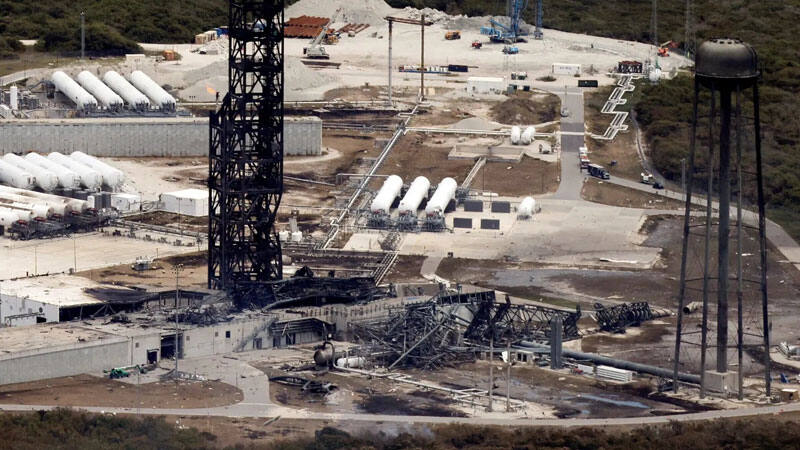
Blue Origin has decided not to restore its destroyed LC-36 launch pad in its old format. Instead, the Florida site will be reworked for a more powerful New Glenn configuration, and the company says that approach could put the rocket back on the pad before the end of the year.
The move is a blunt admission that rebuilding for yesterday’s hardware would waste time. A faster return matters here because Blue Origin is trying to stay in the race against rivals already pushing hard on reusable heavy-lift launchers, while its own commercial and NASA ambitions depend on proving New Glenn can fly reliably and often.
LC-36 will be rebuilt for New Glenn 9 × 4
The new setup is built around an ”enhanced” New Glenn in a 9 × 4 configuration: nine engines on the first stage and four on the second, instead of the current 7 × 2 layout. That is the sort of upgrade that forces a rethink of ground hardware, not just software and wishful thinking.
Blue Origin says the new launch flow will use a hybrid horizontal-vertical architecture. Stages will be mated horizontally inside the assembly hangar, then moved to the pad, where a special crane will raise the rocket upright. The transporter’s job is effectively over, and rebuilding that system quickly was apparently off the table.
What the May 28 static-fire explosion destroyed
The change follows the May 28, 2026 static-fire accident, when a fully assembled New Glenn was strapped to the pad and testing ended in a major explosion. No one was hurt, and the Amazon Leo satellites that were supposed to fly on the rocket had not yet been installed.
According to Blue Origin, the blast took out the lightning tower, transporter-erector, and hydraulic cylinders. The fuel system, integration building, rocket access tower, and water system were left usable, which is the difference between a bad week and a months-long rebuild.
Investigators are looking at the first stage aft section
Dave Limp said the investigation is still underway, but the early evidence points to the rear section of the first stage, where the engines, lines, valves, hydraulics, and booster recovery controls are located. Blue Origin also says the rocket carried enough sensors and cameras to give investigators the telemetry they need.
That matters because launch failures often turn into archaeology unless the hardware was instrumented properly. Blue Origin seems to have at least done that part right, even if the rest of the day was spectacularly wrong.
Blue Origin wants New Glenn flights back by the end of the year
By abandoning the old transporter-based setup, Blue Origin is betting it can regain launch cadence faster than it could by recreating the original pad machinery. Jared Isaacman said during a NASA briefing that the company is determined to get New Glenn flying again before the end of the year, adding that the agency has time until 2027 before it starts getting nervous.
The open question is whether the new 9 × 4 version arrives as a clean fix or a moving target. If the pad rebuild and rocket upgrade stay aligned, Blue Origin gets a faster path back to orbit; if they drift apart, the company could spend the rest of the year explaining why ”enhanced” also means ”delayed.”