

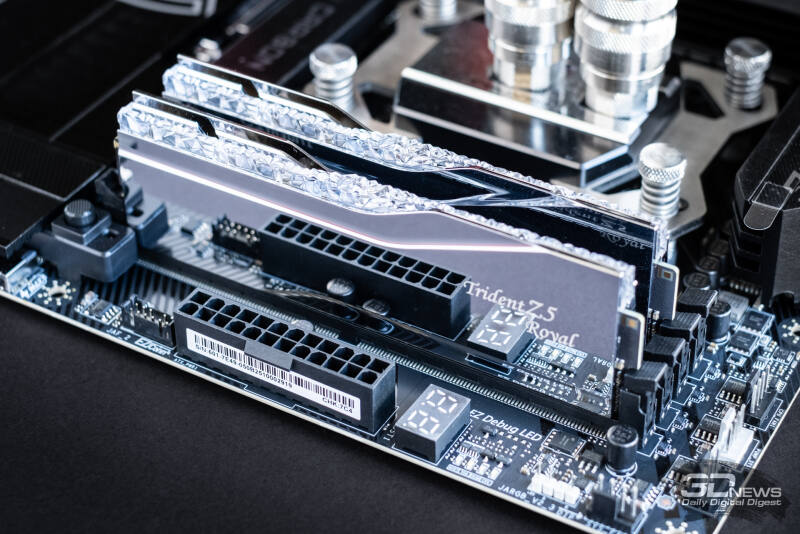
Big-memory DDR5 kits have stopped being a luxury only in the sense that everyone now wants them and almost nobody wants to pay for them. G.Skill’s Trident Z5 Royal DDR5-6400 CL32 64GB is a good example: on Ryzen, it can squeeze out a little extra bandwidth and slightly better latency than a more ordinary 32GB kit, but the gains are modest enough that the real selling point is capacity, not heroics.
That matters because desktop memory has quietly become one of the most expensive parts of a gaming PC, and 64GB kits now sit firmly in premium territory. At the same time, the broader market keeps drifting toward smaller configurations, even as content creators, local AI users, and heavy multitaskers still have a legitimate reason to buy bigger modules. The irony is that the expensive option is not always the fastest one, especially on AMD’s Socket AM5 platform.
What the G.Skill Trident Z5 Royal DDR5-6400 CL32 64GB offers
The kit under review, F5-6400J3239G32GX2-TR5S, uses two 32GB modules rated for DDR5-6400 at 32-39-39-102 and 1.40V with Intel XMP 3.0. It is built on SK hynix A-die chips and comes from G.Skill’s Royal line, which is basically the Trident Z5 RGB family dressed for a black-tie event, with mirrored heatsinks and a crystal-like diffuser on top.
Despite the jewelry-store look, the modules are not unusually tall at around 44 mm, so most dual-tower coolers should clear them with minimal fuss. That is the sort of practical detail many bling-heavy memory kits forget to mention while busy reflecting the entire room back at you.
- Capacity: 64GB, split across 2 × 32GB DDR5 DIMMs
- Rated speed: DDR5-6400
- Timings: 32-39-39-102
- Voltage: 1.40V
- Profiles: Intel XMP 3.0 only
- Warranty: lifetime
Ryzen DDR5 latency matters more than headline speed
On paper, DDR5-6400 looks like a nice step up from the popular DDR5-6000 CL30 kits. In practice, Ryzen is fussy in a very specific way: once memory speed climbs too far, the benefit flattens out and latency starts doing the heavy lifting instead. That is why the test setup mattered so much – the controller had to run in synchronous mode, and the kit had to be tuned beyond its stock XMP profile to show its best side.
G.Skill’s 64GB kit did exactly what a strong dual-rank design should do. In synthetic memory benchmarks, it gained roughly 6% in read and write performance versus a comparable 2 × 16GB setup, while copy performance improved by about 2%. After manual tuning, the lead widened further, with read and write throughput rising by around 12-15% versus the stock XMP settings and latency dropping by more than 10 ns.
Manual tuning changes the picture
The stock profile is only the beginning here. With manual tuning, the timings were tightened from 32-39-39-102 to 30-38-38-50, while tRFC was cut from 943 to 400 cycles. That is a serious reduction, and it shows why high-end SK hynix-based kits still attract tinkerers: the chips have room to move, even when the module layout itself limits raw frequency overclocking.
There is a catch, of course. Dual-rank DIMMs put more strain on the memory controller, so the frequency ceiling is lower than with a conventional 2 × 16GB setup. In this case, the kit topped out at DDR5-7000, which is respectable but nowhere near the silly-high numbers that single-rank enthusiasts chase for bragging rights and forum signatures.
Where 64GB actually helps
In applications, the story is less dramatic than the spec sheet suggests. Across photo editing, video work, rendering, and compilation, the gain from moving to the 64GB dual-rank kit was usually only one or two percent. The real exception was local AI inference, where manual tuning lifted Llama 3.1 8B performance by more than 14% – a reminder that latency-sensitive workloads care far more about memory behavior than marketing-friendly capacity numbers.
Games were even less impressed. Average frame rates mostly stayed within a few percent of the DDR5-6000 CL30 reference, and the bigger module set only really showed a small edge in minimum frame rates. That makes sense: modern Ryzen chips react more strongly to tighter timings than to brute-force bandwidth, so the best gaming result is often the one that looks the least exciting on a product page.
The upshot is simple. If you need 64GB on Ryzen, a premium 2 × 32GB kit like this one makes more sense than populating four slots with 16GB modules, which is harder on the controller and usually worse for frequency scaling. If you only want a cheap FPS boost, this is not the place to look. If you want a no-compromise memory kit for a high-end AM5 build, it is one of the few that can justify its existence – if not its price tag.