

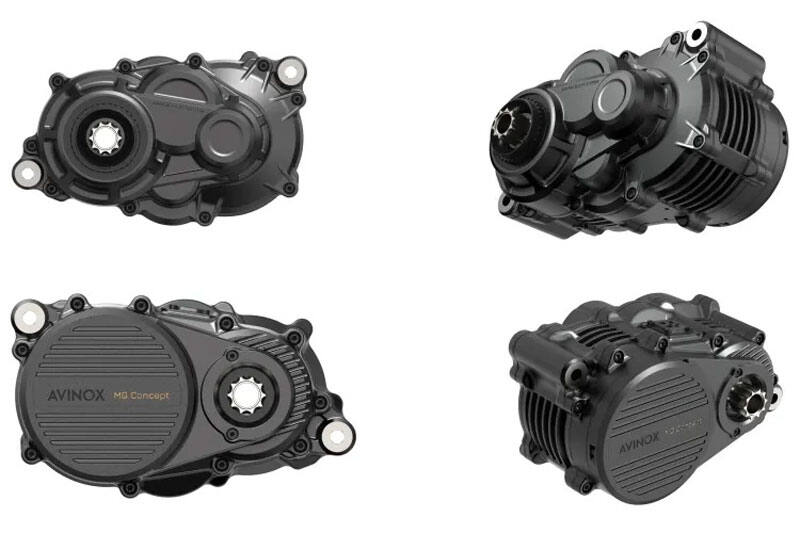
At Eurobike in Frankfurt, two Chinese companies showed where e-bikes may be heading next: away from the clunky chain-and-cassette setup and toward a single central unit that handles both motor and shifting. DJI’s Avinox and the younger Gobao are both pushing motor gearbox unit designs with built-in electronic continuously variable transmission, or eCVT, which means no familiar rear derailleur, no multi-sprocket cassette, and a lot less mechanical drama.
That is a big deal for e-bikes because the drivetrain has long been the awkward bit bolted onto otherwise elegant frames. If these systems hold up in the real world, they could reduce maintenance, simplify frame design, and make premium e-MTBs easier to live with – which is exactly the kind of upgrade riders notice after the first muddy weekend, not after the press release.
Avinox MGU aims at premium e-bikes first
Avinox’s MGU is still a concept, but the company says production should begin in 2027. The headline numbers are eye-catching:
- Roughly 520% transmission range
- Shifts in less than 0.1 seconds
- Operation under heavy load
- Ability to shift while stationary
- Compatibility with both chain and belt drive
The concept did not appear in a vacuum. Canyon, Commencal, Forbidden, and Mondraker helped develop it and showed prototype frames for the new drive system, which suggests Avinox is chasing a top-end launch rather than a broad midmarket rollout. That is a sensible play: new drivetrain tech usually enters the market at the expensive end, where buyers are more forgiving and margins are nicer.
Gobao brings near-production specs
Gobao’s take looks closer to something that could reach shops sooner. Its MGU X1 delivers up to 120 Nm of torque and 1200 W of peak power with a 400% shift range, while the X1P goes up to 150 Nm and 1500 W with a 500% range. Both units weigh 3.85 kg, support cadences above 120 rpm, and are planned for versions capped at 25 km/h or 45 km/h. Gobao also calls them maintenance-free, which is a bold claim in a category where riders tend to discover every weakness through mud, rain, and impatience.
The company is pairing those motors with 500 Wh, 750 Wh, and 900 Wh batteries that support 30 A fast charging. A 750 Wh pack, Gobao says, can go from 0 to 80% in 28 minutes. Fast charging matters here because one of the traditional objections to heavier, more integrated e-bike systems is that they become a little too dependent on a perfect charging routine.
What eCVT could change on the bike
Compared with today’s motors that hide a limited set of fixed ratios, these MGUs promise effectively endless, seamless changes in gearing. Riders can either choose virtual gears themselves or just set a preferred cadence and let the motor decide how to keep the bike in the right zone. That should make climbing, commuting, and cargo hauling feel simpler, while also moving weight toward the center of the bike for better balance.
- Avinox MGU: about 520% range, under 0.1-second shifting, shift while stopped
- Gobao X1: 120 Nm, 1200 W, 400% range
- Gobao X1P: 150 Nm, 1500 W, 500% range
- Both Gobao units: 3.85 kg, cadence above 120 rpm, 25 km/h or 45 km/h versions
The open question is less about whether this idea is clever – it is – and more about how expensive, durable, and serviceable it turns out to be. If the systems survive years of abuse, expect them to spread first through high-end mountain e-bikes, then into city, cargo, and family models. If not, the classic derailleur will keep clattering away, stubborn as ever.