

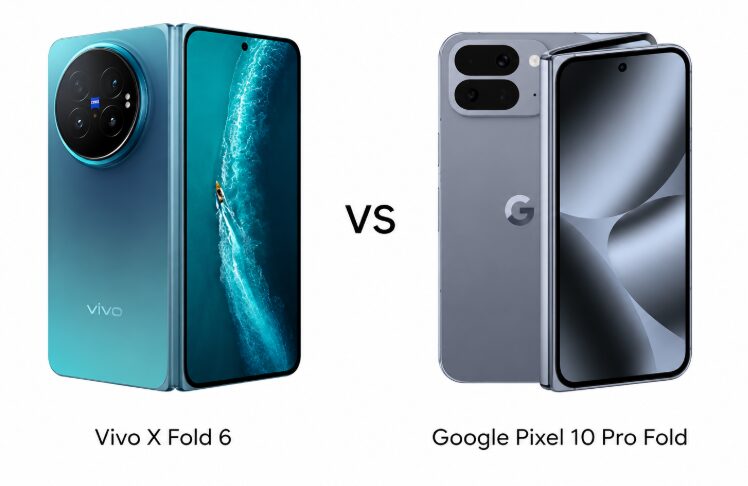
If you go by the spec sheet, Vivo just pulled a very non-Google move: it made the more convincing foldable. The Vivo X Fold 6 is cheaper than the Google Pixel 10 Pro Fold, has a bigger battery, faster charging, a higher-resolution camera system, and brighter inner and outer displays. Google’s Pixel 10 Pro Fold still fights back with tougher protection, smarter connectivity, and years of software support, but the price gap is hard to ignore.
That split says a lot about the foldable phone market right now. One camp is chasing hardware bragging rights; the other is charging extra for software, AI, and long-term peace of mind. Vivo is clearly betting that most buyers will notice the battery first.
Vivo X Fold 6 display and build
Both phones use premium materials and both are built for more than the occasional coffee-table flex. Vivo’s X Fold 6 carries IP58/IP59 protection, while the Pixel 10 Pro Fold steps up to IP68, which is the stronger badge for dust and water resistance.
Vivo counters with an 8.02-inch LTPO AMOLED inner display, Dolby Vision, HDR Vivid, HDR10+, and a 5,000-nit peak cover screen. Google’s 8-inch LTPO OLED panel is still very good, with 120Hz refresh and 3,000-nit peak brightness, but Vivo has the more aggressive display spec sheet and the sharper panel on paper.
Battery life is the easy win
Here’s where the argument gets lopsided. The Vivo X Fold 6 packs a 7,000mAh silicon-carbon battery with 80W wired charging, 40W wireless charging, and reverse wired and wireless charging. The Pixel 10 Pro Fold has a 5,015mAh battery, 30W wired charging, 15W Qi2 magnetic wireless charging, bypass charging, and PPS support.
Google’s extras are tidy and modern, but they don’t change the math: Vivo should last longer and refill far faster. For a folding phone, that matters more than another neat software trick that lives in a demo video.
Camera specs and pricing tilt the table
The camera split follows the same pattern. Vivo uses a 200MP main sensor, a 50MP 3x periscope telephoto, and a 50MP ultrawide lens with Zeiss optics, Zeiss T* coating, Laser AF, and 8K video recording. Google sticks with a 48MP main camera, a 10.8MP 5x telephoto, and a 10.5MP ultrawide, then leans on Best Take, Ultra HDR, Pixel Shift, and Zoom Enhance to do the heavy lifting.
Vivo also includes dual 20MP front cameras, while Google goes with 10MP autofocus selfie cameras that can record 4K video. So the choice is simple enough: more camera hardware and higher resolution from Vivo, or Google’s usual computational polish.
Then there’s the price. Vivo is listed around $1,200 (₹111,000), while Google is around $1,800 (₹160,000). That roughly $600 gap buys you Ultra Wideband, Satellite SOS, eSIM support, and Google’s seven years of Android upgrades – sensible extras, but not exactly cheap extras.
For buyers who want the best hardware per dollar, Vivo is the smarter buy. Google still looks like the more polished software-first foldable, but unless you place a premium on Pixel features and update policy, the X Fold 6 makes the cleaner case. The real question is whether foldable shoppers are finally ready to punish the brand that asks for more and gives less battery.