

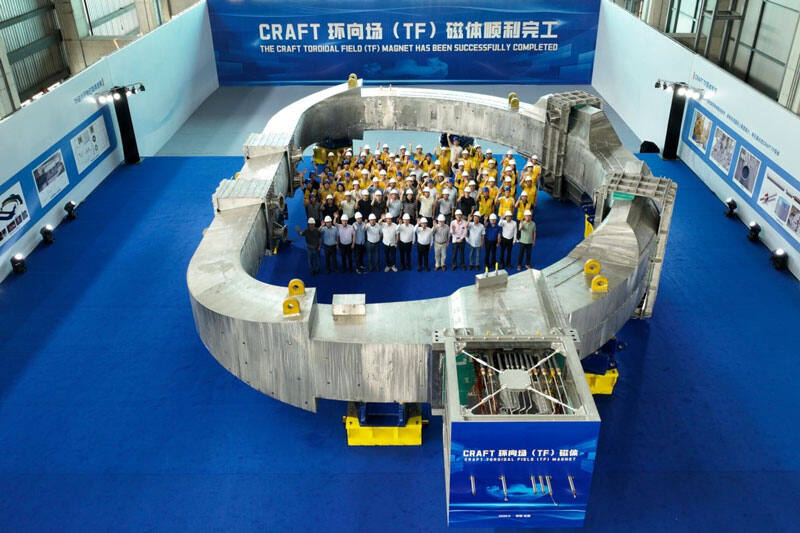
China says it has finished final tests on what it describes as the world’s largest superconducting magnet for a fusion reactor, a milestone that pushes the country closer to industrial-scale fusion hardware while Europe’s ITER project is still under construction. The hardware was built under CRAFT in Hefei, and the message is hard to miss: Beijing is no longer just learning from ITER; it is trying to outrun it.
The headline part is size, but the more interesting part is maturity. A single D-shaped toroidal-field coil took six years to make, which sounds glacial until you remember this is a prototype designed to prove the manufacturing chain. If China can turn the next units out faster, that is the difference between a laboratory trophy and an actual reactor system.
A coil bigger than ITER’s
Each TF-coil measures 21 × 12 × 3.3 m and weighs 582 tons. That is 1.3 times larger than the toroidal magnets used in ITER, and the stored magnetic energy is three times higher. In fusion, bigger does not automatically mean better, but it does signal that Chinese engineers are comfortable scaling a notoriously finicky technology.
The coil is only one half of the story. China also says it has built and tested a central solenoid, the component that induces current in the reactor chamber and helps create plasma in the first place. According to CGTN, it passed full-load testing at 60 kA with stored energy of 6.03 MJ. ITER’s central solenoid is rated for up to 46 kA, so this is not a polite warm-up act.
Why CRAFT matters more than the headline
CRAFT, short for Comprehensive Research Facility for Fusion Technology, is doing the unglamorous work that decides whether fusion remains a science project. It sits between ITER, the French experiment still heading toward operation, and DEMO, the European concept for a future power plant. China is using it as a manufacturing and testing ground for CFETR, the China Fusion Engineering Test Reactor planned for the mid-2030s.
That sequencing matters. Fusion programs usually get judged by plasma milestones, but the real bottleneck is industrial repeatability: magnets, cooling, tolerances, maintenance, and the ability to make the same expensive thing more than once. China’s advantage is that it is trying to build the supply chain and the reactor path at the same time.
From T-7 to BEST
China’s fusion program started with the T-7 tokamak bought from Russia in the 1990s, later followed by HT-7. Then came EAST in 2006, the country’s first homegrown superconducting tokamak. Its successor, the Burning Plasma Experimental Superconducting Tokamak, or BEST, is expected to see first plasma in 2027.
- TF-coil size: 21 × 12 × 3.3 m
- TF-coil mass: 582 tons
- Central solenoid current: 60 kA
- Central solenoid stored energy: 6.03 MJ
The awkward question now is whether China can compress those six-year build cycles without sacrificing reliability. If it can, the country will not just have a big fusion machine; it will have the one thing the field has struggled to produce for decades: a plausible path from experiment to power plant.