

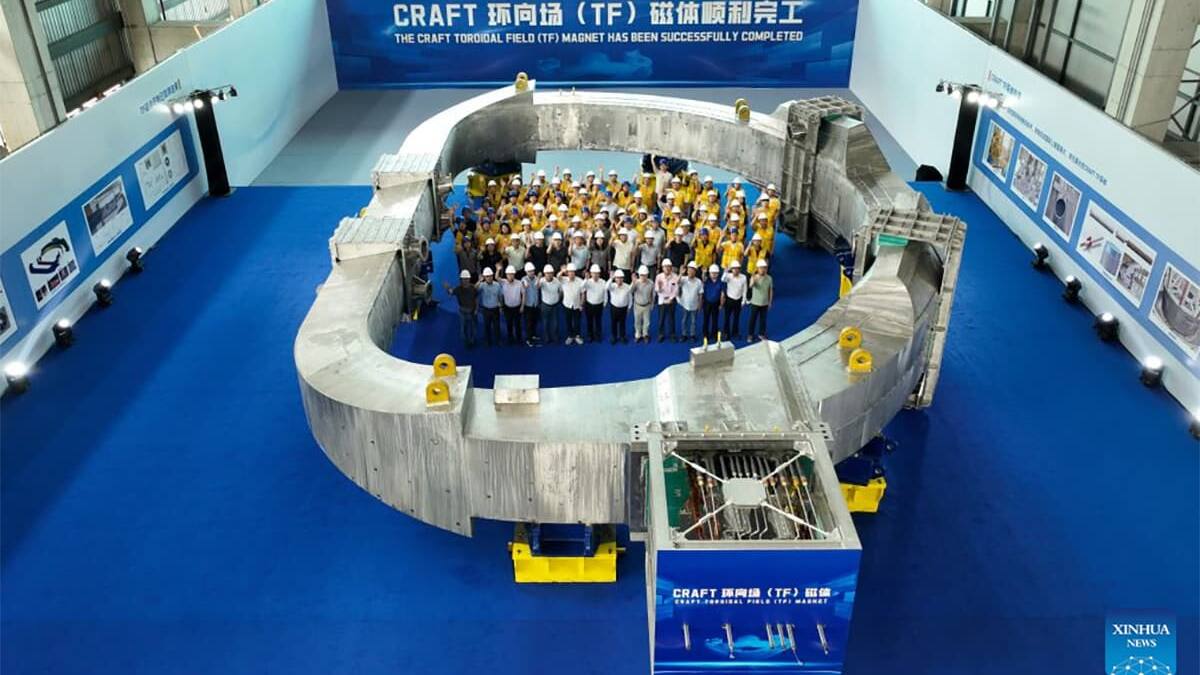
China says it has cleared a major hardware milestone on the road to fusion power: researchers have finished testing the world’s largest superconducting magnet system for a future reactor. The system is meant to help confine plasma hotter than 100 million °C, a temperature range where ordinary materials would fail almost instantly and where magnet tech matters as much as the plasma physics. The work comes from the Institute of Plasma Physics under the Chinese Academy of Sciences and feeds into CRAFT, a fusion technology facility tied to the EAST tokamak, often nicknamed the ”artificial sun.”
That pairing is smart: EAST has been China’s visible fusion testbed, while CRAFT is the less glamorous but more decisive factory for the hardware that commercial plants would actually need. China’s latest test suggests it is trying to turn fusion research into a domestic manufacturing chain, not just a set of lab demonstrations.
China’s giant superconducting fusion magnet
The headline part is the toroidal superconducting magnet, the core of the magnetic cage that keeps plasma suspended inside a reactor. China says the unit measures about 21 meters long, 12 meters wide, and 3.3 meters high, with a mass of 582 tons. The developers also say it is about 1.3 times larger than the comparable element in ITER and can store roughly three times as much energy.
That size race is not just bragging rights. Fusion hardware has always been a game of scaling pain: stronger fields, bigger structures, nastier engineering tolerances. ITER has spent years showing how hard that gets, so Beijing’s pitch is that it can now build the plumbing domestically rather than import the most delicate pieces one by one.
The central solenoid passed a tougher-than-design test
China also reported successful testing of the central solenoid, the component that starts and controls the plasma current. It is designed for an operating current of 46.5 kiloamperes, but during testing it withstood 60 kiloamperes. That kind of overperformance is the sort of result engineers like to put in bold type, and for once they have a reason.
According to the institute, the magnet project took six years and relied on materials made in China, including special steel, insulation, and superconducting wire. For a country trying to move from ”we can build experiments” to ”we can build a supply chain,” that is the more interesting part of the story.
What China is really building
A full reactor would use 16 toroidal magnets like this one, each rated for currents up to 100 kiloamperes and magnetic fields reaching 6.5 tesla at the reactor’s center. That is the sort of infrastructure that separates fusion headlines from fusion power stations: the science is hard, but the industrial repeatability is what decides whether it becomes a grid asset or stays a very expensive laboratory habit.
The broader trend is familiar even if the rhetoric changes from country to country. China, the US, Europe, and private labs are all chasing fusion, but the teams that can mass-produce magnets, cryogenics, and reactor components without treating every build like a moon landing are the ones most likely to get there first.
The next question is whether these magnets translate into longer plasma runs, better stability, and a reactor design that can be built more than once. That is the real exam, and fusion has a long history of passing the engineering quiz while still failing the commercial one.