

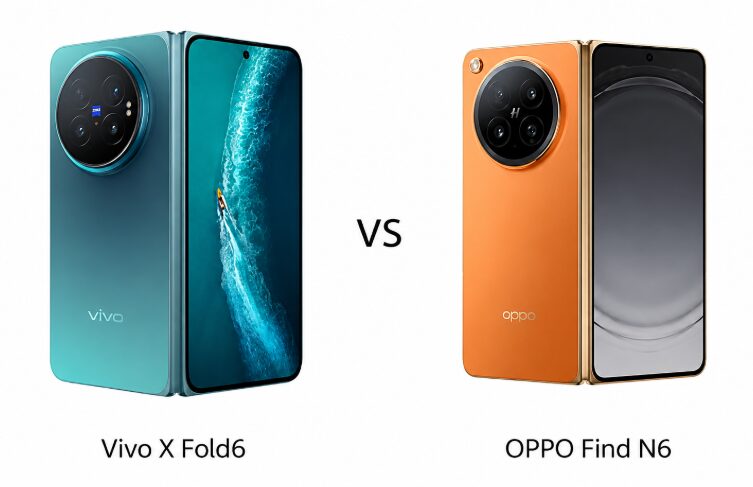
Two premium foldables, two very different pitches: the Vivo X Fold6 is the one to buy if you want endurance, strong cameras, and a friendlier price, while the OPPO Find N6 goes hard on display tech, materials, and productivity extras. In the Vivo X Fold6 vs OPPO Find N6 matchup, the split is simple: Vivo is the value pick, and OPPO is the polished one.
On paper, both devices look suitably overbuilt for life in a bag. Each one brings premium materials and dust-and-water resistance, but OPPO is clearly chasing the fancier finish with an aircraft-grade aluminum frame, a Grade 5 titanium alloy hinge, Nanocrystal Glass, and self-healing memory glass for the inner panel. Vivo takes the quieter route with an aluminum frame and a glass-fiber-reinforced back, which feels more practical than flashy. Both also support stylus input on their screens, but OPPO leans harder into the productivity angle.
Display and build choices
Vivo’s display setup is already strong: an LTPO AMOLED panel with Dolby Vision, HDR10+, HDR Vivid, 120Hz refresh, and a very bright cover screen. OPPO still edges ahead with a larger LTPO OLED display, 2160Hz PWM dimming, Zero-Feel crease tech, higher cover display brightness, Ultra HDR support, and stylus compatibility. The result is simple enough: Vivo is good, OPPO is more loaded, and the extra polish shows up most in daily use rather than in spec-sheet bragging rights.
Chipset, battery, and charging
The performance fight is split between MediaTek and Qualcomm. Vivo uses the Dimensity 9500 Super with UFS 4.1 storage and up to 16GB RAM, while OPPO goes with Snapdragon 8 Elite Gen 5 and the same storage standard. Qualcomm’s chip should have the edge in GPU grunt, AI features, and longer software tuning, but Vivo’s 7000mAh silicon-carbon battery is the headline here, and it is a monster next to OPPO’s 6000mAh pack.
- Vivo X Fold6: 7000mAh battery, 80W wired charging, 40W wireless charging
- OPPO Find N6: 6000mAh battery, 80W wired charging, 50W wireless charging
- Vivo X Fold6: up to 16GB RAM, UFS 4.1 storage
- OPPO Find N6: Snapdragon 8 Elite Gen 5, UFS 4.1 storage
That battery gap matters more than another few benchmark points. Foldables are asking a lot from their batteries already, especially with big inner screens and heavy multitasking, so Vivo’s larger cell could make it the less annoying phone to live with across a full day.
Camera hardware and video recording
Camera specs are eerily close: both phones use a 200MP main camera, a 50MP periscope telephoto, and a 50MP ultrawide. Vivo pairs that setup with ZEISS tuning, T* coating, Laser Autofocus, and 8K video support, which makes it the more enticing option for still photography. OPPO counters with Hasselblad Color Calibration, 4K at 120fps, Dolby Vision HDR video, and stronger selfie recording, including 4K with HDR and gyro-EIS on its dual 20MP front cameras.
That leaves the familiar split: Vivo for people who care most about photo quality and sensor heft, OPPO for users who shoot more video and actually want a foldable that behaves like a creator tool instead of a luxury toy.
Vivo X Fold6 vs OPPO Find N6 price
Pricing makes the decision even clearer. Vivo is listed around $1,200 (approximately ₹1,11,000), while OPPO comes in around $1,800 (approximately ₹1,60,000). That is a serious gap for two phones that both already sit in flagship territory, and it explains why Vivo looks like the rational buy unless you specifically want OPPO’s titanium hinge, stylus support, advanced display extras, and premium finish.
For most buyers, the wild battery and lower price make the Vivo X Fold6 the more convincing package. The OPPO Find N6 feels like the showpiece: more lavish, more ambitious, and more expensive in exactly the way premium foldables usually are. The question is whether those extras are worth the jump, because in this fight the smarter phone and the shinier phone are not the same thing.