

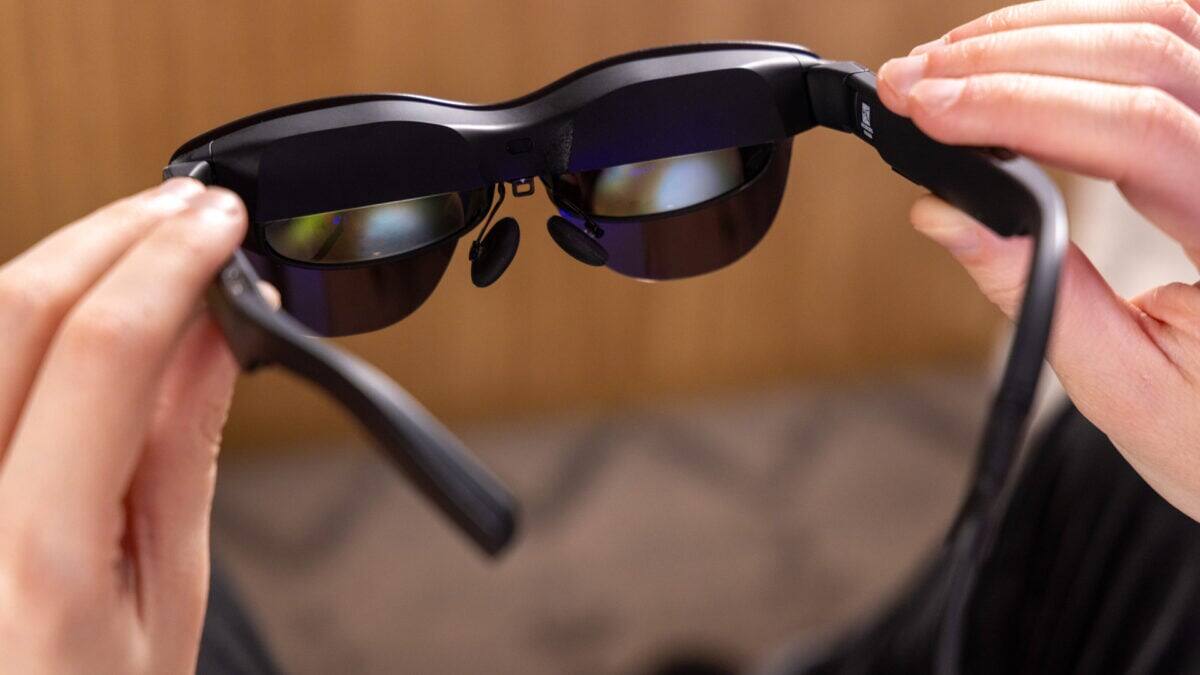
The AR glasses race is no longer about who can cram a screen into the lightest frame. Rokid, Xreal, Snap, RayNeo, and Viture are all pushing toward something more ambitious: glasses that track your world, handle more of the computing themselves, and stop pretending your phone should do all the work. That shift is still early, but the hardware is moving faster than the category’s old ”smart glasses” reputation would suggest.
Rokid’s new Rokid AR is a good example of where the AR glasses market is heading. Early images on Reddit show a tri-camera setup with two sensors in the temples for spatial tracking and a full-color RGB camera for environment recognition, which gives the glasses 6DoF support. More sensors do not automatically mean a better experience, but they usually mean tracking that feels less like a gimmick and more like a product someone meant to finish.
Rokid and Viture are pushing tracking forward
Rokid is not alone here. Viture’s $599 Luma Ultra also uses a similar tri-camera approach, which tells you this is becoming a feature instead of a curiosity. The bigger takeaway is that AR glasses are borrowing more from spatial computing headsets than from the old crop of simple video glasses, even if most of them still need help from another device.
That makes Apple Vision Pro the obvious comparison point, even if the form factors are wildly different. Apple’s headset uses a much larger sensor stack, but the reason it feels so fluid is the same reason these new glasses are chasing more cameras and better tracking: the more the device understands your environment, the less it feels like a screen strapped to your face.
Xreal Aura is aiming at a full AR platform
Xreal and Google are taking the most aggressive swing. Aura is being pitched as a true AR/XR platform, paired with a portable computing and battery puck, so the glasses can work more like a standalone device and less like an accessory begging for a phone. That is a meaningful shift, because the real prize in this category is not brighter displays alone – it’s escaping the leash of the host device.
Google’s involvement also gives Aura more credibility than most early XR promises deserve. According to an early hands-on, the hand tracking is fluid, the display is bright, and the 70-degree field of view is wider than Xreal’s other video glasses. Xreal is aiming for a fall release, with pricing still under wraps, which is exactly the sort of detail that keeps a flashy demo from becoming an actual product.
Cheap video glasses are making the premium pitch harder
Then there is the price pressure. RayNeo’s Air 4 Pro are listed at $299, support 3DoF, and can project a virtual screen as large as 201 inches; they also support HDR10 and are described as brighter and sharper than expected. X by Xreal’s a01 sits at the same $299 price point, which is the kind of overlap that turns ”affordable” into a knife fight.
- RayNeo Air 4 Pro: $299, 3DoF, HDR10, 201-inch virtual screen
- X by Xreal a01: $299
- Viture Luma Ultra: $599, tri-camera tracking
Snap Specs want to be standalone AR glasses
Snap’s Specs are the weirdest-looking and maybe the boldest of the bunch. They are being positioned as standalone glasses with spatial apps for navigation, games, education, and more, and unlike Xreal Aura they do not rely on a separate computing puck. Snap says the smallest model weighs as little as 132g, down from 226g for a developer version released in 2024, and it plans to ship the $2,195 glasses this fall.
That price puts Snap in rarefied air, but the bigger gamble is philosophical: can glasses finally do what headsets have promised for years without feeling like headsets? If AR devices keep shrinking their hardware while growing their software ambitions, the next fight will not be about display specs alone. It will be about whether Apple or Meta decide the category is worth entering – because if they do, the whole contest gets much louder very fast.