

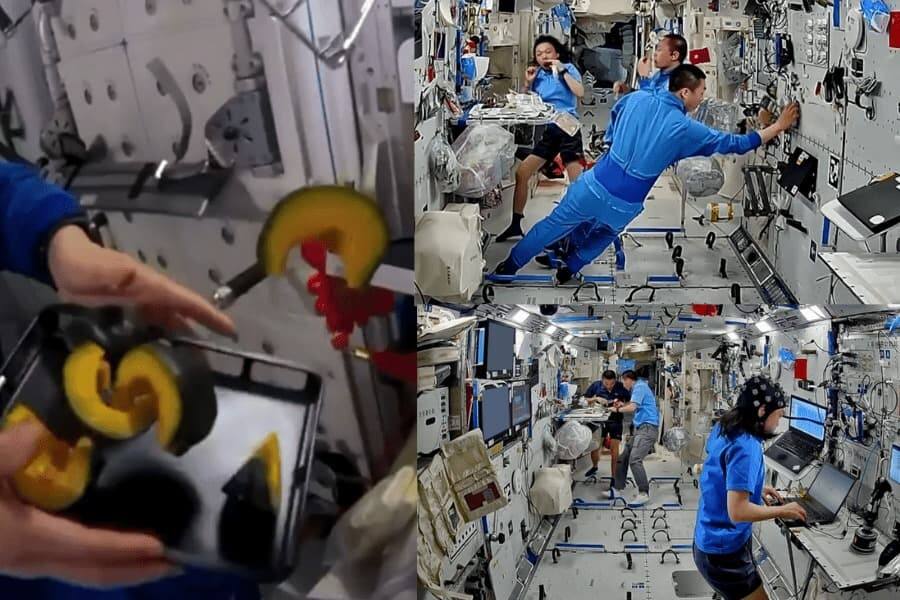
China’s Tiangong crew has reached the one-month mark aboard the space station, and the headline-grabber is not just the science. Taikonauts Zhu Yangzhu, Zhang Zhiyuan, and Li Jiaying have tested a new space cooking system by baking pumpkin in orbit, while also running a packed schedule of medical, robotics, and brain-function experiments.
The Tiangong crew’s first month shows how China’s space station program is evolving. Long-duration missions are no longer just about keeping people alive; they are about making life tolerable enough that crews can stay sharp, healthy, and productive for months at a time.
Tiangong’s first orbital pumpkin
According to the China Manned Space Agency, the crew used an onboard oven to prepare pieces of sweet pumpkin, the first time this kind of baked food has been made on the station. The experiment may sound charmingly low-tech, but it is part of a bigger push to improve psychological comfort during extended stays in orbit. Space agencies have learned this the hard way: if the menu gets depressing, morale follows.
For China, the food test also signals a broader maturity in station operations. NASA and other agencies have long treated variety, texture, and aroma as part of crew care, not just a nice extra, and Tiangong appears to be moving in the same direction.
Medical tests on blood flow and muscles
The main job in the first month was still research. The astronauts performed ultrasound scans on one another, examining blood vessels in the neck and wrists as well as abdominal organs. The goal is to understand how blood flow changes and how the muscular system adapts under prolonged microgravity.
Those results matter far beyond Tiangong. Space medicine has repeatedly shown that the body can behave very differently once gravity stops doing half the work, and China is clearly building the same kind of evidence base that has supported decades of Western human spaceflight.
Robots and brain research on Tiangong
The crew also tested the station’s onboard robot, collecting data meant to improve movement and control algorithms for autonomous systems in space. That is the kind of practical experiment that looks dull until it becomes the difference between a useful robotic assistant and an expensive floating nuisance.
Another set of experiments focused on brain activity using EEG equipment to study visual-motor coordination and behavioral responses under different lighting conditions. The agency says such research will help prepare for future deep-space missions, where fatigue, isolation, and unusual lighting can all chip away at human performance.
Shenzhou-23’s year-long mission
Shenzhou-23 launched on 24 May 2026, and one of its key tasks is a year-long human stay in orbit. That is a serious step up from routine station rotations, and it fits a wider trend: China is steadily using Tiangong as a proving ground for the hardware, procedures, and human resilience needed for more ambitious missions.
The data gathered now is expected to support future Chinese expeditions beyond near-Earth space, including possible missions to the Moon and more distant targets in the Solar System. The pumpkin is cute. The real story is that China is quietly normalizing the machinery of long-duration spaceflight, one experiment, one scan, and, yes, one baked vegetable at a time.