

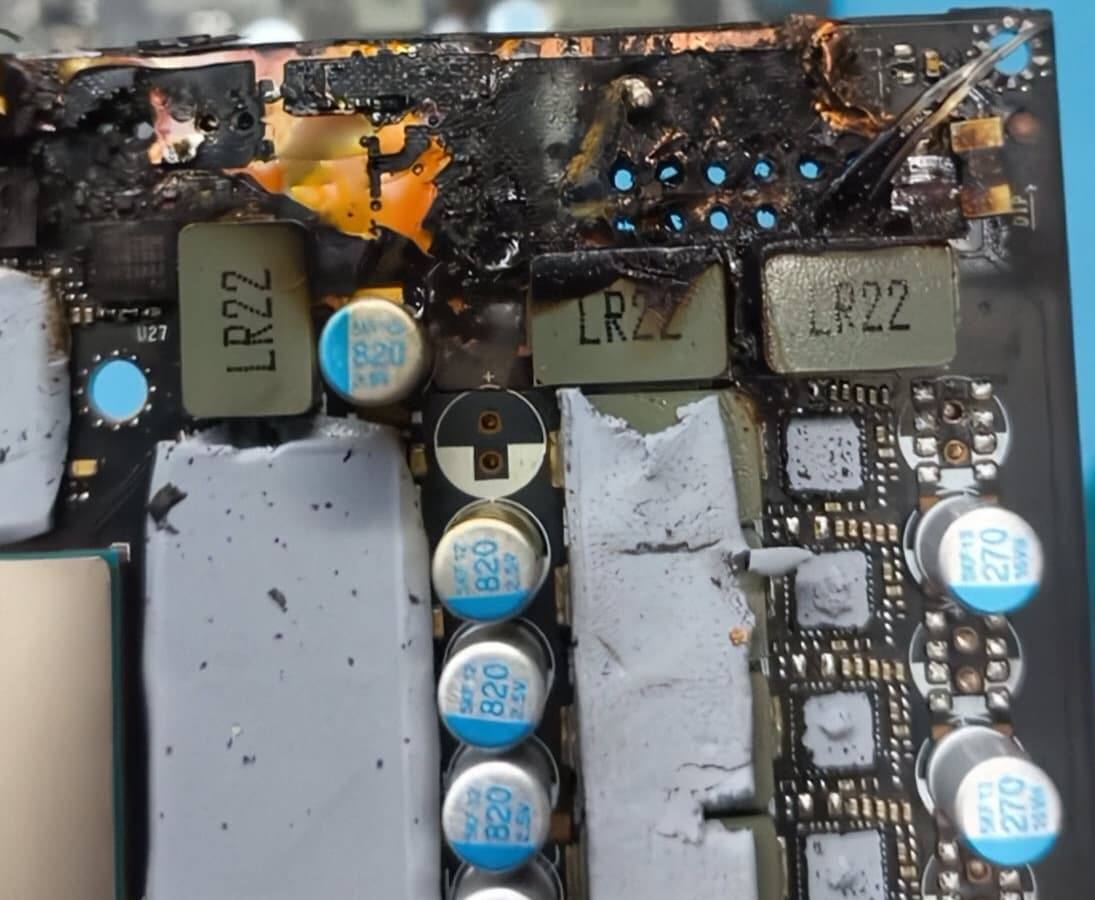
A GeForce RTX 5090 has reportedly been destroyed in Vietnam after its 16-pin power connector overheated so badly that the damage spread far beyond the plug. A local repair shop says the card lost its GPU, memory chips, PCB layers, and the connector itself, turning Nvidia’s flagship into a very expensive lesson in why this cable still makes people nervous.
The photos, posted by repair workshop quyle.gpufix on TikTok, show a card that is well past the point of recovery. The service said it received two RTX 5090 boards: one could be repaired after a botched attempt, while the other was so heavily damaged that restoration was impossible. That kind of failure is exactly what vendors hoped the newer power standard would reduce.
What the repair shop says was destroyed
According to the workshop, the second card suffered a near-total burnout at the 16-pin connector. The heat was severe enough to melt not only the connector, but also the fiberglass board material, internal PCB layers, the GPU, and the video memory chips. In other words, this was not a simple plug swap.
- GeForce RTX 5090
- 16-pin power connector
- GPU and memory chips
- Internal PCB layers and board material
The RTX 5090 connector problem Nvidia still cannot shake
Nvidia’s 16-pin power headaches started making headlines with the GeForce RTX 4090, and the industry response was supposed to be cleaner power delivery through the 12V-2×6 standard and ATX 3.1 power supplies. That helped on paper, but not enough to end the issue. Persistent reports around the RTX 5090 show the problem has not vanished; it has just moved up the stack to even more expensive hardware.
The missing detail here is the most annoying one: nobody has said which power supply, cable, adapter, or system configuration was used. That matters, because these failures can come from a bad connector, a loose fit, a flawed adapter, or plain user error. The point is not that every RTX 5090 is doomed. The point is that a premium GPU should not need this much anxiety attached to its power plug.
Why RTX 5090 failures keep happening to flagship GPUs
The 5090 sits at the top of Nvidia’s consumer stack, which means it is built for extreme power draw and sold into builds that often use adapters, custom cables, and heavy loads. That is a messy environment for a connector that has already earned a reputation for heat damage. Competitors are watching closely, because reliability problems in the halo product tend to stick to a brand long after the benchmark charts are forgotten.
For now, the open question is whether better cable design and stricter installation habits will actually reduce these incidents, or whether the 16-pin connector will keep generating repair-shop horror stories every time a new flagship lands in the wild.