

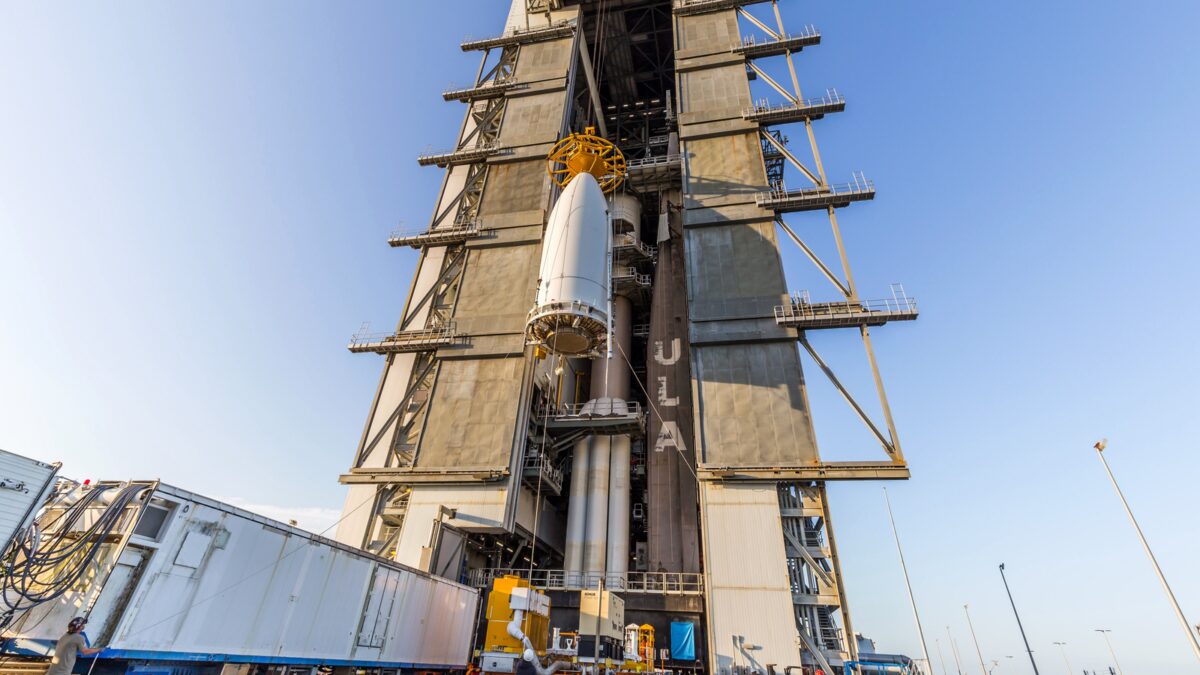
United Launch Alliance is sending Atlas V off with one more hefty job: the Atlas V 551 is set to launch 29 Amazon Leo satellites on 2 July 2026 at 00:24 Eastern time from Cape Canaveral. It is the final Atlas V mission in the Amazon Leo program, after which Amazon’s broadband constellation will move to Vulcan Centaur. That makes this a retirement flight with a very practical payload – the sort of ending rocket fans love and logistics teams tolerate.
The mission, called Amazon Leo-8, will add another batch to a network designed for global high-speed internet access. Amazon Leo is clearly taking the same path as other megaconstellation projects: build fast, launch often, and keep stacking satellites until coverage starts to look real instead of aspirational. The timing also underlines why ULA is shifting hardware now – Atlas V is still capable, but no one buys a legacy launch vehicle to do all the heavy lifting forever.
What Atlas V 551 brings to the mission
Atlas V 551 is one of the heaviest and most powerful versions of the rocket family. United Launch Alliance says the two-stage launcher stands 62.2 meters tall, has a liftoff mass of about 587,000 kg, uses five solid rocket boosters, and a 5-meter fairing. In plain English: this is the beefy version, built for dense payloads that need a strong shove into low Earth orbit.
- Rocket: Atlas V 551
- Payload: 29 Amazon Leo satellites
- Launch time: 2 July 2026 at 00:24 Eastern time
- Launch site: Cape Canaveral
Amazon Leo’s expanding broadband fleet
Amazon Leo is aiming at the same prize that has turned low Earth orbit into a crowded neighbourhood: global satellite broadband. The idea is straightforward, if not cheap – more satellites mean more coverage, lower latency, and fewer dead zones, provided the ground network and user terminals keep up. The company is also looking well beyond the launch pad, with service planned in Uzbekistan, showing that this constellation is being positioned as an international utility rather than a regional experiment.
The shift to Vulcan Centaur after this flight is the real handoff. Atlas V has been a dependable workhorse for years, but the future belongs to newer launchers that can support larger mission mixes and, just as important, a more modern supply chain. The question now is whether Amazon Leo can keep its deployment pace fast enough to turn all those launches into actual service before competitors make the same promise look old.