

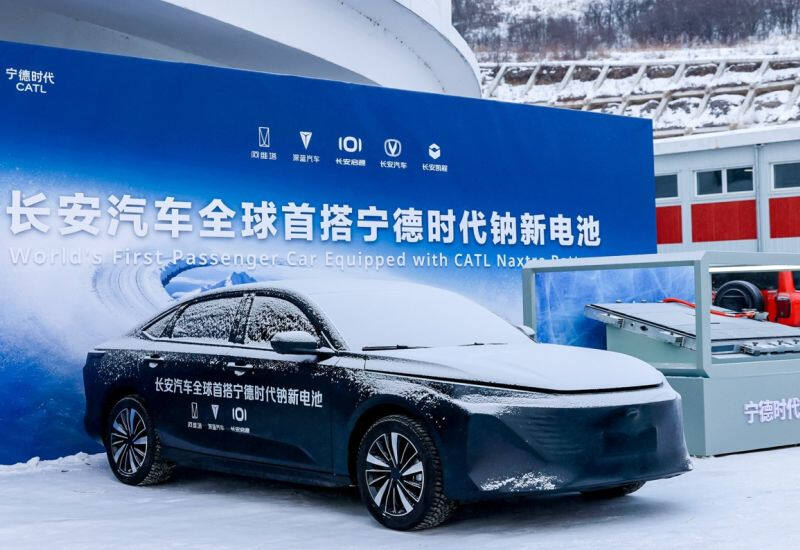
China’s EV race is producing plenty of futuristic battery talk, but CATL is pouring a small bucket of cold water on the hype. The world’s biggest battery maker says sodium-ion batteries and solid-state EV batteries will not reach mass adoption for another three to five years at best, even as rivals keep dangling near-term launch promises.
That gap between marketing and manufacturing is the real story here. Lab demos are easy; scaling battery chemistry into millions of packs without wrecking safety, cost, or durability is the part that eats years and budgets for breakfast. CATL’s latest comments suggest both technologies are still on that long road.
CATL’s solid-state EV battery timeline is moving slowly
At an industry event, CATL chairman Robin Zeng said the company’s solid-state batteries are only at the fourth of nine preparation stages before mass production. In other words, there is still a long road between a promising prototype and something a carmaker can actually bolt into vehicles at scale.
CATL’s chief scientist, Wu Kai, expects the company to reach the seventh or eighth stage by the end of 2027, which would put it close to the final step. Next year, CATL plans to begin certification of pilot batches of solid-state traction batteries. That is progress, but it is not a launch announcement.
What counts as solid-state is getting policed
Chinese regulators are also drawing a line around the term itself. Batteries with 5% to 20% liquid electrolyte are treated as hybrid designs, while a traction battery needs no more than 5% liquid electrolyte to be legally called solid-state. That matters because battery names are now part of the sales pitch, and the government clearly does not want buyers paying premium prices for chemistry with asterisks attached.
There is, however, a practical upside for manufacturers: existing lithium-ion production lines reportedly need only about 10% modification to make hybrid batteries. That helps explain why some brands can talk fast about advanced cells while still building something much closer to a transitional product.
Sodium-ion batteries face a different problem
Former CATL executive Wu Zuyu, now leading Hithium Energy Storage, said sodium-ion batteries are still about five years away from mass production. Their selling point is better performance in cold weather, but the industry is still wrestling with lifespan, which is the sort of boring detail that tends to decide whether a battery family survives.
- Good durability target for sodium-ion batteries: 15,000 charge-discharge cycles
- Hithium’s stationary-storage target: 20,000 cycles
- CATL expects 10,000 to 20,000 EVs to use its sodium-ion batteries this year
CATL and BYD both think sodium-ion packs could reach cost parity with lithium-ion as soon as this year or next year. That is the kind of claim that gets attention, but cost parity alone does not make a car battery successful; the chemistry still has to last, and last cheaply.
Car makers are still chasing near-term headlines
Dongfeng Motor says its 1,000 km batteries could enter mass production by the end of this year, although they are likely to be hybrid rather than fully solid-state. That would be a familiar outcome in this market: the biggest gains arriving first in the ”almost new” category, while the truly next-generation stuff stays in the lab a while longer.
The more interesting open question is whether sodium-ion finds its first big life in cars or in stationary storage, where weight and energy density matter less. General Motors has already shown interest in the technology for data center energy storage, which may end up being the cleaner commercial path if EV makers keep demanding more range, lower cost, and miracle-grade durability all at once.