

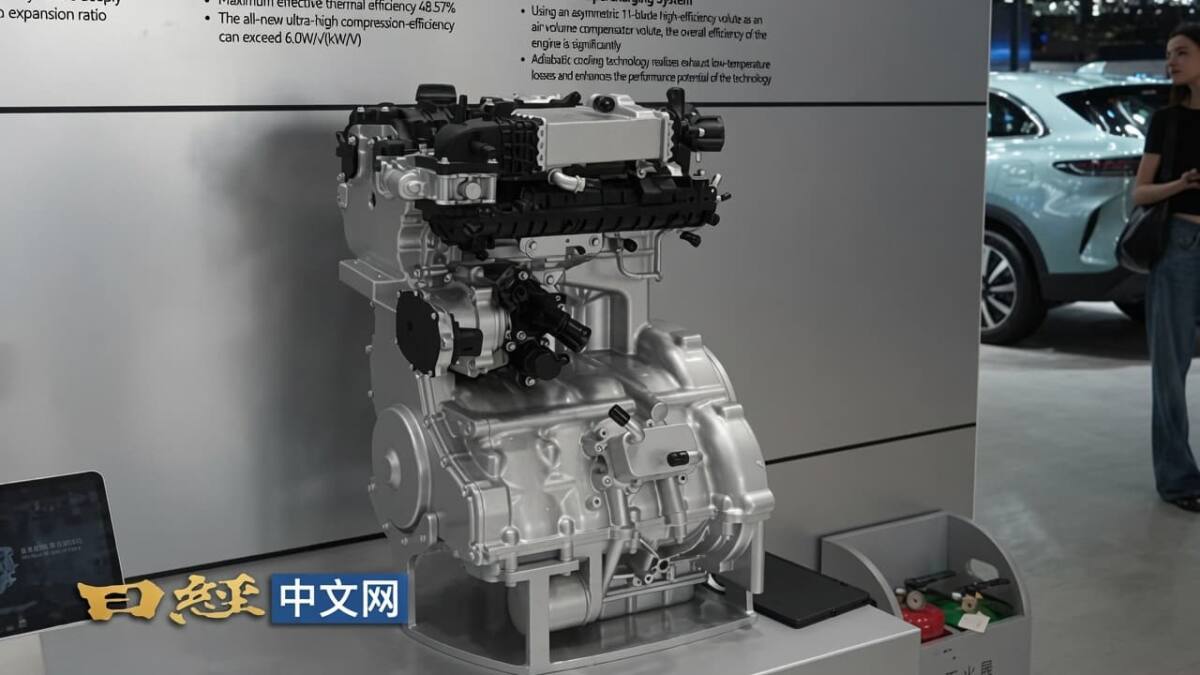
Chery says it has built a new hybrid engine that reaches a peak thermal efficiency of 48.57%, a figure it describes as the highest in the industry so far. The Chinese automaker says the Kunpeng Tianqing engine is designed for plug-in hybrids and extended-range electric vehicles, giving it another talking point in the race to squeeze more miles out of every drop of fuel.
That is a meaningful jump in a sector where most gasoline engines sold today sit somewhere between 38% and 45% efficiency. Better engines still matter once the battery runs low, especially in markets where charging infrastructure is patchy.
Why 48.57% thermal efficiency stands out
Thermal efficiency measures how much of the fuel’s heat becomes useful engine power. In plain English, less energy is wasted as heat, which is exactly what engineers have been chasing for decades. Chery’s claim edges past Geely’s earlier hybrid engine result of 48.41%, a small gap on paper but enough to matter in a prestige contest where every fraction of a percent gets a banner announcement.
The new unit, called Kunpeng Tianqing, is designed to improve combustion efficiency through engine architecture changes and better fuel injection into the cylinder. It is meant for multiple vehicle types, including plug-in hybrids and extended-range electric vehicles, which is where this kind of technology tends to matter most: big batteries are useful, but better engines still decide how far the car can go once the electrons run out.
The company also has scale on its side. In 2025, Chery said its wholesale sales of passenger vehicles reached 2.8 million units, while exports totaled 1.34 million units, making it the top domestic automaker in export volume. That matters because efficiency tech is only half the job; the other half is turning it into something stable, affordable, and repeatable on assembly lines without blowing up costs.
The race among Chinese automakers
Chery is not alone in pushing hybrid hardware harder. Geely previously reported a 48.41% thermal-efficiency hybrid engine using artificial intelligence to optimize fuel use, while Changan has already put into production a direct-injection hybrid engine with 500-bar high-pressure fuel injection. The pattern is hard to miss: Chinese carmakers are using hybrids as a proving ground for advanced combustion tech, even as battery-electric vehicles grab the headlines.
There is also a practical export angle here. Chery says the engine will eventually be sent to overseas markets with weak charging infrastructure, which is exactly where hybrids can still make business sense. Pure EVs are easier to sell in cities with dense fast-charging networks; outside those bubbles, a highly efficient hybrid remains the boringly sensible answer.
What happens next for Kunpeng Tianqing
The next hurdle is not the lab result, but mass production. Chery says companies still need to finish building a stable manufacturing system and keep costs under control, which is the part that often turns engineering bragging rights into real products. If it can do that, the 48.57% figure may end up being remembered less as a press release number and more as the point where hybrid engines got uncomfortably close to their theoretical ceiling.