

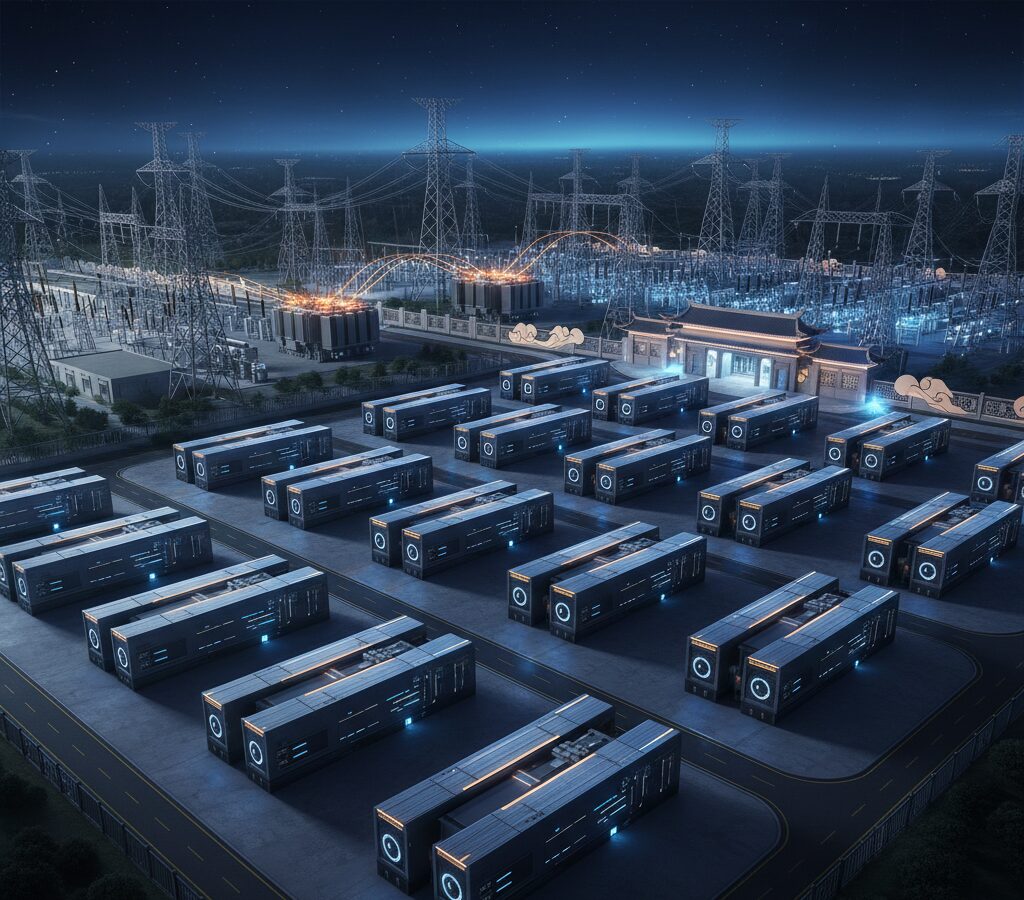
China has finished testing what it says is the world’s first fully carbon supercapacitor energy storage system at 5 MW, a containerized unit built by Beijing Greenfa Zhongke Lithium Capacitor Technology. The pitch is straightforward: less energy density than lithium-ion, but far more speed, far longer life, and far less drama about fires, dendrites, and constant replacement.
The certification matters as much as the hardware. The system completed full standard testing and received CNAS conformity approval, which carries international recognition. That gives the project a credibility boost at a time when grid operators are under pressure to add storage that can react almost instantly instead of just sitting there looking energetic.
What the 5 MW supercapacitor storage system is built to do
This is not a lithium battery replacement in the usual sense. Supercapacitors are better suited to short, repeated bursts of power, especially frequency regulation in grids where storage may cycle hundreds of times a day. Beijing Greenfa says the system can respond to load changes in less than 10 milliseconds and withstand more than 1 million charge and discharge cycles.
- Power output: 5 MW
- Supercapacitor size: 4500 Farads
- Specific energy: 16 Wh/kg
- Specific power: 18 kW/kg
- Total elements: 22,400
Why utilities may care more than battery fans
For grid work, the trade-off is sensible. Lithium-ion remains the default for bulk storage because it packs more energy, but supercapacitors are the sprinters: quick to charge, quick to discharge, and built for punishing duty cycles. That makes them attractive in a world where renewable-heavy grids need fast balancing, not just long-duration backup.
The company says active balancing keeps efficiency above 95%, while voltage differences between cells stay within 64 mV. It also argues that the design avoids lithium dendrite risks and has a much lower fire hazard, which is the sort of feature every operator likes and every insurer notices.
The first deployment is in Qinghai
The first installation will be the Dongyue independent energy storage project in Qinghai province. There, the system will be used for ultra-fast grid regulation, with no need to replace the elements during its service life, according to the developers. If it performs as advertised, this will look less like a lab curiosity and more like a niche answer to a problem lithium was never especially good at solving.