

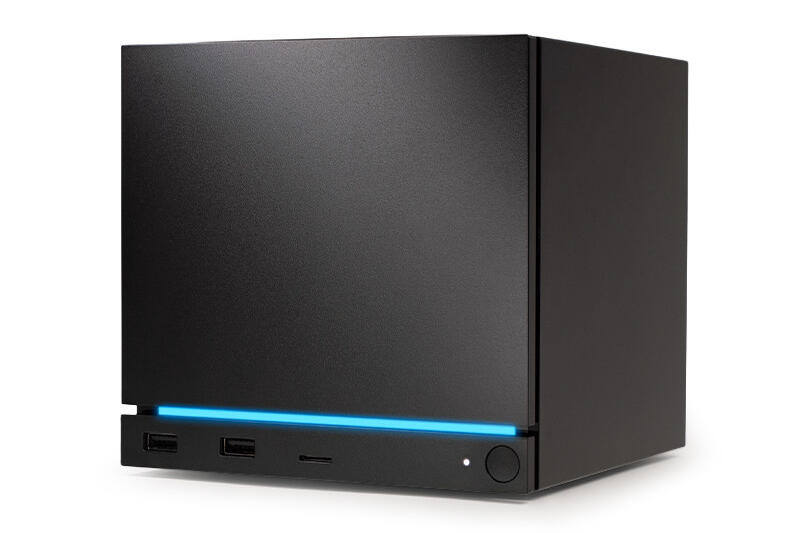
Valve’s Steam Machine has landed with a starting price of $1049, and the surprising part is not that it’s expensive – it’s that the company may be telling the truth about how little margin there is in it. A fresh build from The Verge, using close off-the-shelf parts, came out higher than Valve’s asking price, which suggests this compact gaming box is being sold far more like a hardware statement than a profit machine.
That matters because Valve is trying to sell something awkwardly positioned between a console and a small PC. Sony’s PlayStation 5 is far cheaper, but it does not run like a general-purpose desktop, and most tiny PCs either run hotter, cost more, or give up performance. Valve seems to have chosen the least glamorous path: keep the box small, keep the specs serious, and accept that the math will be ugly.
What The Verge used to approximate the Steam Machine
Because a direct clone is not really possible, The Verge moved up to desktop-class parts in a mini-ITX build. The result used a Fractal Design Terra mini-ITX case, an AMD Ryzen 5 8400F, an ASRock Challenger Radeon RX 7600, 16 GB of G.SKILL Flare X5 DDR5-6000 memory, and a Corsair SF750 power supply. The list also included a low-profile Thermalright cooler and either a 512 GB or 2 TB SSD.
- AMD Ryzen 5 8400F: $149.99
- ASRock Challenger Radeon RX 7600 8 GB: $279.97
- ASUS ROG Strix B650E-I Gaming WiFi: $179.99
- G.SKILL Flare X5 16 GB DDR5-6000: $204.99
- Thermalright AXP90 X47: $21.90
- Team Group T-FORCE G50 512 GB SSD: $101.99
- Patriot Viper VP4300 Lite 2 TB SSD: $279.99
- Corsair SF750 (2024): $159.99
- Fractal Design Terra Mini-ITX: $169.99
That adds up to $1268.81 with the 512 GB drive, or $1446.81 with the 2 TB version. In other words, Valve’s box is not cheap, but neither is the hardware recipe needed to get close to it in a similarly tiny chassis. The real premium here is not raw speed; it is packing respectable gaming performance into a cube that measures about 15 cm on each side.
Why a tiny gaming PC is still the expensive part of gaming
That trade-off is exactly why this category keeps tripping over itself. You can buy more performance for less money in a normal tower, but once the case shrinks and the cooling budget tightens, prices climb fast. Valve is also using custom AMD CPU and GPU silicon, which makes an apples-to-apples parts list impossible and explains why the company can position Steam Machine as a near-cost product without sounding completely absurd.
There are alternatives, and they are messy in their own way. Minisforum’s AtomMan G1 Pro pairs a Ryzen 9 8945HX with a desktop GeForce RTX 5060, 32 GB of memory, and a 1 TB SSD for $1400, but it is reportedly noisier. Framework’s Desktop starts at $1269 with a Ryzen AI Max 385, yet its integrated Radeon 8050S graphics are weaker, and the chassis is a bit larger.
SteamOS and the shortage problem
Valve has a separate problem on its hands: memory shortages kept Steam Machine from shipping in the volumes it wanted. The company has tried to soften that blow by opening SteamOS 3.8, which can now run on any PC with AMD Radeon graphics. That is smart strategy, because if the hardware is hard to buy, the software can still spread.
The bigger question is whether Valve wants Steam Machine to be a one-off halo product or the start of a broader living-room PC push. If component prices keep behaving like component prices usually do, the next wave of tiny gaming boxes will probably stay awkwardly priced – and enthusiasts will keep doing the spreadsheet math before they buy anything.