

That last number is the eyebrow-raiser. Conventional multirotors hovering typically sit somewhere around 100-250 W/kg, so Floaty is not just different in concept; it is dramatically cheaper to keep airborne. Of course, the catch is obvious: it needs the right kind of airflow, which makes it a specialist rather than a universal replacement.
Where a robot like this could be useful
The obvious first jobs are the boring ones that matter: inspecting industrial structures with strong rising air, including smokestacks. Beyond that, the researchers point to payload handling for weather balloons, guiding rockets during atmospheric re-entry, and eventually hybrid systems that combine passive gliding with active propulsion when the wind stops cooperating.
If that future arrives, the interesting question is not whether propellers disappear. It is whether flight robots start behaving less like miniature helicopters and more like opportunists, switching between engines and airflow the way birds already do. That may be the smarter design, and it is annoyingly elegant.
That last number is the eyebrow-raiser. Conventional multirotors hovering typically sit somewhere around 100-250 W/kg, so Floaty is not just different in concept; it is dramatically cheaper to keep airborne. Of course, the catch is obvious: it needs the right kind of airflow, which makes it a specialist rather than a universal replacement.
Where a robot like this could be useful
The obvious first jobs are the boring ones that matter: inspecting industrial structures with strong rising air, including smokestacks. Beyond that, the researchers point to payload handling for weather balloons, guiding rockets during atmospheric re-entry, and eventually hybrid systems that combine passive gliding with active propulsion when the wind stops cooperating.
If that future arrives, the interesting question is not whether propellers disappear. It is whether flight robots start behaving less like miniature helicopters and more like opportunists, switching between engines and airflow the way birds already do. That may be the smarter design, and it is annoyingly elegant.
- Mass: 340 g
- Average flight time: about 33 minutes
- Power draw: about 3.4 W, or around 10 W/kg
- Disturbance tolerance: side gusts of about 4 m/s
That last number is the eyebrow-raiser. Conventional multirotors hovering typically sit somewhere around 100-250 W/kg, so Floaty is not just different in concept; it is dramatically cheaper to keep airborne. Of course, the catch is obvious: it needs the right kind of airflow, which makes it a specialist rather than a universal replacement.
Where a robot like this could be useful
The obvious first jobs are the boring ones that matter: inspecting industrial structures with strong rising air, including smokestacks. Beyond that, the researchers point to payload handling for weather balloons, guiding rockets during atmospheric re-entry, and eventually hybrid systems that combine passive gliding with active propulsion when the wind stops cooperating.
If that future arrives, the interesting question is not whether propellers disappear. It is whether flight robots start behaving less like miniature helicopters and more like opportunists, switching between engines and airflow the way birds already do. That may be the smarter design, and it is annoyingly elegant.
Researchers in Germany have built Floaty, a propellerless flying robot that stays aloft without propellers, wings powered by motors, or the usual copter-style energy burn. Instead, it borrows the bird trick: sit inside an upward air current, reshape the body to catch it, and let physics do the heavy lifting.
That sounds almost unfair in a field obsessed with more thrust, bigger batteries, and ever-louder rotors. It also points to a practical niche that quadcopters hate: places where the air is already moving up, from chimneys to atmospheric probe missions.
How Floaty stays in the air
The robot was developed by the Max Planck Institute for Intelligent Systems in Tübingen and the University of Stuttgart. Its body has four independently controlled flaps on top, and those flaps change how much of the airflow the robot presents, which in turn adjusts lift, roll, pitch, and yaw. In plain English: it does not create its own thrust; it edits the wind it is already sitting in.
That approach is very different from a multirotor, where every minute in the air is bought with spinning blades and a constant power drain. Here, the servos only reposition the flaps, while an experimentally trained aerodynamic model calculates the control inputs needed to keep the machine stable across six degrees of freedom.
What the test data says
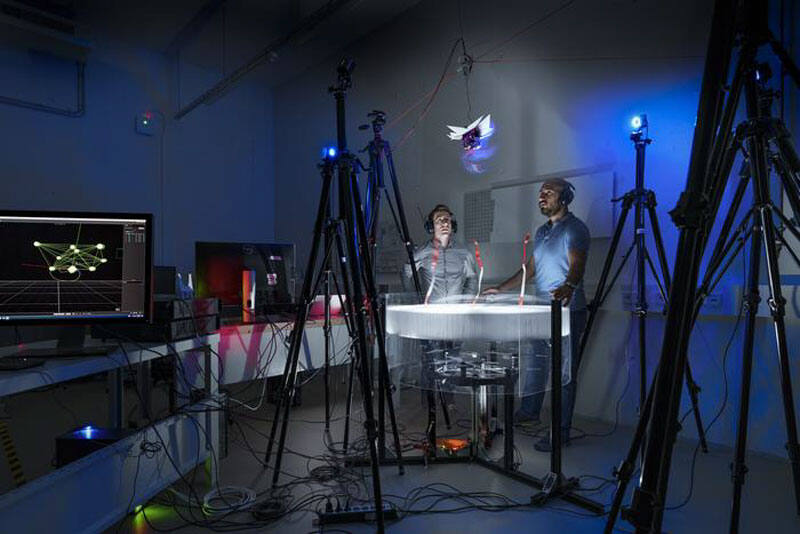
Floaty was tested in a vertical wind tunnel 1.2 m wide. The robot hovered in airflow speeds of 8-11 m/s, with its position tracked by an OptiTrack system at 200 Hz and control commands sent by radio. To stop it from tipping, the team dropped its center of mass about 7 cm below the flap plane and shaped the flaps with a 42.5° curve.
- Mass: 340 g
- Average flight time: about 33 minutes
- Power draw: about 3.4 W, or around 10 W/kg
- Disturbance tolerance: side gusts of about 4 m/s
That last number is the eyebrow-raiser. Conventional multirotors hovering typically sit somewhere around 100-250 W/kg, so Floaty is not just different in concept; it is dramatically cheaper to keep airborne. Of course, the catch is obvious: it needs the right kind of airflow, which makes it a specialist rather than a universal replacement.
Where a robot like this could be useful
The obvious first jobs are the boring ones that matter: inspecting industrial structures with strong rising air, including smokestacks. Beyond that, the researchers point to payload handling for weather balloons, guiding rockets during atmospheric re-entry, and eventually hybrid systems that combine passive gliding with active propulsion when the wind stops cooperating.
If that future arrives, the interesting question is not whether propellers disappear. It is whether flight robots start behaving less like miniature helicopters and more like opportunists, switching between engines and airflow the way birds already do. That may be the smarter design, and it is annoyingly elegant.