

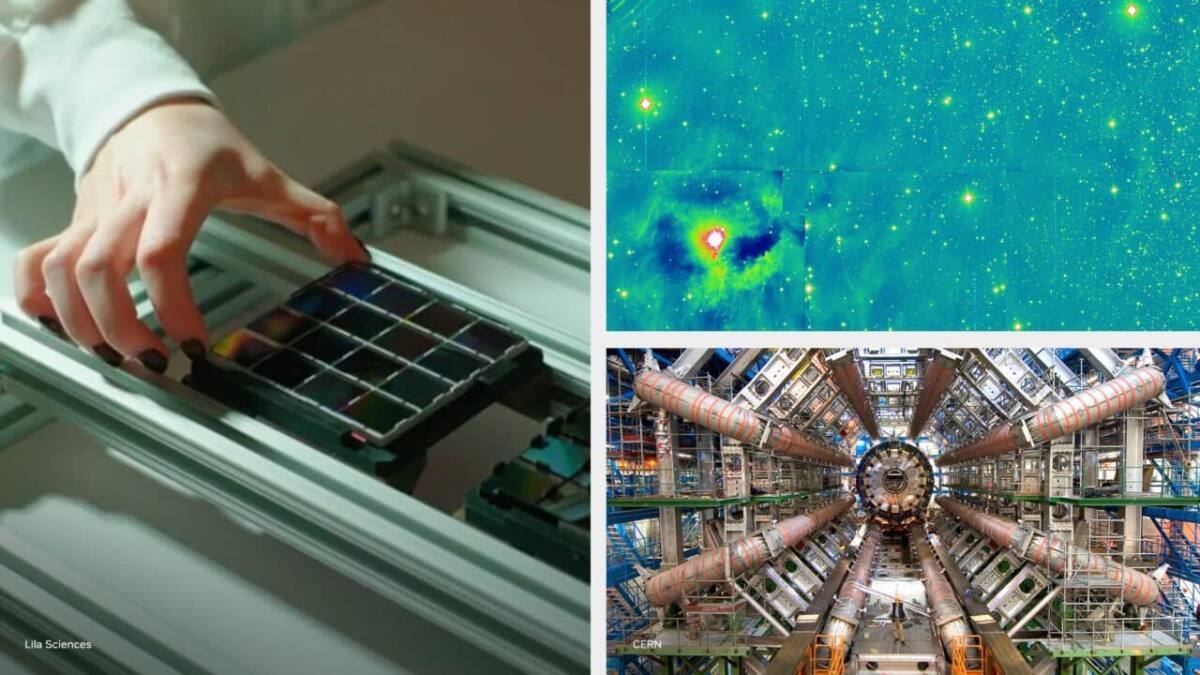
Nvidia is trying to do for science what GPUs already did for gaming, AI training, and a good chunk of the cloud: make slow computing feel embarrassing. At ISC 2026 in Hamburg, the company showed new scientific computing tools aimed at astronomy, particle physics, chemistry, and materials research, with some workloads running thousands of times faster than on conventional CPUs.
The headline act is cuPhoton, a package for multidimensional scientific data from telescopes, X-ray systems, and laser experiments. On Nvidia GB200 NVL72 systems, it accelerated loading and reading FITS astronomy files by 14,900 times, while signal processing and analysis ran up to 8,400 times faster using 32 Grace Blackwell superchips. That kind of jump is especially relevant for observatories facing a firehose of data rather than a neat stream, including the Vera Rubin Observatory and its Legacy Survey of Space and Time.
cuPhoton and the Vera Rubin data flood
Rubin’s LSST camera is described as the world’s largest digital camera, and it will repeatedly capture images of billions of distant galaxies, as well as faint Solar System objects. In practice, that means the bottleneck is no longer the telescope itself – it’s what happens after the exposure ends. Nvidia says Princeton and Harvard researchers helped develop cuPhoton, which is a sensible sign: the company wants credibility in a field that does not care how shiny the hardware brochure looks.
There is also a broader pattern here. Telescope projects, from Rubin to future survey instruments, are increasingly drowning in data faster than traditional pipelines can sort it. If the software stack can keep up in real time, astronomers can spend less time waiting for files to move and more time deciding whether the universe has actually done something interesting.
DAQIRI turns discarded detector data into a target
Another new tool, DAQIRI, is built for high-speed transmission from scientific sensors and detectors. Unlike older systems that can lose information when storage limits bite, DAQIRI is designed to handle streams in real time, which opens the door to analyzing data that would otherwise be thrown away.
That matters in the A-GHOST project, where CERN, the University of Chicago, and University College London are using the library to analyze ATLAS data from the Large Hadron Collider. Nvidia says more than 99% of events are typically discarded because the full stream cannot be stored, but AI-assisted analysis can inspect those rejected events too, improving the odds of spotting rare signals such as those associated with dark matter.
ALCHEMI targets batteries, catalysts, OLEDs and cosmetics
For chemistry and materials science, Nvidia is pushing ALCHEMI, a platform made up of microservices for molecular and materials modeling. The pitch is simple: run calculations across millions of compounds at once and shrink the cycle between idea and result from weeks to days.
Lila Sciences, which is building autonomous scientific labs, says ALCHEMI helped it speed up large-scale materials discovery by 50% and magnetic-property calculations by 30%. After additional TensorNet optimization, training became six times faster and memory use dropped by a factor of three. The target list is broad enough to sound a little corporate-pamphlet-y – batteries, catalysts, OLED displays, even cosmetics – but the underlying trend is real: whoever controls the fastest simulation stack can shape where the next wave of lab money goes.
Nvidia’s scientific computing tools explained
The real play is bigger than a set of point tools. Nvidia is trying to make its accelerators and software the default plumbing for scientific discovery, from the telescope dome to the collider tunnel to the materials lab. If that works, researchers get less waiting and more experimentation; if it doesn’t, the old CPU-based bottlenecks stay exactly where they are and the universe keeps being difficult on purpose.
- cuPhoton: FITS file loading and reading up to 14,900 times faster on GB200 NVL72.
- cuPhoton: signal processing and analysis up to 8,400 times faster with 32 Grace Blackwell superchips.
- DAQIRI: real-time data handling for scientific sensors and detectors.
- ALCHEMI: parallel calculations across millions of compounds for chemistry and materials research.
The next question is whether labs and observatories will standardize on Nvidia’s stack fast enough to make these gains sticky. If they do, the company won’t just be supplying the chips under the hood – it will be shaping how modern science is done.