

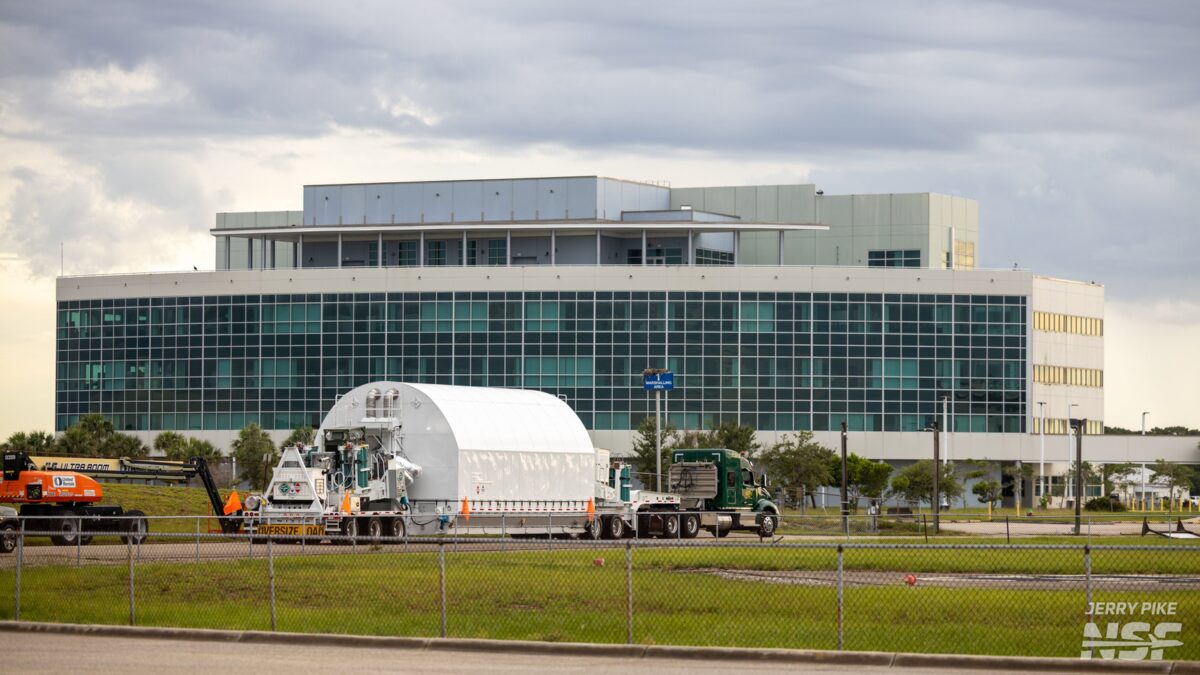
NASA has moved the Nancy Grace Roman Space Telescope into final prelaunch prep at the Kennedy Space Center, where technicians will check, fuel, and configure the observatory ahead of a planned August 30 launch on SpaceX’s Falcon Heavy. If all goes to schedule, the NASA space telescope will head to deep space from LC-39A, using one of the biggest commercial rockets flying today to send a flagship science telescope toward its working orbit.
The telescope’s arrival is the kind of milestone that looks mundane on the outside and expensive on the inside. Once it entered the Payload Hazardous Servicing Facility inside a protective container, the real work began: making sure every system is ready for the harsh environment far beyond Earth, where there is no convenient repair shop and very little room for improvisation.
What the Nancy Grace Roman Space Telescope is built to do
Roman carries a 2.4-meter mirror and wide-field optics designed to map large patches of sky, study dark energy, spot exoplanets, and help astronomers understand how the universe is structured. NASA says the observatory will operate about 1.5 million km from Earth, a perch chosen for steady deep-space observations rather than flashy close-up heroics.
- Mirror size: 2.4 meters
- Operating distance: about 1.5 million km from Earth
- Launch vehicle: Falcon Heavy
- Launch site: LC-39A
- Launch date: August 30
Falcon Heavy gets the science payload, not the headlines
SpaceX usually gets the attention with Falcon Heavy, but this mission is really a reminder of why heavy-lift rockets still matter for science. A telescope with this kind of ambition needs margin, not just launch capacity, and the pairing of Roman with Falcon Heavy gives NASA room to send a sophisticated observatory to a stable deep-space working location.
That also puts Roman in a small club of space telescopes built for survey work at scale, where the payoff is less about one dramatic image and more about an avalanche of data. In astronomy, breadth can be the sharpest tool in the box.
Pegasus barge reaches Kennedy Space Center
Before the telescope itself arrived, space photographer Jerry Pike shared drone images showing the Pegasus barge reaching the Kennedy Space Center, a quiet clue that the logistics chain was already in motion. That kind of choreography is easy to miss, but it is exactly what a major NASA launch looks like: shipping, handling, final inspections, fueling, and then a very expensive pause before ignition.
The open question now is not whether Roman is scientifically ambitious – it plainly is – but whether NASA can keep the late-stage launch sequence smooth all the way to August 30. With a telescope this complex, the last few weeks are where optimism meets paperwork, torque wrenches, and a lot of checklists.