

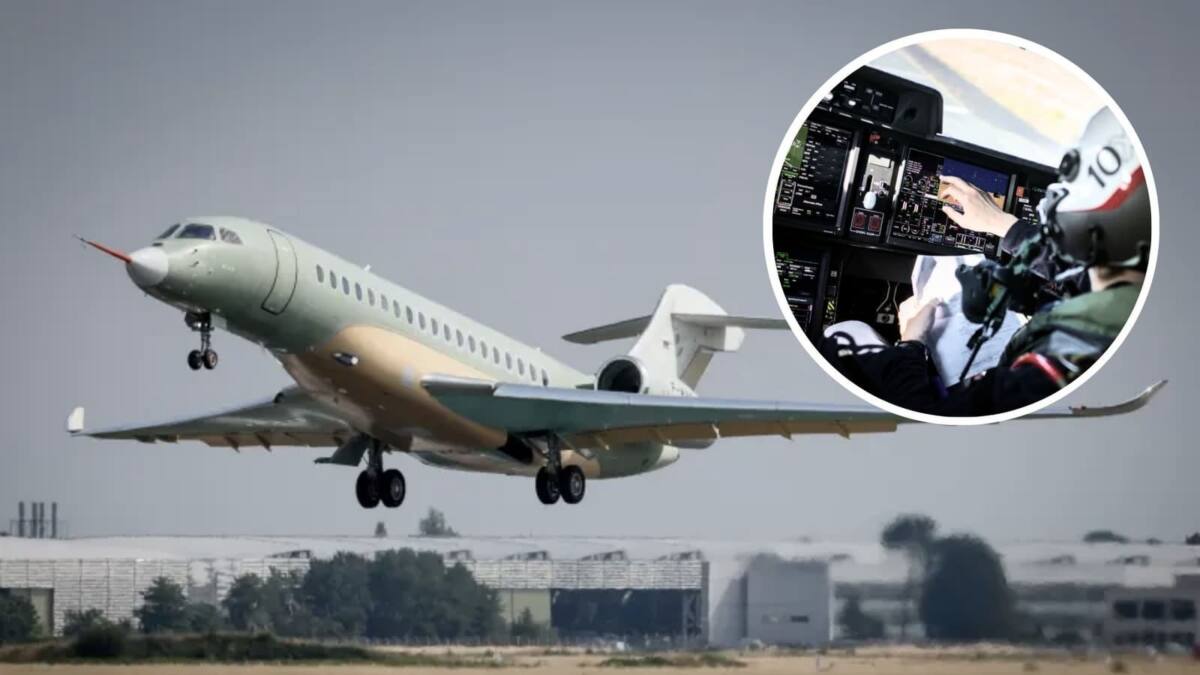
Dassault Aviation has finally put the Falcon 10X in the air, and that matters because this is the company’s most ambitious business jet yet: a new flagship meant to cover 13,900 km while cruising at up to Mach 0.82. The first flight from Bordeaux-Mérignac in France marks the start of flight testing and moves the program from glossy renderings to the part where engineers find out what the aircraft actually does.
The debut sortie lasted about two and a half hours. Test pilots Sebastien Dupon de Dineshen and Fabrice Dunyac checked handling and core onboard systems as the jet climbed to about 12,200 meters and returned safely to its departure airport. Dassault said the measured figures matched expectations, which is exactly the sort of boring sentence aerospace companies like to hear after a first flight.
What Dassault tested on the first Falcon 10X flight
- Flight duration: about two and a half hours
- Departure and landing: Bordeaux-Mérignac, France
- Altitude: about 12,200 meters
- Speed: 0.82 Mach, or 1,000 km/h
For Dassault, the flight is more than a ceremonial milestone. Business aviation is a crowded prestige market, and long-range capability is one of the few features that still separates the truly top-end aircraft from the merely expensive ones. Gulfstream and Bombardier have spent years trying to own that conversation, so Dassault needs the Falcon 10X to look credible fast.
Second and third Falcon 10X prototypes are already lined up
The test campaign is set to expand quickly. Dassault says the second prototype is nearing completion and will soon join the flight program, while the third aircraft will carry a full passenger cabin so engineers can test cabin equipment, systems, and real-world operating scenarios. That’s the sensible order: prove the airframe first, then stress the luxury bits later, instead of pretending a sofa and a coffee machine will validate an aircraft.
Chief executive Eric Trappier credited the result to the company’s engineering teams and international partners, while Dupon de Dineshen said the jet behaved predictably and exactly as calculated. That kind of confidence is useful, but the real test will come as the program gets harder, heavier, and more expensive: more flight hours, more software checks, more surprises.
Dassault’s 2026 bragging right is unusually bold
Dassault also says it is the only manufacturer in the world in 2026 to have flown a completely new aircraft type. That is a pointed claim, and it reflects how difficult aircraft development has become even for established players. The company’s pitch is simple enough: deep experience in both civil and military aviation, plus the engineering muscle to turn it into a flagship jet that can actually cross oceans at speed.
The open question is not whether the Falcon 10X can fly again; it can. The harder part is whether Dassault can keep the test program moving without delay, because in this class of aircraft, schedule discipline is almost as important as range.